


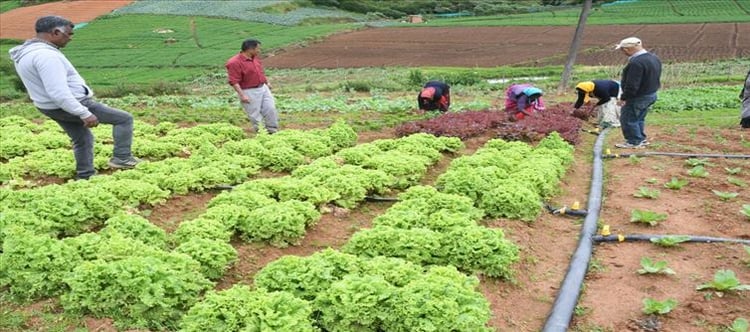

Accordingly ravikumar mp on Venmani anniversary whether there will be a holiday for agricultural workers has raised a question. On 25th December, 1968, 44 Dalits, boys and girls, especially agricultural workers, were burnt to death in the hut of Ramaiah in Venmani village in Nagai taluka of Tanjore district i.e. present-day Nagai district in Kilvellur taluka. Venmani Memorial Day was being observed yesterday which is seen as the biggest tragedy across the country. Villupuram mp asked whether the agricultural laborers will have a holiday on this day. ravikumar raised the question. He said in his statement that: "Farmers are the people who own land. It is ingrained in the common wisdom that the workers who work on the land are not considered as farmers. Only the farmers who own land can become members of cooperative banks and can get loans. They can also avail loans from public sector banks for agriculture. Enrollment in crop insurance scheme is possible only if you own land. Land should be owned even if you want to get agricultural loan at low interest rate. All the benefits announced by the government like cooperative loan waiver, free electricity, tax waiver, interest waiver are for the land owners. They are of no use to the landless agricultural labourers.
Meanwhile in tamil Nadu, not only during natural calamities but also during normal times due to the shrinking area of agricultural land, agricultural laborers are the most affected. As employment in rural areas has become scarce, thousands of agricultural laborers have migrated from their villages to big cities and other states. The agricultural laborers who are driven away as 'agricultural refugees' cannot find work in the cities either. Due to this they commit suicide in hundreds every year.
Earlier in 2022, a total of 11,290 people who were involved in the agricultural sector committed suicide in india, according to the National Crime Records Bureau (NCRP) report ('Accidental Deaths and Suicides in India' - ADSI 2022). 6,083 of them are agricultural labourers. A total of 606 agricultural laborers committed suicide in tamil Nadu alone in 2022 (567 males, 39 females). This is 10% of the number of agricultural laborers committing suicide in india (page 246). tamil Nadu ranks 3rd in agriculture labor suicides after maharashtra (1540) and karnataka (1069). Poverty and unemployment are said to be the main causes of suicides among agricultural workers.
Despite the hundreds of suicides, the suicides of agricultural workers were not made a political issue. That is because they are not mobilized workers. Political parties do not come forward to intercede for them.
The wages of agricultural laborers are very much lower than the wages of laborers employed in other sectors. Their wages are determined by the government based on the Minimum Wages Act. As per the current Minimum Wages Act, the minimum wages were to be revised every five years. This time limit is too long and therefore the workers have been demanding to change it.
In 2001, a meeting of labor welfare officials of South indian states held in chennai discussed this and recommended that the minimum wage for agricultural industries be revised every two years and for other sectors every four years. But the companies did not accept it. They objected to the old revision of wages only once in five years. After examining all of them in detail, the tamil Nadu government decided in 2004 to revise the minimum wage every four years. According to the revised Minimum Wages Act in tamil Nadu in june 2021, a farmer engaged in plowing in tamil Nadu should be paid 500 rupees if he brings his own air plow and oxen and 400 rupees if he comes alone to do the ploughing. Apart from ploughing, the daily wage for all kinds of agricultural work including sowing, planting and harvesting is Rs 229 only. Whatever the government decides and declares, the wages of the agricultural laborers are decided by the landowners according to the local conditions. The wages paid by the landlords are always lower than the wages fixed by the government. Not only are landlords paying less, the government is also paying less.
 click and follow Indiaherald WhatsApp channel