
-

Andhra Pradesh
-
Bharatiya Janata Party
-
Cabinet
-
CBN
-
CM
-
Congress
-
court
-
Delhi
-
Episode
-
Father
-
Fish
-
Gift
-
Government
-
House
-
Hyderabad
-
India
-
Indian
-
KCR
-
Leader
-
Minister
-
Party
-
Population
-
Punjab
-
ram mandir
-
ram pothineni
-
READ
-
revanth
-
Revanth Reddy
-
School
-
Smart phone
-
Supreme
-
TDP
-
Telangana
-
Telangana Chief Minister
-
Thanneeru Harish Rao
-
zero

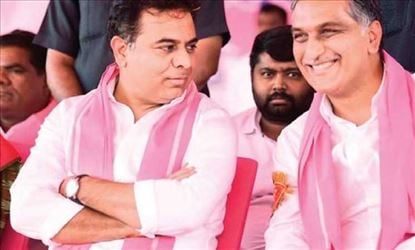
BRS leader Harish Rao has reportedly been placing calls to sitting Congress ministers in Telangana, triggering alarm inside Revanth Reddy's Congress Legislative Party. According to Namasthe Telangana, whispers at a recent CLP meeting saw ministers urgently cautioning each other not to answer Harish Rao's calls — a panic that reveals deep insecurity within the ruling party about potential defections and factional vulnerabilities.
The 5W+H: Who, What, When, Where, Why, How
- Who: BRS senior leader T. Harish Rao and multiple sitting Congress ministers in Telangana's Revanth Reddy cabinet, as reported by Namasthe Telangana.
- What: Harish Rao has allegedly been calling Congress ministers, prompting a hushed 'don't answer' directive that swept through a Congress Legislative Party (CLP) meeting, per Namasthe Telangana.
- When: During a recent CLP meeting in 2025, with the political chatter intensifying in the current legislative session period, as reported by Namasthe Telangana.
- Where: Hyderabad, Telangana — at the Congress Legislative Party meeting venue, according to Namasthe Telangana.
- Why: The calls are widely interpreted as BRS's attempt to destabilise the Congress government by cultivating back-channel contact with disgruntled ministers, according to political observers cited by Namasthe Telangana.
- How: Harish Rao allegedly placed direct phone calls to individual Congress ministers; when word spread inside the CLP meeting, ministers began warning one another to avoid taking the calls, per Namasthe Telangana's reporting.
BRS leader Harish Rao's phone calls to sitting Congress ministers have triggered open panic inside Revanth Reddy's Congress Legislative Party — and the most telling detail is not that the calls were made, but that the Chief Minister's own flock needed to be told, in whispered urgency, not to answer them. According to Namasthe Telangana, the scene at a recent CLP meeting in Hyderabad was less a display of governing confidence than an exercise in mutual surveillance: ministers huddling, murmuring warnings, treating a ringing phone like a live grenade.
The question no one in Congress wants to answer out loud is simple: if the party's MLAs and ministers are secure, loyal, and satisfied, why would a phone call from the opposition's chief troubleshooter cause this level of dread?
The Harish Rao Playbook: Why He Calls, and Why It Works
T. Harish Rao is not an ordinary opposition backbencher making social calls. He is BRS's most effective political operator — a man who, during the KCR years, managed everything from defection engineering to constituency-level patronage networks with surgical precision. His Rolodex is arguably the most dangerous weapon in Telangana's opposition arsenal. When Harish Rao dials a Congress minister, the call carries an implicit offer, a veiled threat, or at minimum, a reminder that the door to the other side has not been permanently shut.
What makes the current round of calls significant, according to political circles in Hyderabad, is the timing. The Revanth Reddy government is navigating a difficult stretch — governance delivery has been uneven, internal factional simmering has not fully cooled since the cabinet expansion, and BRS, far from collapsing as many Congress leaders predicted after the 2023 electoral rout, has been quietly reorganising under Harish Rao's operational command. As Namasthe Telangana has separately reported, Harish Rao has also been sharpening his public attacks on Congress ministers — questioning Minister Adluri Laxman Kumar's inconsistencies on Gurukul school tenders and flagging the allegedly irregular transfer of an official named Laxmi Bhai — moves designed to keep the ruling party on the defensive while simultaneously reaching out to its more vulnerable members in private.
The dual strategy — public aggression plus private outreach — is textbook Harish Rao. It is designed to create precisely the atmosphere of uncertainty that was on display at the CLP meeting.
Political Pulse
The backstage chatter in Hyderabad's political corridors, as sources close to both parties describe it, is blunt: at least a handful of Congress ministers and MLAs are not just answering Harish Rao's calls — they are returning them. The talk in legislative circles is that certain second-rung ministers, passed over for plum portfolios or nursing grievances about the Chief Minister's centralised style, have maintained quiet channels with BRS since well before these calls became CLP gossip. "Everyone knows who the soft targets are," a Congress insider is understood to have remarked to associates. "The problem is, the CM knows too — and that is making everyone nervous, not just the ones actually talking."
(This reflects political corridor chatter and unverified speculation, not confirmed fact.)
The 'don't answer' whisper, in this reading, was not simply practical advice — it was a loyalty test disguised as caution. In a room full of legislators who know they are being watched by their own chief minister's apparatus, the act of publicly agreeing to ignore Harish Rao's calls becomes a performance of fidelity. The ministers who nodded most vigorously may not be the most loyal; they may simply be the most aware of the surveillance.
Why Revanth Reddy's Reaction Reveals More Than Harish Rao's Calls
The deeper story here is not BRS's outreach — opposition parties always fish in troubled waters; that is the grammar of Indian politics. The deeper story is the Congress response. A confident chief minister with a secure majority and a satisfied cabinet does not need the CLP meeting to turn into a counter-intelligence briefing. The fact that 'don't pick up Harish Rao's phone' became the dominant whisper at a gathering meant to discuss legislative strategy tells you everything about the anxiety at the top.
Revanth Reddy's leadership style, as multiple political observers in Telangana have noted, leans heavily on centralised control — decisions flow through a tight inner circle, portfolio allocations have favoured loyalists, and dissent is managed less through persuasion than through pressure. This approach works when the government is delivering results and the opposition is weak. But when governance stumbles — and Harish Rao's public attacks on tender irregularities and bureaucratic transfers are designed to amplify exactly those stumbles — centralised control starts to feel less like discipline and more like distrust. And distrusted leaders produce exactly the kind of restless, back-channel-seeking ministers that Harish Rao is targeting.
India Herald's read of the real dynamic at work here is this: the CLP panic is less about Harish Rao's phone and more about the structural vulnerability Revanth Reddy has created by running his cabinet on a short leash. The calls are the symptom; the disease is a governing style that has not built enough internal goodwill to make its own ministers immune to a single ring from the opposition.
The Defection Calculus: Is BRS Seriously Fishing, or Just Rattling the Cage?
Whether Harish Rao's calls represent a genuine 'Operation Akarsh'-style defection bid or a strategic rattling exercise is the question Telangana's political class is debating. The arithmetic, for now, does not favour a dramatic floor-crossing — Congress holds a comfortable majority, and the anti-defection law makes individual switches politically and legally risky. BRS does not need defections to win; what it needs is to project the image of a Congress government that cannot trust its own people.
And on that front, the CLP meeting did BRS's work for it. The moment the 'don't answer' whisper leaked — and in Hyderabad politics, everything leaks — it became the story. Not the legislative agenda, not the government's achievements, not the opposition's weakness: the story was that Congress ministers are scared of their own phones.
That is a narrative gift to Harish Rao, delivered free of charge by the very people trying to guard against him.
What Comes Next: The Signal to Watch
The coming weeks will reveal whether this episode was a one-off tremor or the early signal of a deeper fault line. If Revanth Reddy responds by tightening the screws further — reshuffling portfolios, sidelining suspected back-channelers, increasing surveillance — he risks deepening the very resentment that makes his ministers susceptible. If he responds by loosening the leash — addressing grievances, distributing power more generously, showing trust — he risks emboldening those who have already been in contact with BRS to push for more.
The smarter play, as political analysts in Hyderabad suggest, would be proactive engagement: address the underlying discontent before it needs a phone call from across the aisle to be heard. But proactive engagement has not been this government's signature move — and Harish Rao, who has spent a political lifetime reading exactly these windows of opportunity, knows it.
The phone will ring again. The question that should keep the Chief Minister awake is not who will answer — it is why anyone in his cabinet would even want to.
Allegations reported here are attributed to named sources and remain unproven unless a court has ruled; matters sub judice are reported without prejudgment.
Reported and written with AI assistance under India Herald's editorial standards; a human editor governs publication.
By the Numbers
- According to Namasthe Telangana, Harish Rao has publicly questioned Minister Adluri Laxman Kumar's contradictory statements on Gurukul school tenders, while simultaneously maintaining private outreach to Congress ministers — a dual-track strategy that mirrors classic BRS destabilisation tactics.
Key Takeaways
- BRS leader Harish Rao has reportedly been calling sitting Congress ministers, triggering a panicked 'don't answer' directive inside the CLP meeting, according to Namasthe Telangana.
- The episode reveals structural vulnerability in Revanth Reddy's centralised leadership — a confident government does not treat an opposition phone call as a crisis.
- Harish Rao's dual strategy of public attacks on governance failures and private outreach to disgruntled ministers is textbook destabilisation, per political observers.
- The real defection risk is less about floor-crossings and more about BRS successfully projecting the narrative of a Congress government that cannot trust its own ministers.
- The Chief Minister's next move — tighter control or genuine engagement — will determine whether this remains a tremor or becomes a fault line in Telangana's ruling coalition.
Frequently Asked Questions
Why is Harish Rao calling Congress ministers in Telangana?
According to Namasthe Telangana and political observers in Hyderabad, BRS leader Harish Rao is reportedly reaching out to sitting Congress ministers as part of a dual strategy — combining public attacks on governance failures with private back-channel contact to cultivate disgruntled ruling-party members and project instability.
What happened at the Congress CLP meeting regarding Harish Rao's calls?
As reported by Namasthe Telangana, whispers swept through a recent Congress Legislative Party meeting with ministers urgently cautioning each other not to answer Harish Rao's phone calls — a reaction widely interpreted as reflecting deep insecurity within Revanth Reddy's cabinet about potential back-channeling with BRS.
Is there a real defection threat to the Congress government in Telangana?
Political analysts suggest the immediate arithmetic does not favour dramatic floor-crossings, as Congress holds a comfortable majority and the anti-defection law poses significant barriers. However, BRS's strategic goal appears to be projecting the image of a Congress government that cannot trust its own people, rather than engineering immediate defections.


 click and follow Indiaherald WhatsApp channel