
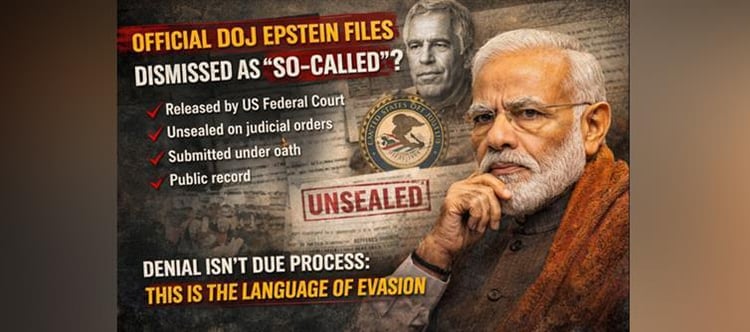


⚡ WORDS THAT MATTER
Governments don’t panic quietly.
They choose their words carefully.
So when the indian government responded to reports involving Narendra Modi and the Epstein case by calling them “so-called Epstein files” and “trashy ruminations by a convicted criminal”, it wasn’t just a clarification.
It was a framing battle.
And framing, in politics, is often more revealing than denial.
🧾 THE OFFICIAL STATEMENT: WHAT WAS SAID — AND WHAT WASN’T
The government statement acknowledged only one uncontested fact:
👉 The Prime Minister’s official visit to israel in July 2017.
Everything else was dismissed outright — not debated, not contextualised, not addressed — but contemptuously rejected.
That rhetorical choice matters.
Because it attempts to collapse the source, the process, and the record into one word: trash.
⚖️ “SO-CALLED EPSTEIN FILES”? THAT’S NOT HOW COURTS WORK
Here’s the inconvenient part.
The Epstein documents in question were not leaked whatsapp forwards or anonymous blog posts.
They emerged from U.S. federal court proceedings, overseen and unsealed through a judicial process involving the U.S. Department of Justice.
That means:
Evidence, emails, and testimonies are submitted under oath
Courts determine what is sealed vs unsealed
Once unsealed, documents become public record
The DOJ releases them in compliance with court orders
Calling such material “so-called” isn’t a rebuttal.
It’s delegitimisation by language.
🧨 ATTACK THE CONTENT — OR ATTACK THE PROCESS?
There are only two honest ways to deal with court-released records:
1. Dispute authenticity (with evidence)
2. Contextualise or rebut content (with facts)
What the statement does instead is attack the character of the messenger — Jeffrey Epstein — without addressing the status of the material itself.
Yes, Epstein was a convicted criminal.
Yes, his crimes were monstrous.
But courts do not discard documents based on moral revulsion.
They judge evidentiary relevance and legality.
That distinction matters in any rule-of-law system.
🧠 WHY THIS FRAMING IS DANGEROUS
If documents released through judicial oversight can be dismissed purely because they are uncomfortable, then public accountability collapses.
Today it’s Epstein.
Tomorrow it’s any inconvenient record.
The issue is not whether the email proves wrongdoing — that remains unestablished.
The issue is whether official court records can be waved away with adjectives instead of answers.
❗ WHAT A STRONG RESPONSE WOULD HAVE LOOKED LIKE
A confident government could have said:
The email is unauthenticated or taken out of context, or
The language is metaphorical or speculative, or
No meeting or communication ever occurred, as supported by records
Instead, it chose contempt over clarity.
And contempt, in public discourse, often signals defensiveness rather than certainty.
🧨 FINAL WORD: THIS IS ABOUT PROCESS, NOT Allegation
No guilt has been proven.
No wrongdoing has been established.
But something else has been exposed:
👉 A willingness to blur the line between court-released records and rumour
👉 A preference for dismissal over explanation
👉 A rhetorical strategy that treats citizens as spectators, not stakeholders
In a democracy, public records deserve public answers — not labels.
Because once facts are dismissed as “so-called,” truth itself becomes optional.
 click and follow Indiaherald WhatsApp channel