
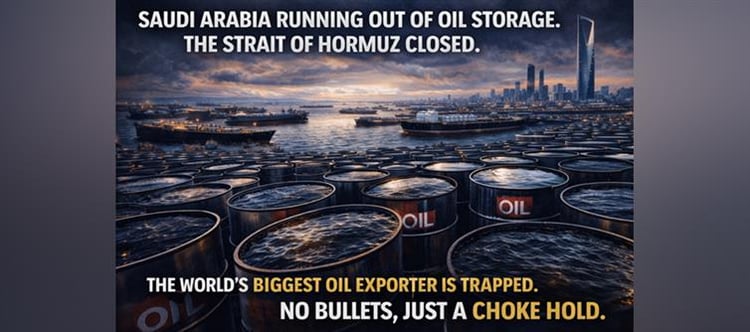


The Day oil Stopped Moving
In modern warfare, the most devastating weapon isn’t always a missile.
Sometimes it’s geography.
And few places on Earth illustrate that better than the Strait of Hormuz — a narrow stretch of water through which nearly one-fifth of the world’s oil supply normally flows.
If that passage truly shuts down, the consequences are immediate and brutal.
Tankers stop moving. Ports start overflowing. Energy markets panic.
And countries built on oil suddenly discover that their greatest strength can also become their greatest vulnerability.
1. The oil Superpower That Can’t Move Its Oil
For Saudi Arabia, the stakes are enormous.
The kingdom is the world’s largest oil exporter, pumping millions of barrels every day.
But exporting oil requires something simple: ships.
If the Strait of Hormuz becomes impassable, those ships can’t leave the Gulf.
Suddenly, the largest oil exporter on Earth faces an extraordinary problem — it cannot move its own product.
Pipelines fill. Terminals overflow. Storage tanks reach capacity.
And oil that once represented power and wealth becomes a logistical nightmare.
2. Tankers Stuck in a Floating Traffic Jam
When oil shipments stop, the consequences pile up quickly.
oil tankers sit idle offshore, waiting for routes to reopen.
Ports become bottlenecks.
Storage facilities fill faster than they can be emptied.
Every barrel that cannot be exported adds pressure to a system designed for constant movement.
oil economies depend on flow.
When the flow stops, everything begins to back up.
3. The Global Shockwave
The Strait of Hormuz isn’t just Saudi Arabia’s problem.
It’s the world’s problem.
Roughly 20 percent of global oil shipments pass through that narrow channel connecting the Persian gulf to the open ocean.
If that artery closes, energy markets immediately feel the shock.
oil prices spike.
Shipping insurance explodes.
And governments around the world begin scrambling to secure supplies.
A single chokepoint can shake the entire global economy.
4. The Power of Geography
What makes this scenario so striking is that it doesn’t necessarily require massive destruction.
No bombing campaigns.
No widespread military strikes.
Just a blockade or disruption in the right location.
In geopolitics, geography can be as powerful as any weapon system.
And the Strait of Hormuz is one of the most powerful leverage points on the planet.
Control the passage — and you control the flow of energy.
5. When oil Turns From Asset to Liability
For oil-producing nations, crude is usually the ultimate source of strength.
It fuels economies, funds governments, and shapes global influence.
But when exports stop, oil flips from asset to burden.
Barrels pile up with nowhere to go.
Prices become unpredictable.
And the very resource that built the economy starts creating pressure inside it.
In extreme cases, producers may even have to cut production simply because they cannot store or ship the oil they pump.
6. The Human Impact Behind the Strategy
For ordinary people, these geopolitical maneuvers aren’t an abstract strategy.
They translate into real consequences.
Jobs tied to the energy sector come under pressure.
Government revenues fluctuate.
Fuel prices surge or fall unpredictably.
The ripple effects spread from financial markets to everyday households.
While leaders debate military options and strategic responses, families experience the economic uncertainty firsthand.
7. Wars Without Bullets
Modern conflicts are increasingly fought through leverage rather than direct destruction.
Blockades.
Sanctions.
Supply disruptions.
Economic choke points.
Instead of destroying infrastructure, these strategies immobilize it.
They turn systems designed for constant movement into frozen networks of stalled ships, idle pipelines, and overflowing terminals.
It’s warfare through paralysis rather than explosion.
The Bottom Line
In a world built on energy flows, control of a single narrow waterway can reshape the balance of power.
The Strait of Hormuz is more than just a shipping route.
It’s a pressure point capable of rattling global markets and immobilizing oil economies.
And if that pressure point ever closes completely, the world won’t just watch oil prices rise.
It will watch one of the most critical arteries of the global economy suddenly stop beating.
 click and follow Indiaherald WhatsApp channel