
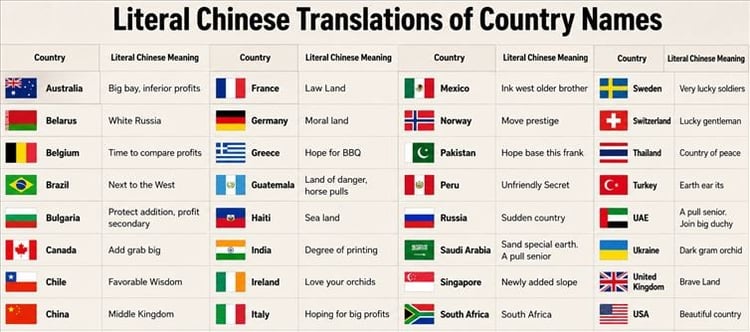


The Wild, Weird, and Accidentally Hilarious Literal Chinese Meanings of Country Names
Most people never think about how country names sound in other languages.
But once you start literally translating Chinese names for countries back into English, things get absurdly entertaining very quickly.
Some sound majestic. Some sound philosophical. Some accidentally sound like failed startup names, fantasy kingdoms, or cryptic fortune-cookie messages written at 3 AM.
And a few sound so chaotic they genuinely feel AI-generated.
Of course, these names were never meant to be interpreted word-for-word in English. Chinese country names are largely phonetic approximations using characters chosen for pronunciation, not literal meaning. But when you break those characters apart individually, the results become unintentionally hilarious.
THE MOST ICONIC ONES
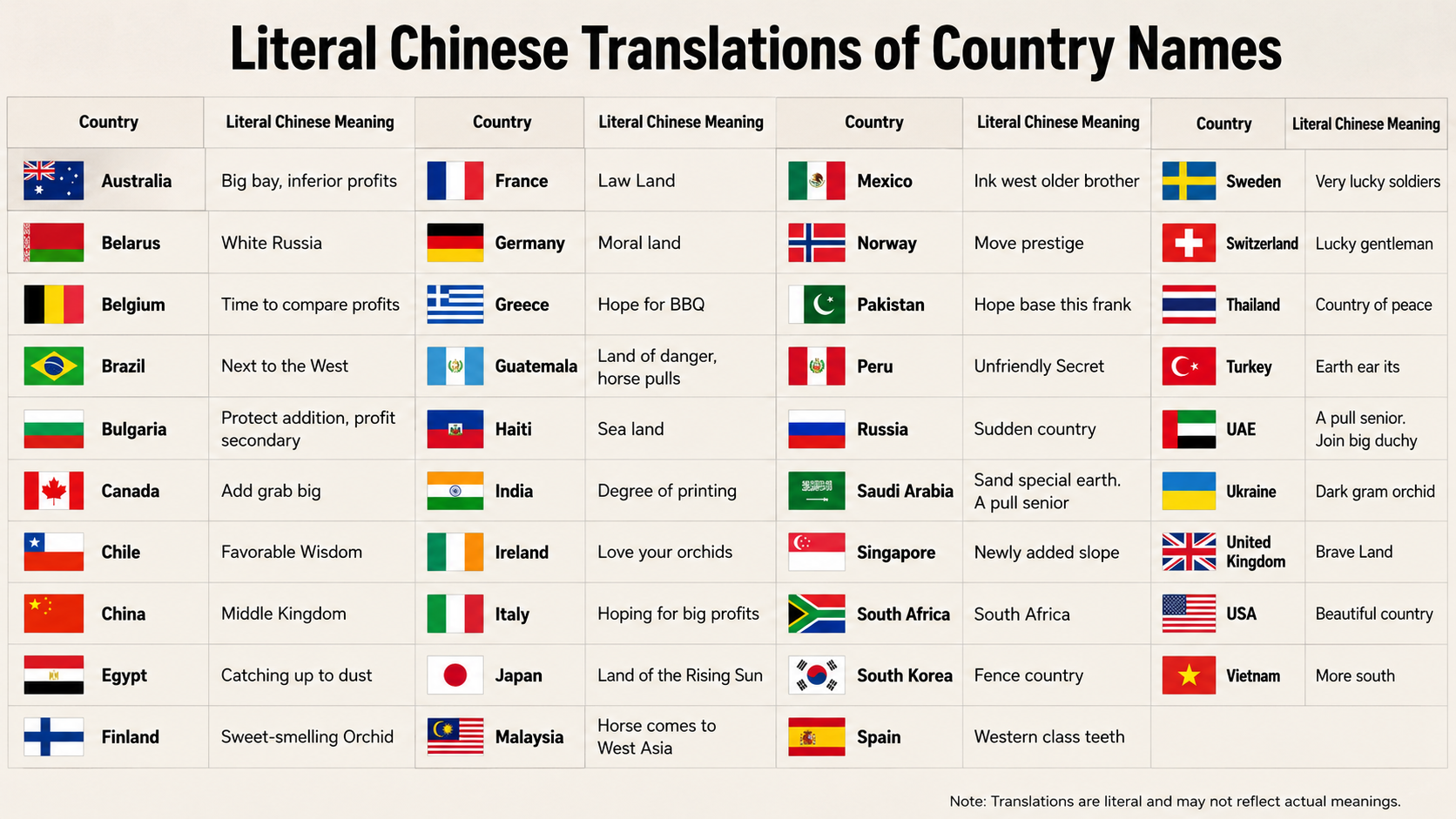
| Country | Literal Chinese Interpretation |
|---|---|
| 🇨🇳 China | “Middle Kingdom” |
| 🇺🇸 USA | “Beautiful Country” |
| 🇯🇵 Japan | “Land of the Rising Sun” |
| 🇫🇷 France | “Law Land” |
| 🇩🇪 Germany | “Moral Land” |
| 🇬🇧 United Kingdom | “Brave Land” |
| 🇹🇭 Thailand | “Country of Peace” |
| 🇷🇺 Russia | “Sudden Country” |
| 🇸🇬 Singapore | “Newly Added Slope” |
| 🇨🇦 Canada | “Add Grab Big” |
| 🇮🇳 India | “Degree of Printing” |
| 🇬🇷 Greece | “Hope for BBQ” |
| 🇪🇸 Spain | “Western Class Teeth” |
| 🇨🇭 Switzerland | “Lucky Gentleman” |
| 🇫🇮 Finland | “Sweet-Smelling Orchid” |
WHY THIS GETS SO WEIRD
Chinese writing uses characters that carry both sound and meaning simultaneously. So when names are transliterated from foreign languages into Chinese, the chosen characters often create bizarre accidental phrases if translated literally back into English.
That’s why some names sound poetic…
…and others sound like someone smashed random motivational words together.
THE FUNNIEST PART
The contrast is incredible.
America gets “Beautiful Country.”
China is known as the “Middle Kingdom.”
Meanwhile, canada somehow ends up as “Add Grab Big,” and greece sounds like it’s organizing a barbecue party.
It’s the perfect reminder that language is far stranger — and far more entertaining — than most people realize.
 click and follow Indiaherald WhatsApp channel