
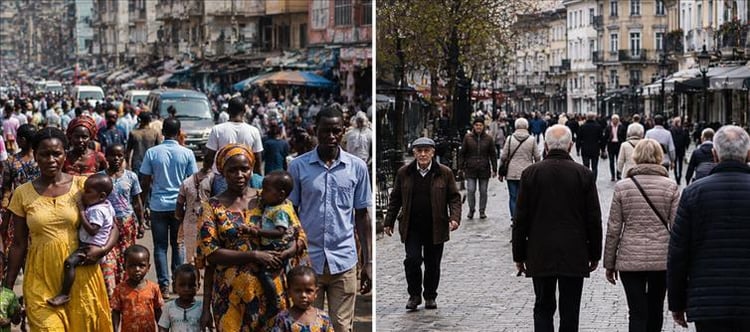


The world's population story is no longer just about growth. It's increasingly about where growth is happening—and where it isn't.
According to the latest UN projections, a massive fertility divide is opening between regions of the world. Some parts of the planet continue to have enough children to sustain rapid population growth, while others are falling far below the level needed to replace their populations over time.
The result? Two very different demographic futures are beginning to emerge.
Global Fertility Rates by Region
| Region | Total Fertility Rate |
|---|---|
| Africa | 4.0 |
| Middle East | 2.3 |
| Oceania | 2.0 |
| Asia | 1.7 |
| North America | 1.7 |
| South America | 1.7 |
| Europe | 1.4 |
Replacement level fertility is approximately 2.1 children per woman.
The Great Demographic Split
1. Africa Stands In A League Of Its Own
With a fertility rate of 4.0, Africa is producing nearly twice the number of children needed for long-term population replacement. No other region comes remotely close. This is the engine behind Africa's projected population surge throughout the 21st century.
2. europe Faces The Deepest Fertility Crunch
At just 1.4 children per woman, europe sits well below replacement level. The gap may look small on paper, but over generations it translates into aging populations, shrinking workforces, and slower population growth—or outright decline.
3. The Rest Of The World Is Clustering Below Replacement
Asia, North America, and South America all sit at 1.7. Even regions traditionally associated with population growth are now having fewer children than needed to maintain their populations naturally.
4. The Middle east Is The Last Major Region Above Replacement
At 2.3, the Middle east remains one of the few regions still comfortably above the replacement threshold, though fertility rates there have also fallen significantly compared with previous decades.
The Bigger Picture
This isn't just a story about babies. It's a story about economics, labor markets, housing, healthcare systems, migration, and political power.
The world isn't experiencing one demographic trend. It's experiencing two. While some regions are preparing for explosive population growth, others are confronting the reality of demographic aging and long-term decline.
The numbers suggest that the population map of the 22nd century may look very different from the one we know today—and that transformation is already underway.
 click and follow Indiaherald WhatsApp channel