
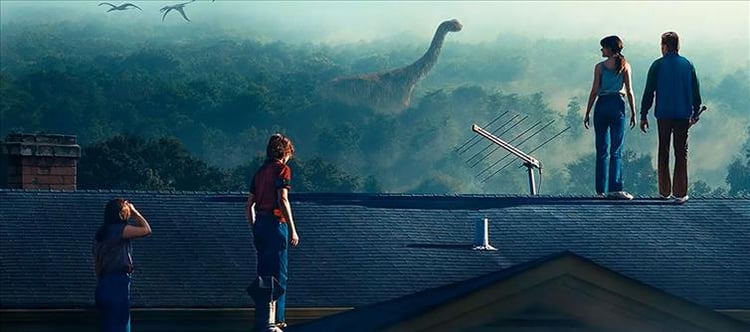


The End of Oak Street Review: A Roaring Amblin Throwback That Turns Suburbia Into a Dinosaur Nightmare
The Verdict: Old-School Adventure With Modern Teeth
There is something wonderfully refreshing about The End of Oak Street. At a time when big-screen spectacle often means another interconnected universe, another world-ending catastrophe, or another superhero saving civilization, David Robert Mitchell’s sci-fi survival thriller takes a much simpler—and arguably more entertaining—route. It takes an ordinary suburban neighborhood, throws it into a prehistoric nightmare, surrounds it with dinosaurs, and asks an ordinary family to survive the chaos. Produced by J.J. Abrams and led by Anne Hathaway and Ewan McGregor, the film feels deliberately old-fashioned in the best possible way. It has the unmistakable DNA of an Amblin adventure, the occasional dark humor of Joe Dante, and enough suspense to keep its relatively lean 90-minute runtime brisk.
Story: When the Perfect Suburb Becomes a Prehistoric Killing Ground
Set in the early 1980s, The End of Oak Street begins in deceptively familiar territory. The Platt family lives on the seemingly perfect Oak Street, where manicured lawns and friendly neighbors hide a household slowly coming apart. Denise Platt, played by Hathaway, is increasingly frustrated with her marriage and quietly pours her dissatisfaction into a novel she is writing in the basement. Greg, portrayed by McGregor, spends his time working extra jobs while dealing with professional problems, leaving Denise feeling increasingly disconnected from him. Their son Brian is navigating the awkwardness of adolescence, while teenage daughter Audrey is desperate to attend Cornell despite the family’s financial limitations.
The family’s domestic problems suddenly become irrelevant when an unexplained flash of light transforms their entire world. Oak Street is somehow transported into a prehistoric environment, effectively cutting the residents off from everything they know. Dinosaurs now roam around what was once a peaceful suburban community, and the residents quickly discover that this isn't some harmless adventure. People begin disappearing and dying, forcing the Platts to abandon their everyday concerns and concentrate on staying alive.
The premise sounds intentionally ridiculous on paper, but Mitchell understands exactly how to sell it. Instead of immediately turning the film into a nonstop dinosaur extravaganza, he allows the situation to unfold gradually. That decision gives the story a sense of mystery and makes the prehistoric creatures feel genuinely threatening. The film's central question isn't merely how the neighborhood got there, but whether these ordinary people can survive long enough to discover the answer.
Performances: Hathaway and McGregor Give the Chaos a Human Core
The biggest reason the film works beyond its high-concept premise is the central pairing of Anne Hathaway and Ewan McGregor. The screenplay gives them recognizable marital tension rather than instantly transforming them into action heroes, and both performers make the relationship feel considerably richer than the broad strokes of the writing might suggest.
Hathaway's Denise is particularly effective. She begins as an unhappy woman trapped between domestic responsibility, creative frustration, and a marriage that appears to have lost its spark. Once the dinosaurs arrive, that frustration gradually turns into fear, determination, and survival instinct. Hathaway sells every stage of that transformation without making Denise suddenly feel like an implausible superhero.
McGregor's Greg provides an excellent counterbalance. He isn't introduced as someone capable of taking down prehistoric predators. He is cautious, optimistic, occasionally overwhelmed, and clearly out of his depth. That makes his attempts to protect his family more compelling because the danger feels genuine. The chemistry between Hathaway and McGregor also gives the film emotional weight whenever the action slows down.
Christian Convery and Maisy Stella bring enough personality to Brian and Audrey to prevent the younger characters from becoming irritating distractions. Their sibling relationship has the expected bickering, but there is also a convincing sense of affection underneath it. Even Starbuck, the family's adorable dog, gets moments that could easily have become silly but instead add to the movie's eccentric charm.
P.J. Byrne is another welcome presence as the Platts' fussy neighbor, providing some much-needed comic relief. But ultimately, the film belongs to Hathaway, McGregor and the prehistoric monsters surrounding them.
Technicalities: Atmosphere Over CGI Overload
Mitchell's most interesting technical decision is what he chooses not to show. Rather than constantly filling the screen with dinosaurs, The End of Oak Street uses darkness, sound, movement, and restricted visibility to build anticipation. A glimpse of a creature can sometimes be more effective than a prolonged CGI showcase, and Mitchell understands that suspense comes from uncertainty.
The neighborhood itself becomes an important visual device. Instead of traveling across multiple continents or destroying famous landmarks, the film confines its characters to a relatively small suburban environment. Streets, houses, backyards, and familiar domestic spaces suddenly become potential death traps. That geographical restriction gives the action a maze-like quality.
The retro setting also contributes significantly to the movie's identity. The early-1980s atmosphere isn't merely cosmetic. It reinforces the sense that we are watching a throwback adventure, one where characters cannot simply pull out a smartphone and call for help. Their survival depends on improvisation, physical courage, and whatever household objects happen to be nearby.
The sound design and creature reveals are particularly important to the film's tension. The sudden roar of a dinosaur or the appearance of a massive creature at the edge of a familiar street can transform an ordinary suburban image into something terrifying. The film understands that scale matters, and its biggest creatures are designed to dominate the frame rather than simply exist as background decoration.
Action: The Dinosaurs Finally Become the Main Event
When the film decides to unleash its action, The End of Oak Street becomes considerably more entertaining. Mitchell avoids turning every sequence into an enormous CGI battle and instead concentrates on survival. That distinction gives the set pieces a refreshing physicality.
Watching ordinary residents attempt to defend themselves with kitchen knives, baseball bats, tools, and whatever else they can find is considerably more engaging than watching heavily armed military forces attack dinosaurs with futuristic technology. The limitations make the danger feel immediate.
One of the film's most absurdly entertaining images involves McGregor swinging a sledgehammer at a T. rex's ankle. On paper, it sounds almost comical. Within the heightened reality established by the movie, however, it becomes exactly the kind of ridiculous-but-thrilling moment that audiences can enjoy without overthinking.
Starbuck barking at pterodactyls is another example of the movie understanding its own tone. The End of Oak Street isn't trying to be relentlessly grim. It knows that a dinosaur attack on a suburban street can be terrifying and hilarious within the same scene.
The movie's strongest action sequences also benefit from the threat of genuine consequences. Characters can die suddenly, and the film doesn't always protect its supporting cast simply because they are recognizable faces. That unpredictability adds tension and makes the dinosaurs feel like actual predators rather than theme-park attractions.
Analysis: Why the Amblin Influence Works
The most obvious comparison is to classic Amblin-era filmmaking, particularly the Steven Spielberg tradition of taking ordinary families and placing them inside extraordinary circumstances. There is something intentionally nostalgic about that approach, but Mitchell doesn't simply imitate it.
The film's greatest strength is its simplicity. The entire world doesn't need to be saved. There is no sprawling mythology demanding multiple sequels. There isn't a complicated multiverse that needs to be explained. There is simply one neighborhood, one family, and a prehistoric world surrounding them.
That simplicity becomes surprisingly effective in the modern blockbuster landscape. After years of increasingly complicated franchise storytelling, the film's relatively contained premise feels almost rebellious. It asks the audience to care about whether one family can make it through the night rather than whether the entire cinematic universe survives.
There are also clear traces of Mitchell's earlier work. Fans expecting the unsettling, creeping horror atmosphere of It Follows may initially be surprised by the film's more accessible adventure tone. Yet his instinct for suspense remains visible. He knows how to delay a reveal, how to make an apparently empty street feel dangerous, and how to allow anticipation to become almost as important as the creature itself.
What Works
The high-concept premise: Transporting an entire suburban neighborhood into prehistoric territory is absurd, inventive, and immediately cinematic.
Anne Hathaway and Ewan McGregor: Their performances provide emotional credibility to material that could easily have become cartoonish.
The contained setting: Keeping the action around Oak Street gives the film a distinctive survival-game atmosphere and prevents the spectacle from becoming generic.
Creature suspense: Mitchell wisely avoids overexposing the dinosaurs, making their appearances more impactful.
Practical survival: Household objects becoming weapons makes the characters feel vulnerable and keeps the action grounded.
Retro Amblin energy: The movie successfully recreates the feeling of old-school adventure without becoming completely dependent on nostalgia.
Pacing: At around 90 minutes, the film wastes little time and delivers its entertainment without overstaying its welcome.
Dark humor: The occasional absurdity works because the movie embraces the ridiculousness of its own premise.
What Doesn't Work
Uneven logic: As the story develops, the explanation behind the phenomenon requires increasingly generous suspension of disbelief.
Underdeveloped plot threads: Some mysteries and character-related developments receive less payoff than they deserve.
Broad emotional writing: The marital conflict between Denise and Greg sometimes feels more like a functional plot device than a fully developed relationship.
Limited character depth: The supporting residents of Oak Street could have been explored further, particularly given how much potential the premise offers.
Mitchell fans may be surprised: Anyone expecting another deeply unsettling psychological horror film may find the movie considerably more conventional.
Some tonal inconsistencies: The film occasionally jumps between genuine danger, family drama, and cartoonish humor without completely smoothing the transitions.
The Big Picture: A Blockbuster That Knows What It Wants to Be
The most impressive thing about The End of Oak Street is that it doesn't appear embarrassed by its own simplicity. It doesn't need to reinvent science fiction or redefine dinosaur cinema. Instead, it takes a wonderfully straightforward concept and executes it with enough confidence to make the audience embrace the ride.
Yes, the science becomes increasingly questionable. Yes, some characters deserve more development. And yes, a few narrative threads feel as though they were introduced with greater ambition than the final screenplay could accommodate. But these shortcomings rarely destroy the experience because Mitchell keeps returning to the fundamental promise of the movie: ordinary people trying to survive extraordinary creatures in the middle of their own neighborhood.
That is ultimately what makes the film work. The stakes feel personal, the action feels immediate, and the setting gives the spectacle an identity.
Final Verdict
The End of Oak Street may not be David Robert Mitchell's most ambitious film, but it could be one of his most accessible. It takes the suspenseful instincts that defined It Follows, combines them with an unmistakable Amblin-style adventure sensibility, adds two major stars, throws in dinosaurs, and somehow arrives at an entertaining late-summer blockbuster that doesn't require homework.
It isn't flawless, and its increasingly fantastical mythology occasionally threatens to undermine the grounded survival story established in the opening act. But once the dinosaurs start attacking, the film knows exactly what audiences came for. It delivers scares, laughs, family drama and old-fashioned spectacle without drowning everything in franchise mythology.
Most importantly, it proves that a blockbuster doesn't need to save the universe to feel huge. Sometimes all you need is one street, one terrified family and a very large dinosaur.
Ratings⭐ 4/5
Story: 8/10
Performances: 8.5/10
Direction: 8/10
Action: 8.5/10
Visuals & Creature Work: 8/10
Technical Execution: 8/10
Pacing: 8.5/10
Entertainment Value: 9/10
Originality: 8/10
Overall Rating: 8.2/10
India Herald Percentage Meter: 82%
Entertainment Meter: ████████████████░░░░ 82%
Verdict: A roaring, surprisingly charming Amblin throwback that turns suburban survival into big-screen dinosaur fun.
 click and follow Indiaherald WhatsApp channel