
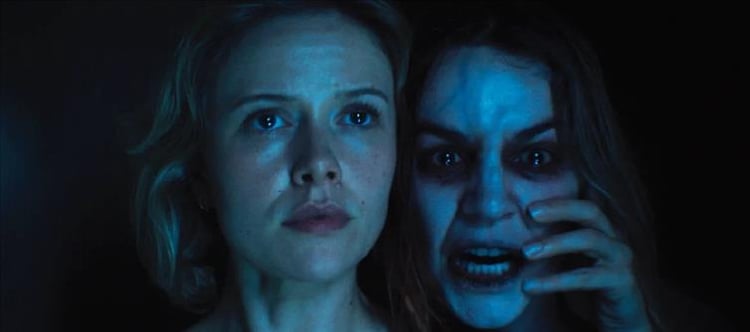


Insidious: Out of the Further Review: The Further Has More Monsters, But Not Enough Fresh Nightmares
Introduction
Insidious: Out of the Further arrives as the sixth chapter of a horror franchise that once turned a simple supernatural premise into genuinely unnerving cinema. This time, the series moves away from the Lambert family and introduces Gemma, a young mother whose connection to The Further gives the franchise a potentially exciting new direction. Amelia Eve leads the film, while Lin Shaye returns as Elise Rainier, and Come Play filmmaker Jacob Chase takes over writing and directing duties. The central hook is undeniably intriguing: Gemma can not only enter The Further, but can bring entities from that purgatorial realm back into the real world. That idea gives the sequel a chance to expand the mythology rather than repeat it. Unfortunately, the film frequently struggles to turn that promising concept into consistently frightening cinema.
Story
The story follows Gemma, a young mother raising her daughter in the house where she grew up. Her life takes a supernatural turn when she discovers that she possesses the ability to travel into The Further, the strange dimension populated by lost souls and demonic entities that has defined the Insidious mythology. The real danger emerges when Gemma discovers that the connection works both ways. She can bring creatures from The Further into our world, transforming what was once a realm of supernatural imprisonment into a doorway through which evil can invade everyday reality. Once the entities realize what Gemma is capable of, she becomes the centre of a terrifying struggle between the living and the dead.
The concept is arguably the film's most promising idea because it changes the fundamental rules of the franchise. Instead of simply sending characters deeper into The Further, Chase creates the possibility of The Further invading our world. Yet the execution eventually falls back on familiar Insidious mechanics: dark rooms, wandering spirits, sudden appearances, supernatural investigations, and characters repeatedly finding themselves trapped in ominous spaces. The result is a movie that introduces a new protagonist and expands the mythology while still feeling remarkably familiar.
Performances
Amelia Eve carries much of the film's emotional burden as Gemma. The role requires her to balance maternal vulnerability with supernatural determination, and Eve gives the character enough sincerity to make Gemma's predicament matter. She is particularly effective when the film concentrates on the emotional consequences of her unusual ability rather than simply using her as a vehicle for another scare sequence. Eve's casting also makes sense for the franchise's attempt to establish a new generation of characters. (
Brandon Perea, Maisie Richardson-Sellers and the supporting cast provide competent genre performances, although the screenplay does not always give them enough material to become genuinely memorable. The biggest familiar face is Lin Shaye, whose Elise Rainier remains one of the franchise's most recognisable figures. Her presence brings a welcome sense of continuity and personality to a film otherwise populated by newcomers. Shaye understands exactly how to balance Elise's warmth, eccentricity and supernatural authority, making her one of the film's most dependable assets.
Direction
Jacob Chase approaches the material with a clear understanding of how the Insidious universe is supposed to function. His previous work on Come Play demonstrated an interest in supernatural horror built around technology, domestic spaces, and unseen threats, and here he gets considerably more room to explore the mythology of The Further. The film occasionally produces striking imagery and demonstrates an appetite for taking the franchise somewhere stranger.
The problem is that the movie does not always trust its own new ideas. Whenever it appears ready to push the mythology into genuinely unfamiliar territory, it frequently retreats into established franchise rhythms. That creates an awkward tension between innovation and repetition. Chase wants to expand Insidious, but the franchise's familiar visual and narrative language keeps pulling the film back toward conventional sequel territory.
Technicalities
Technically, Out of the Further remains polished genre filmmaking. David Garbett's cinematography gives the film the shadowy, oppressive atmosphere expected from an Insidious movie, while Gregory Plotkin's editing keeps the supernatural sequences moving without turning the entire film into visual chaos. Joseph Bishara's score remains crucial to the franchise's identity, particularly because sound has always been one of Insidious' strongest weapons.
The production design and creature work also help create some memorable images. The Further remains an effective cinematic playground precisely because it can look simultaneously familiar and completely alien. Some of the film's grotesque ideas, including a particularly disturbing dental sequence, demonstrate that Chase is capable of finding fresh horror within mundane environments. Even when the scares do not fully land, the movie occasionally produces images that stay with the viewer.
Horror & Scares
The biggest question for any Insidious sequel is simple: is it scary? The answer is frustratingly inconsistent. There are effective moments, creative scare setups, and several unsettling creature designs, but the movie does not maintain the sustained dread that made the first film so effective. Instead, it often relies on familiar supernatural imagery that audiences have already seen repeatedly throughout the franchise.
The film's strongest sequences tend to occur when it experiments with the physical relationship between The Further and the real world. That concept creates opportunities for horror that the earlier movies did not possess. Unfortunately, the middle section reportedly loses momentum, with the film becoming less frightening precisely when it should be escalating toward its biggest supernatural confrontation. Collider's Charlie Ridgley similarly described the film as containing ineffective scares and a dull stretch in the middle while praising its willingness to pursue a more ambitious story about redemption, grace, and forgiveness.
Analysis
There is an interesting thematic idea underneath Out of the Further: the possibility that horror can emerge from guilt, trauma, forgiveness, and the inability to let go of the past. Rather than treating The Further merely as a monster warehouse, the movie attempts to connect its supernatural mythology to emotional redemption. That gives the film more thematic ambition than a simple collection of jump scares.
This is also where the movie becomes more interesting than its formula suggests. The concept of bringing spirits back from The Further can be read metaphorically as an inability to keep the past buried. The supernatural becomes an external expression of unresolved emotional baggage. Gemma's journey consequently has the potential to become a story about confronting what has been lost rather than merely surviving what is chasing her.
However, the film does not always develop these ideas with sufficient depth. The mythology can become convoluted, and the emotional material occasionally feels secondary to the mechanics of getting characters from one supernatural set piece to another. The Guardian's assessment is particularly harsh, arguing that the franchise has become trapped in repetitive imagery and story beats, while acknowledging a handful of inventive moments and Lin Shaye's continuing charm.
Franchise Fatigue
The central problem with Out of the Further is not that it is completely devoid of ideas. It is that the Insidious formula has become increasingly recognizable. The original film benefited enormously from mystery: viewers did not know what The Further was, what lived there, or what rules governed it. Six films into the franchise, that mystery has inevitably diminished.
The movie therefore faces the same problem that has affected many long-running horror franchises. Expanding the mythology can make the universe bigger, but it can simultaneously make it less frightening. Once the audience understands the rules, the unknown becomes known. The demons may change, the characters may change, and the houses may change, but the basic machinery remains recognizable. That is why the movie's most inventive moments feel considerably more effective than its conventional scare sequences.
What Works
The central concept: Giving Gemma the ability to bring entities out of The Further is an excellent expansion of the franchise mythology.
Amelia Eve: She gives Gemma genuine emotional vulnerability and makes the new protagonist easy to invest in.
Lin Shaye: Elise remains one of the franchise's strongest characters, and Shaye brings warmth and personality whenever she appears.
Atmosphere: The shadowy cinematography, production design, and sound maintain the distinctive Insidious mood.
Creature imagery: Several supernatural designs and grotesque sequences demonstrate genuine visual imagination.
The thematic ambition: Redemption, grief, forgiveness, and unresolved trauma give the story more substance than a standard haunted-house sequel.
A willingness to experiment: Chase occasionally pushes the franchise beyond its established formula rather than simply recreating the Lambert storyline.
What Doesn't Work
Too many familiar scares: The film repeatedly falls back on supernatural conventions the franchise has already exhausted.
Inconsistent pacing: The middle portion loses momentum and makes the 106-minute runtime feel longer than it should.
Predictability: Once the rules of the story become clear, several developments are easy to anticipate.
Convoluted mythology: Expanding The Further sometimes makes the universe feel more complicated rather than more mysterious.
Uneven emotional depth: The redemption themes are interesting but are not explored as deeply as they could have been.
Franchise fatigue: Six films in, some of the demons, imagery, and narrative beats simply do not have the same impact anymore.
Scares that don't always land: The movie has creative ideas but not enough consistently frightening execution.
Verdict
Insidious: Out of the Further is an intriguing but uneven attempt to keep a long-running horror franchise alive. Its biggest advantage is that it does not simply recycle the Lambert family story. By introducing Gemma and giving her the extraordinary ability to bring entities out of The Further, Jacob Chase establishes a genuinely interesting new rule for the universe. Amelia Eve gives the rebooted story an emotional centre, while Lin Shaye's return provides a welcome connection to the franchise's strongest years.
But the film ultimately cannot escape the gravitational pull of its own formula. The further the story goes, the more familiar the scares become. The movie occasionally finds wonderfully creepy images and interesting thematic territory, but those moments compete with repetitive supernatural sequences and a middle section that struggles to maintain tension. Even the broader critical response reflects that split: some critics have praised the film as a fun, creative soft reboot, while others have found it stale and painfully familiar.
For hardcore Insidious fans, there is enough mythology, demon lore, and Lin Shaye nostalgia to make the trip worthwhile. For horror audiences expecting the genre innovation seen in recent years, however, this may feel like a franchise desperately trying to convince everyone that The Further still has somewhere new to go.
Ratings: ★★★☆☆ / 5
India Herald Percentage Meter: 60%
Bottom Line
The Further may be deeper than ever, but Insidious: Out of the Further proves that a horror franchise can run out of scares long before it runs out of demons.
 click and follow Indiaherald WhatsApp channel