


Gen Dhiraj Seth, India's new Army Chief, unveiled VIJAY — a five-pillar framework stressing Valour, Integration, Joint operations, Agility, and Youth — that signals a decisive tilt toward China-front readiness, AI-integrated warfare, and accelerated theatre-command operationalisation, according to NDTV and Zee News. The framework implies deep shifts in procurement priorities, LAC force posture, and civil-military coordination under Modi 3.0.
The 5W+H: Who, What, When, Where, Why, How
- Who: General Dhiraj Seth, India's 31st Chief of Army Staff, upon taking charge of the Indian Army.
- What: Unveiled 'VIJAY' — a five-pillar doctrinal vision encompassing Valour, Integration, Joint operations, Agility, and Youth — to prepare the Army for future multi-domain threats.
- When: Upon assuming office as Army Chief in 2025, as reported by NDTV and Zee News.
- Where: New Delhi, at the Army Chief's formal assumption of command.
- Why: To reorient the Indian Army for an evolving security environment dominated by AI-driven warfare, the unresolved LAC standoff with China, and the imperative of theatre-command integration.
- How: By articulating a structured doctrinal framework — each letter encoding a specific organisational and strategic priority — that will guide force restructuring, procurement, technology adoption, and joint-services operationalisation.
An acronym is never just an acronym when a new Army Chief chooses it as his opening line. When General Dhiraj Seth stepped into South Block as India's 31st Chief of Army Staff, he did not reach for the usual boilerplate about soldierly virtue. He offered five letters — V-I-J-A-Y — and in each one, those who read defence policy for a living could hear the distinct click of a doctrinal lock turning.
According to NDTV, Gen Seth's VIJAY stands for Valour, Integration, Joint operations, Agility, and Youth. According to Zee News, the framework is explicitly designed to prepare the Indian Army for "future threats" in a rapidly evolving security environment. On the surface, this reads like motivational wallpaper — the sort of thing that gets laminated and hung in cantonment corridors. But peel back the letters and each one maps onto a live fault-line in Indian defence planning, a budget fight waiting to happen, and a strategic signal aimed squarely at the adversary across the Line of Actual Control.
View on X
V for Valour — But Whose Valour, and Against Whom?
Valour is the least surprising pillar, and that is precisely why its placement at the front matters. By leading with the kinetic, the offensive, the combat-credible, Gen Seth is signalling that the Indian Army under his watch will not be defined by peacekeeping rotations or disaster-relief optics. The emphasis, according to his remarks reported by ANI, is on "combat readiness" — a phrase that, in the current strategic grammar, reads almost exclusively as LAC-facing. India's western front with Pakistan has stabilised into a lower-intensity equilibrium since the 2021 ceasefire. The eastern Ladakh theatre, by contrast, remains a live deployment zone with tens of thousands of troops in position. Valour, in Seth's lexicon, appears to be code for China-front credibility.
I and J — Integration and Joint Operations: The Theatre-Command Question
Here is where the bureaucratic wallpaper peels off and the real power play begins. Integration and Joint operations — two of VIJAY's five pillars — are effectively a public declaration that Gen Seth intends to push the stalled theatre-command project forward. India's experiment with joint theatre commands has been one of the most politically fraught defence reforms of the decade. The Air Force has historically resisted models that subordinate air assets to a ground-force commander. The Navy has guarded its maritime theatre autonomy fiercely. And the civilian defence bureaucracy, never eager to cede control, has found reasons to delay at every turn.
By naming Integration and Jointness as two separate pillars — giving them double the weight of any other idea in his framework — Gen Seth is making a pointed institutional argument. According to the reporting by NDTV, his vision explicitly addresses the need to "tackle the challenges of this evolving security environment" through joint operability. In plain language: the days of the three services operating as parallel armies with a polite coordination mechanism are, in Seth's telling, numbered.
View on X
The political implication here is significant. Theatre commands require the Defence Ministry, the Cabinet Committee on Security, and ultimately the Prime Minister's Office to make hard choices about command authority, budget allocation, and inter-service hierarchy. Under Modi 3.0, where the PMO's direct control over defence policy has only tightened, Gen Seth's public advocacy for integration is simultaneously a pledge of loyalty to the reform agenda and a bid for institutional territory. If the Army leads theatre-command integration — and the naming convention of his vision suggests it intends to — it becomes, de facto, the first among equals in the joint architecture. The Air Force and Navy will read this clearly.
A for Agility — The AI and Procurement Signal
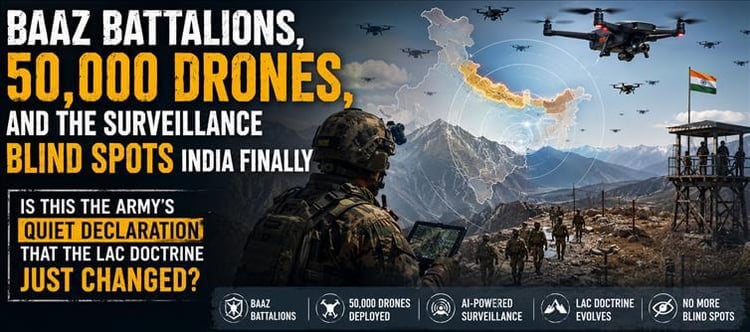
Agility, the fourth letter, is the pillar most likely to reshape defence procurement. In modern military doctrine, agility is a synonym for technology-enabled speed — drones, AI-driven surveillance, autonomous systems, and rapid logistics. Gen Seth's emphasis here, read alongside his broader remarks about future threats, strongly suggests a push toward AI-integrated warfare capabilities that will redirect procurement budgets away from legacy heavy-metal platforms toward lighter, faster, sensor-driven force multipliers.
For India's defence-industrial base, this is both an opportunity and a threat. Companies positioned in the drone and AI space stand to gain enormously. But the traditional heavy-equipment lobby — the makers of tanks, artillery, and large-platform systems — may find their order books under pressure. And for the LAC specifically, agility translates into mountain-warfare units equipped with real-time satellite feeds, drone swarms for high-altitude reconnaissance, and logistics networks that can sustain troops at 15,000 feet without the crippling delays that have plagued past winter deployments.
View on X
Y for Youth — Generational Churn or Agniveer Endorsement?
The final letter is perhaps the most politically loaded. Youth, in the context of the Indian Army in 2025-26, is inseparable from the Agniveer scheme — the short-term military recruitment programme that has been both the Modi government's signature defence-human-resources reform and its most politically controversial. By naming Youth as a pillar, Gen Seth appears to be signalling institutional endorsement of Agniveer's underlying logic: that a younger, fitter, more technologically literate force is strategically superior to the older, pension-heavy legacy model.
This is a live political wire. Agniveer has faced sustained criticism from opposition parties and from veterans' organisations who argue it creates a class of undertrained, disposable soldiers. Gen Seth's elevation of Youth to a doctrinal pillar — not a human-resources policy, but a strategic vision element — is a reframing that serves both the Army's institutional interests and the ruling party's political narrative. Whether that alignment is coincidence or coordination is the kind of question that gets asked in Lutyens' Delhi drawing rooms but never answered on the record.
Political Pulse
The whisper in South Block corridors, according to defence circles tracked closely by India Herald, is that VIJAY is as much a message to Delhi as it is to Beijing. Gen Seth's predecessor navigated a careful line between the PMO's reform ambitions and the Army's institutional conservatism. The talk among retired lieutenant generals and defence commentators is that Seth has chosen to lean in — to align himself visibly with the Modi 3.0 agenda on theatre commands, Agniveer, and indigenous procurement — betting that political alignment buys him the institutional room to actually execute.
The more cynical read, circulating among opposition-aligned strategic analysts, is that VIJAY is a slogan dressed as strategy — that the real test is not the acronym but the budget. Will the 2026-27 defence allocation actually reflect AI-first procurement? Will the theatre-command notification that has been "imminent" for three years actually land? And will the Army's LAC deployments get the winter-logistics funding that operational commanders have been requesting for two consecutive cycles?
India Herald's read of what is really driving this is sharper than both takes: VIJAY is a negotiating position. By going public with a doctrinal framework on day one, Gen Seth has made it politically expensive for the civilian establishment to deny him resources. Every unmet pillar of VIJAY now becomes a visible failure — not of the Army Chief, but of the government that appointed him and publicly celebrated his vision. That is not naivety. That is a general who understands that in Modi's India, the camera is a weapon too.
The Rival's Calculus
And then there is the adversary. China's People's Liberation Army has been watching India's theatre-command debate with something between amusement and strategic interest. Every year the reform stalls, the PLA's Western Theatre Command — which already operates as an integrated joint force — extends its advantage. Gen Seth's VIJAY, if it moves from acronym to action, would represent the most significant Indian response to the PLA's integrated-command model since the Galwan crisis of 2020. Beijing will parse this not as a press conference but as a statement of intent — and calibrate its own LAC posture accordingly.
View on X
Five letters. Each one a front, a budget line, a political signal, and a message to a rival who reads Indian defence press conferences with the same care India reads PLA white papers. The question that will determine whether VIJAY enters the history books or the lamination machine is the one no acronym can answer: does this Army Chief have the political capital to turn five letters into five outcomes — and does Modi 3.0 have the fiscal room to fund the future Gen Seth just described?
By the Numbers
- Gen Dhiraj Seth is India's 31st Chief of Army Staff, unveiling VIJAY as his inaugural doctrinal framework — according to NDTV.
- Integration and Joint operations occupy two of VIJAY's five pillars — the strongest public signal yet from an Army Chief on theatre-command urgency.
- China's PLA Western Theatre Command already operates as an integrated joint force — the model India's stalled reforms are designed to match.
Key Takeaways
- Gen Dhiraj Seth's VIJAY framework — Valour, Integration, Joint operations, Agility, Youth — is a doctrinal statement, not a slogan, with each pillar mapping onto a live strategic and political fault-line.
- Integration and Joint operations receiving two of five pillars signals the strongest push yet for theatre-command operationalisation, directly challenging Air Force and Navy resistance.
- Agility implies a procurement pivot toward AI, drones, and sensor-driven systems — potentially at the expense of legacy heavy-equipment platforms favoured by the traditional defence-industrial lobby.
- Youth as a doctrinal pillar effectively endorses the Agniveer scheme's strategic logic, aligning the Army institutionally with the Modi government's most controversial defence reform.
- The real test of VIJAY is not rhetorical but fiscal: whether the 2026-27 defence budget reflects AI-first procurement and whether the long-stalled theatre-command notification finally lands.
- By going public on day one, Gen Seth has made every unmet VIJAY pillar a visible political failure for the government — turning the acronym into a negotiating lever for resources.
Frequently Asked Questions
What does VIJAY stand for in Gen Dhiraj Seth's vision?
VIJAY stands for Valour, Integration, Joint operations, Agility, and Youth — a five-pillar doctrinal framework unveiled by Gen Seth upon taking charge as India's 31st Army Chief, according to NDTV and Zee News.
How does VIJAY affect India's theatre-command reforms?
Integration and Joint operations occupy two of five VIJAY pillars, signalling the strongest push yet from an Army Chief to operationalise theatre commands — a reform stalled for years due to inter-service resistance and civilian bureaucratic delays.
Does VIJAY signal a shift from the Pakistan front to the China front?
Defence analysts and the emphasis on combat readiness, agility, and AI-integrated warfare strongly suggest VIJAY prioritises the LAC and China-front preparedness over the relatively stabilised western border with Pakistan.
What does the Youth pillar mean for the Agniveer scheme?
By elevating Youth to a doctrinal pillar, Gen Seth appears to institutionally endorse the Agniveer short-term recruitment model's strategic logic — framing a younger, tech-literate force as a strategic necessity rather than a cost-cutting measure.
Who was the Army Chief before Gen Dhiraj Seth?
Gen Dhiraj Seth succeeded the previous Army Chief as India's 31st COAS. His predecessor navigated the initial phases of LAC stabilisation and the early theatre-command deliberations.



 click and follow Indiaherald WhatsApp channel