
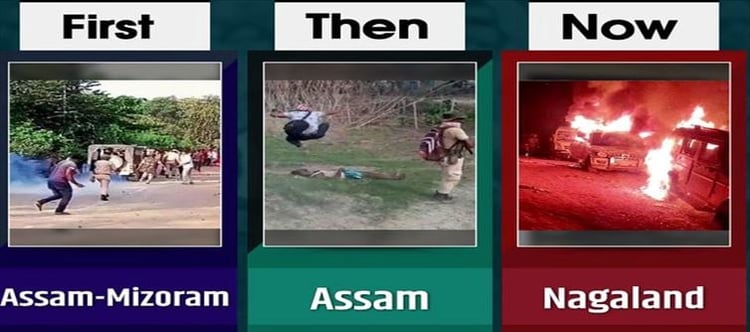


The month-long Naga economic blockade in Manipur, triggered by the killing of six Liangmai Naga civilians, has opened a dangerous third front in a state already torn between Meitei and Kuki communities. According to Aaj Tak and TV9 Bharatvarsh, Delhi's conspicuous silence reflects a political calculus where no electoral dividend justifies the risk of picking a side.
The 5W+H: Who, What, When, Where, Why, How
- Who: Naga tribal communities, specifically Liangmai Nagas, whose six civilians were killed; Manipur's BJP-led state government under N. Biren Singh; and the central BJP leadership in Delhi, according to Aaj Tak.
- What: A near-month-long economic blockade of key highways in Manipur's hill districts, triggered by the killing of six Liangmai Naga civilians, has choked essential supplies to the state capital Imphal, as reported by TV9 Bharatvarsh.
- When: The blockade has been running for close to a month as of July 2025, with security forces deployed on highways, according to TV9 Bharatvarsh.
- Where: Manipur's hill districts, with blockades on the national highways connecting Imphal to the rest of India, as reported by Aaj Tak and TV9 Bharatvarsh.
- Why: The Naga community is protesting the killing of six Liangmai Naga civilians, demanding accountability and justice from the state and central governments, according to Aaj Tak.
- How: Naga community organisations have enforced an economic blockade on vital supply highways, while state security forces have been deployed in strength but have failed to break the deadlock or address the underlying grievance, as reported by TV9 Bharatvarsh.
Six bodies. One month. Zero words from South Block. That is the arithmetic of Manipur's newest crisis — and the numbers do not lie about what Delhi considers expendable.
The killing of six Liangmai Naga civilians in Manipur has triggered what is now approaching a month-long economic blockade of the state's lifeline highways, according to TV9 Bharatvarsh. Security has been tightened along the arteries connecting hill districts to the Imphal valley, but the blockade holds. Supplies are dwindling. And the loudest sound from New Delhi is the conspicuous absence of any sound at all.
For nearly three years, the world has understood Manipur's agony as a binary — Meitei versus Kuki-Zo, valley versus hills, Hindu versus Christian, with ethnic violence that has killed hundreds and displaced tens of thousands since May 2023. That framing, while not inaccurate, was always dangerously incomplete. It erased the third community that has long inhabited the state's northern hills and has its own deep grievances: the Nagas.
What the current blockade reveals is the emergence of that third front — and with it, the collapse of the last convenient simplification Delhi used to avoid doing anything decisive about Manipur.
The Liangmai Killings: What Happened and What It Means
According to Aaj Tak, six Liangmai Naga civilians were killed in circumstances that the Naga community views as a targeted atrocity. The details of the killings — who pulled the trigger, under what chain of command or communal motive — remain contested and under investigation. But the community's response has been unambiguous: a total economic blockade of the highways that are Imphal's oxygen line to the rest of India.
This is not a protest march or a candlelight vigil. This is the choking of an entire state's supply chain. Manipur, landlocked and dependent on two national highways for fuel, food, and medicine, has been through this before. Naga blockades paralysed the state in 2010-11 and 2016-17, each time over grievances the Centre preferred to defer rather than resolve. The difference now is that this blockade lands on a state already shattered — its civil society fractured, its security forces stretched across the Meitei-Kuki divide, its chief minister's credibility a punchline in the hills.
TV9 Bharatvarsh reports that heavy security deployment has been made along the affected highways, but the blockade has not been broken. The state machinery, already working at a fraction of its capacity due to the ethnic crisis, appears paralysed.
Political Pulse
Here is the part no official statement will say. The corridors of North Block have a phrase for Manipur: the file nobody wants on their desk. And there is a reason the file stays orphaned.
The Naga question in Manipur has always been the BJP's most uncomfortable geometry. The party governs the state under N. Biren Singh, a Meitei leader whose authority in the hills ranges from thin to non-existent. The BJP also governs Nagaland next door, where it shares power with the NDPP and where the long-running Naga peace accord with the NSCN(IM) remains unsigned. Any strong move on the Naga blockade in Manipur — whether cracking down or conceding — sends shockwaves into the Nagaland coalition and potentially torpedoes the peace process that has been the party's talking point in the Northeast for a decade.
The whisper in Delhi's political corridors, as sources familiar with the Northeast desk describe it, is that the BJP's strategists see no electoral upside in wading into a Naga-Meitei-Kuki triangle where every intervention alienates at least two communities. The Meitei vote is the most electorally significant in Manipur's assembly arithmetic, the Kuki-Zo vote matters in specific hill constituencies, and the Naga vote is split between Manipur and Nagaland in ways that make clean electoral calculations nearly impossible. The political calculus, bluntly, is that silence costs less than speech.
There is talk in Northeast political circles that even the Governor's office — traditionally the Centre's proxy for crisis management — has been kept on a deliberately loose leash, avoiding any dramatic intervention that could be read as Delhi taking a side. The result is a kind of strategic paralysis dressed up as restraint.
(This reflects political corridor chatter and unverified speculation, not confirmed fact.)
The Third Front No One Wants to Name
India Herald's read of what is really driving this crisis cuts deeper than the killings themselves. For two years, Delhi managed Manipur by treating it as a bilateral ethnic crisis — tragic, but containable. The Meitei-Kuki framing allowed the Centre to position itself as a neutral arbiter (critics would say an absent one) between two warring communities, deploying security forces and making the right noises about peace without committing to the structural political settlement either side demands.
The Naga blockade demolishes that framing. It is no longer two communities in conflict with Delhi as referee. It is three communities with three distinct, often mutually exclusive, sets of demands — and a state government that represents, at best, one of them. The Nagas want accountability for six dead civilians. The Kukis want a separate administration. The Meiteis want territorial integrity. The Centre wants to talk about none of it until after the next election cycle.
What makes this genuinely dangerous is the geography. The Nagas control the northern hill districts and, crucially, the highways. The Kukis dominate the southern hills. The Meiteis hold the valley. In a three-front scenario, no single security deployment can hold all three axes, and no political concession to one community avoids enraging the other two. This is the textbook definition of a governance trap.
By the Numbers
~6 — Liangmai Naga civilians killed, the trigger for the current blockade, according to Aaj Tak.
~30 days — approximate duration of the ongoing highway blockade as of reporting, per Aaj Tak.
2 — the number of national highways connecting landlocked Imphal to the rest of India, both vulnerable to hill-district blockades.
3 — the ethnic fronts (Meitei, Kuki-Zo, Naga) now simultaneously active in Manipur's crisis, a structural escalation from the binary framing of 2023-24.
What Comes Next — The Road Around the Corner
If history is any guide — and in Manipur, history is the only guide that has not been transferred out — the blockade will end one of two ways: either Delhi quietly brokers a backroom deal with Naga tribal bodies (as it did in 2017), buying temporary peace with promises it may or may not keep; or the blockade simply exhausts itself as supplies run critically low and public pressure within the valley forces a crisis-within-a-crisis.
The more consequential question is what the blockade changes structurally. India Herald's assessment is that this marks the moment Manipur's crisis officially outgrew the Centre's preferred framing. Any future political settlement — and one will eventually be forced, whether by exhaustion or by catastrophe — must now account for three negotiating parties, not two. That triples the complexity and halves the already slim odds of a durable resolution before the 2027 Manipur assembly elections.
Watch for two signals in the coming weeks. First, whether the NSCN(IM) or any Naga armed faction publicly backs the blockade — that would transform it from a civilian protest into something far more volatile and would force Delhi's hand. Second, whether the Kuki-Zo organisations, who have their own blockade history, choose solidarity with the Nagas or see an opportunity in their rival's crisis. If both hill communities align against the valley, the arithmetic of Manipur changes overnight — and the BJP's strategy of strategic silence becomes untenable.
The six Liangmai Nagas who died did not die in a geopolitical vacuum. They died in a state where the very concept of shared governance has been bleeding out for three years, and where the Centre has decided, repeatedly, that the political cost of intervention exceeds the political cost of inaction. That calculus holds — until it does not. And the blockade's clock is still ticking.
Allegations reported here are attributed to named sources and remain unproven unless a court has ruled; matters sub judice are reported without prejudgment.
Reported and written with AI assistance under India Herald's editorial standards; a human editor governs publication.
By the Numbers
- 6 Liangmai Naga civilians killed, triggering the blockade (Aaj Tak)
- Approximately 30-day economic blockade of national highways as of reporting (Aaj Tak)
- 2 national highways connect landlocked Imphal to the rest of India, both vulnerable to hill-district blockades
- 3 distinct ethnic fronts now simultaneously active in Manipur — a structural escalation from the previous binary framing
Key Takeaways
- The killing of six Liangmai Naga civilians has triggered a month-long economic blockade of Manipur's lifeline highways — a crisis that opens a third ethnic front beyond the Meitei-Kuki binary Delhi has used to frame the state's conflict since 2023.
- Delhi's silence reflects a political calculus: in a three-community triangle, every intervention alienates at least two constituencies, and no electoral dividend justifies the risk — especially with the Nagaland peace process hanging in the balance.
- The blockade exposes a governance trap — Nagas control the northern highways, Kukis the southern hills, Meiteis the valley — making any single security or political solution structurally impossible without a tripartite settlement.
- The key signals to watch: whether Naga armed factions back the blockade (forcing Delhi's hand) and whether Kuki-Zo groups align with or exploit the Naga protest — either development could make the BJP's strategic silence untenable before the 2027 assembly elections.
Frequently Asked Questions
Why are Naga groups blockading highways in Manipur?
Naga tribal organisations launched the economic blockade after six Liangmai Naga civilians were killed in Manipur. They are demanding accountability and justice from both the state and central governments, according to Aaj Tak.
How does the Naga blockade affect Manipur's daily life?
Manipur is landlocked and depends on two national highways for fuel, food, and medicine. The blockade of these highways by Naga groups in the hill districts has choked essential supplies to the Imphal valley, according to TV9 Bharatvarsh.
Why has the central government not intervened in the Manipur Naga blockade?
Political analysts and corridor sources suggest that the BJP-led Centre sees no electoral upside in intervening in a three-community crisis where any move risks alienating at least two groups. Additionally, action in Manipur could destabilise the fragile Naga peace process in neighbouring Nagaland.
Is the Manipur crisis now a three-way ethnic conflict?
The Naga blockade effectively transforms what was framed as a Meitei-Kuki binary conflict into a three-front crisis involving Meiteis, Kukis, and Nagas — each with distinct and often mutually exclusive demands, making resolution significantly more complex.

 click and follow Indiaherald WhatsApp channel