



⚡When Safety Turns Into Surveillance
You just bought a brand-new smartphone. You expect sleek design, fast apps, maybe a nice camera. Instead, you get a pre-installed passenger on your device — one that you cannot remove.
The government’s new directive makes Sanchar Saathi a permanent, undeletable resident on every new phone sold in India. Under the guise of cyber-security, it transforms your device into a tracking terminal — giving the state persistent access to your handset.
This isn’t just about catching stolen phones.
This is about control.
And consent just became optional.
💥 SANCHAR SAATHI MANDATE: WHAT CHANGED — AND WHY IT MATTERS
1️⃣ A Quiet Order Behind Closed Doors — But Massive Impact on Every User
On 28 november 2025, the Department of Telecommunications (DoT) issued a directive instructing every major handset maker — from apple to samsung, Xiaomi, and others — to pre-install Sanchar Saathi on all new smartphones sold in India.
Manufacturers have 90 days to comply. For phones already in the supply chain or on sale, the app will be pushed via a forced software update.
Users will have no option to delete or disable it. The app becomes a default, permanent layer on your phone.
This isn’t a voluntary security app anymore — it’s a mandate.
2️⃣ What Sanchar Saathi Does — And What It Means in Practice
According to official sources, Sanchar Saathi is meant to help:
• Verify whether a handset’s unique IMEI is genuine, or previously blacklisted as lost/stolen.
• Block lost or stolen phones from network access and prevent re-use or resale.
• Report suspected spam/fraud calls or messages.
• Let users check “mobile connections in their name” — helping curb identity misuse or SIM fraud.
On paper, these are legitimate concerns: IMEI spoofing, phone theft, fraud — all real issues in a country with over 1.2 billion mobile users.
But the problem lies not in the why — but in the how.
3️⃣ From Protection to Compulsion: Where User Consent Disappears
Sanchar Saathi was originally optional. Users could voluntarily install it if they wished.
Now, it’s forced onto every phone, with no option to uninstall. The government has essentially decided: Your phone, but you don’t own all of it.
That removes meaningful user consent — a cornerstone of wallet PLATFORM' target='_blank' title='digital-Latest Updates, Photos, Videos are a click away, CLICK NOW'>digital privacy.
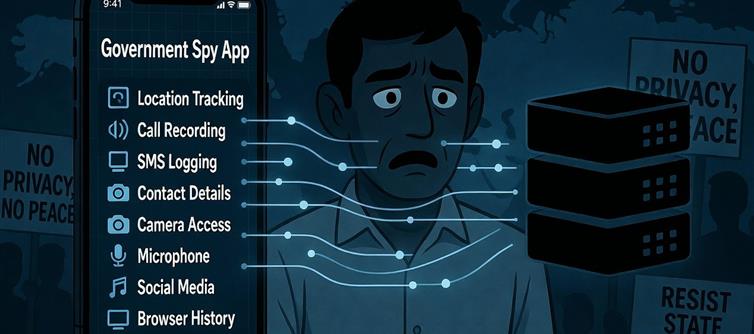
And once such a mandate is accepted, what stops further “features”? What if the app is updated to monitor call logs, contact lists, SMS/IM messages, location, device ID, or more intrusive data — all under “cybersecurity”?
The potential for overreach, surveillance, and abuse becomes too great to ignore.
4️⃣ Privacy Experts Warn: This Is State Surveillance Under a Security Banner
Digital-rights advocates are already ringing alarm bells. Many call this directive a “big brother” move — a government-mandated backdoor into personal devices.
Opposition from tech companies is likely: for example, apple typically resists pre-installing third-party or government apps on new phones.
The cumulative effect? A massive shift in who controls the device — the user or the state?
In a country already grappling with rising wallet PLATFORM' target='_blank' title='digital-Latest Updates, Photos, Videos are a click away, CLICK NOW'>digital surveillance, this could mark a dangerous new baseline: government-default control over every smartphone in India.
5️⃣ What It Means for Everyday Users — And Why You Should Care
No matter what phone you buy — flagship or budget — the app comes in.
You cannot opt out, disable, or remove it.
If misused, the app could access sensitive data: IMEI, device ID, and — depending on future updates — potentially location, call/SMS logs, and even communications.
Transparency is limited: the directive was private; there was no public debate, no open consultation, no opt-out option.
Trust in safety becomes trust in control — potentially eroding wallet PLATFORM' target='_blank' title='digital-Latest Updates, Photos, Videos are a click away, CLICK NOW'>digital privacy and freedom for millions.
What started as a tool for lost-phone tracking or fraud prevention now risks morphing into a permanent, unremovable surveillance instrument.
🔥 CONCLUSION — WHEN SECURITY SLIPS INTO SURVEILLANCE
Sanchar Saathi’s mandate isn’t just about cyber safety or stolen phones.
It’s about control.
About turning every smartphone into a state-managed portal — whether we like it or not.
In a democracy, surveillance should be the exception — not the default.
Today, india is forcing its citizens to accept the opposite.
Citizens should ask:
Is your phone yours anymore — or just another node in a national tracking grid?
 click and follow Indiaherald WhatsApp channel