


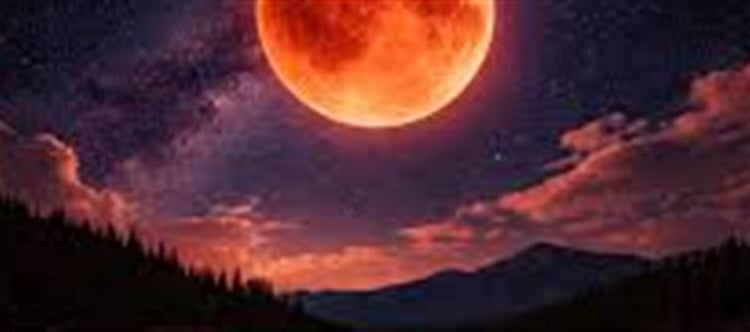

What Is a Total Lunar Eclipse?
A total lunar eclipse occurs when the Earth comes directly between the sun and the moon, casting a shadow that completely covers the Moon. During this event, sunlight passing through the Earth’s atmosphere gets refracted and gives the moon a reddish hue, which is why it is often called a “Blood Moon.”
Why Does the moon Turn Red?
The reddish color of the moon during a total lunar eclipse happens due to Rayleigh scattering. As sunlight passes through the Earth’s atmosphere, shorter blue wavelengths are scattered away, while longer red wavelengths bend toward the moon, giving it its characteristic deep red or copper tone.
Types of Lunar Eclipses
Lunar eclipses can be categorized into three types:
Partial Lunar Eclipse – Only a portion of the moon enters Earth’s shadow.
Total Lunar Eclipse – The entire moon passes through Earth’s umbra, causing the “Blood Moon” effect.
Penumbral Lunar Eclipse – The moon passes through the outer part of Earth’s shadow, causing subtle dimming.
When Will the Next ‘Blood Moon’ Appear?
The next total lunar eclipse, or Blood moon, is expected to be visible in [insert general timeframe, e.g., “mid-2026”]. Depending on your location, viewers can witness the moon gradually darken and turn red as Earth’s shadow moves across its surface. Exact timing will vary by region.
How to watch Safely
Unlike solar eclipses, lunar eclipses are completely safe to watch with the naked eye. You can also enjoy them using binoculars or a telescope for a closer view. Key tips:
- Find a location with minimal light pollution
- Check local timings for the eclipse phases
- Capture photographs with long exposure for dramatic effects
Significance of Lunar Eclipses
Lunar eclipses have fascinated humans for centuries, inspiring myths, legends, and scientific study. Observing a Blood moon provides an opportunity to appreciate the dynamics of our solar system and the Earth-Moon-Sun alignment.
Disclaimer:
The views and opinions expressed in this article are those of the author and do not necessarily reflect the official policy or position of any agency, organization, employer, or company. All information provided is for general informational purposes only. While every effort has been made to ensure accuracy, we make no representations or warranties of any kind, express or implied, about the completeness, reliability, or suitability of the information contained herein. Readers are advised to verify facts and seek professional advice where necessary. Any reliance placed on such information is strictly at the reader’s own risk.
 click and follow Indiaherald WhatsApp channel