


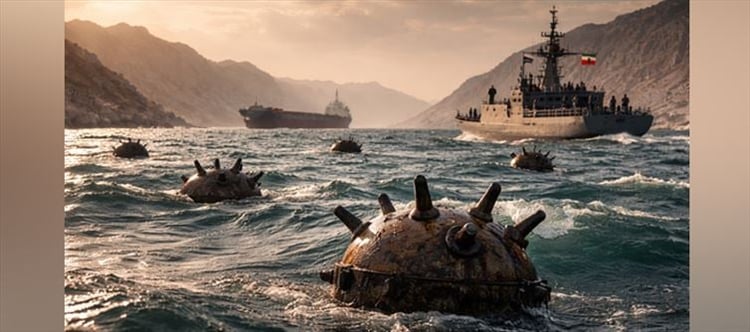

The Strait of Hormuz has always been one of the world’s most critical choke points—but right now, it’s something else entirely: unpredictable, tense, and increasingly dangerous. What should be a tightly monitored strategic corridor is now being described as a floating risk zone, where uncertainty itself has become the biggest threat.
A rushed move with lasting consequences
Earlier this year, iran reportedly moved quickly to secure the waterway using naval mines. But the execution appears to have been chaotic—lacking systematic tracking, mapping, or proper documentation.
No records, no control
Without precise placement records or navigational tracking, these mines are no longer fixed threats—they’re unknown variables. That changes everything, turning a controlled defense measure into a broader hazard.Currents take over
Strong sea currents in the Strait don’t sit still—and neither do unanchored or poorly tracked mines. Over time, they drift, spreading unpredictably across shipping lanes and making safe navigation far more complex.A risk to everyone—including the originator
This isn’t a one-sided problem. Even vessels linked to iran could face difficulty navigating the same waters, highlighting how quickly strategic actions can backfire when control is lost.Global impact: oil under pressure
The Strait handles a significant portion of the world’s oil transit. Any disruption—real or perceived—can ripple across global markets, affecting supply chains, prices, and economic stability far beyond the region.
⚡ Closing Punch:
The Strait of Hormuz isn’t just a geopolitical hotspot anymore—it’s a test of control versus consequence. When strategy turns unpredictable, the risks don’t stay local. They drift, expand, and eventually reach the entire world.
 click and follow Indiaherald WhatsApp channel