
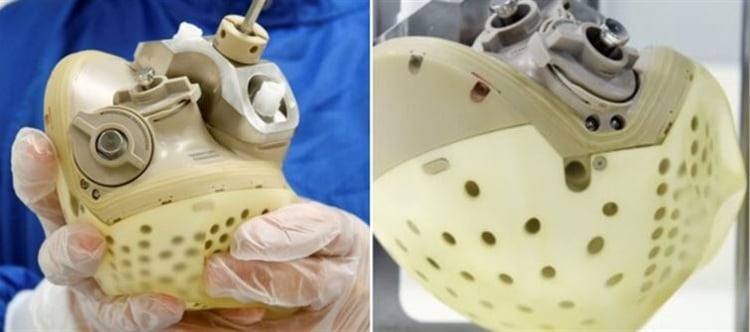


Imagine a world where heart failure no longer means waiting—hoping—for a donor who may never come. That future just got a step closer. In France, scientists have built something extraordinary: an artificial heart that doesn’t just pump blood—it thinks, adapts, and keeps going. But behind the headlines of a “forever heart” lies a far more complex, high-stakes reality.
1. A Full Mechanical Replacement—Not Just Support
The Carmat Aeson isn’t a helper device—it’s a complete takeover. It replaces both ventricles of a failing heart, stepping in as a fully functional, life-sustaining organ.
2. Engineering That Mimics Life
Instead of simple pumping, this device uses electro-hydraulic systems to recreate a natural heartbeat. Flexible membranes push blood in pulses, while bovine tissue valves help replicate the feel—and function—of a real human heart.
3. A heart That Adjusts to You
What sets it apart? Intelligence. Built-in sensors and algorithms monitor the body and automatically adjust blood flow. Resting, walking, even light activity—the device responds in real time, just like a biological heart would.
4. Freedom… With a Catch
There’s no internal battery. Patients carry a roughly 4kg external controller and battery pack, with 4–8 hours of runtime per set. A cable runs through the skin—constant power is non-negotiable.
5. A Lifeline, Not a Forever Fix (Yet)
While early trials show patients living months—even years—this isn’t a permanent solution yet. It’s mainly a bridge to transplant, buying time where options were once nonexistent.
6. The Risks Still Loom Large
This isn’t a simple upgrade. Surgery is complex, and complications like infection, blood clots, or stroke remain real threats. Add to that the company’s financial instability in 2025, and the rollout faces uncertainty.
🔥 FINAL WORD:
The Carmat Aeson is a glimpse into the future of medicine—bold, brilliant, and slightly unsettling. It proves one thing beyond doubt: we’re getting closer to replacing the human heart. But for now, this “forever” solution still comes with limits—and a long road ahead.
 click and follow Indiaherald WhatsApp channel