
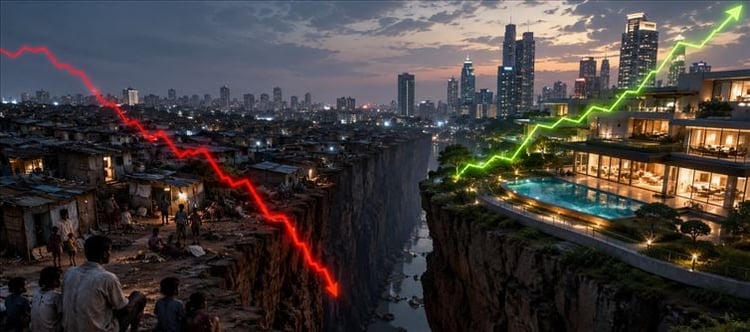


There’s a dangerous economic divide growing across the world — and india is standing right in the middle of it. Economists call it a “K-shaped recovery.” In simple terms, one section of society keeps moving upward while the other sinks deeper into financial stress. The rich get richer. The poor get poorer. But in india, this divide cuts even deeper because most people don’t have the cushion, mobility, or financial escape routes available in richer countries.
In places like the United States, even someone in the lower half of society may still hold assets, savings, or the option to relocate to cheaper regions and maintain a decent quality of life. That safety net matters. In india, for a huge chunk of the population — especially the bottom 90% — survival is directly chained to the health of the domestic economy. If jobs slow down, salaries stagnate, taxes rise, or inflation spikes, there’s nowhere to run. No backup plan. No second passport. No offshore safety cushion.
That’s why bad economic policies hit ordinary indians harder than most people realize. Whether it’s crushing taxation, distorted fuel policies, shrinking job markets, reckless freebies, or weak real returns on investments, the burden always falls heaviest on those trying to climb upward. And when wealth-building opportunities shrink, it’s the middle and lower classes that bleed first.
The top 5–10% will always find alternatives. Better investments. Better mobility. Better protection.
The bottom 90% only have one weapon: demanding policies that actually create wealth, jobs, investments, and growth.
Because without wealth creation, “development” is just a slogan with better lighting.
 click and follow Indiaherald WhatsApp channel