
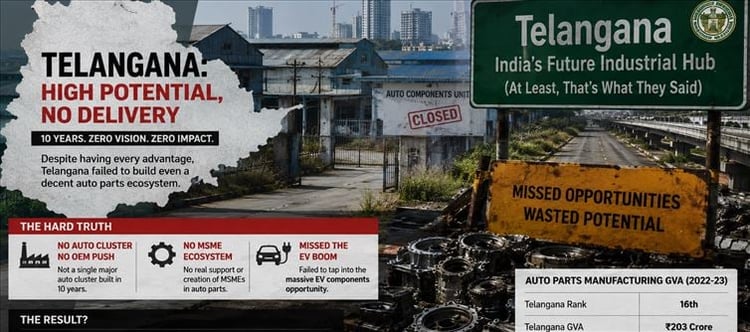


telangana entered the last decade with nearly every advantage needed to become a major force in India’s automobile and auto components industry. The state had strong infrastructure, international airport connectivity, a growing urban economy, skilled engineering talent, and an existing industrial base that included companies like mahindra & Mahindra.
Yet despite all that potential, critics argue the state failed to convert opportunity into large-scale industrial growth during the decade-long rule of the Bharat Rashtra Samithi government led by K. Chandrashekar Rao.
According to industry discussions and economic comparisons, telangana currently contributes only a very small share to India’s auto parts manufacturing ecosystem, reportedly ranking around 16th nationally with roughly ₹203 crore in Gross Value Added — just a tiny fraction of India’s total sector output.
That underperformance is exactly what frustrates many observers. Unlike states lacking industrial infrastructure, telangana already had the foundational ingredients needed to attract major automotive investments.
Critics argue the state missed several major opportunities over the past decade:
• No aggressive push to build large integrated auto manufacturing clusters
• Limited success in attracting major OEM and supplier ecosystems
• Weak MSME expansion in auto component manufacturing
• Failure to capitalize aggressively on the global EV component supply-chain shift
• Insufficient long-term industrial depth despite strong branding campaigns
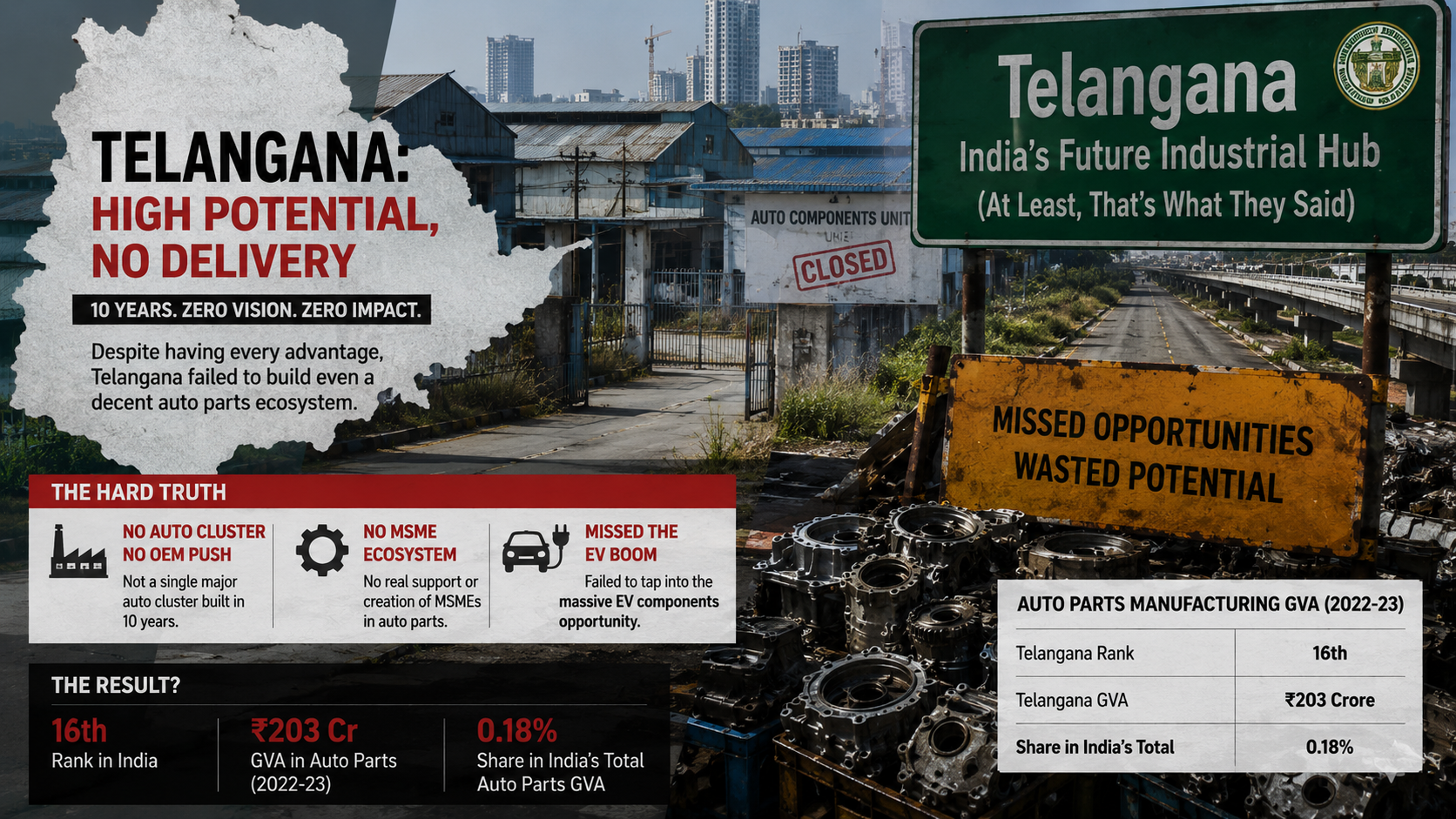
The electric vehicle revolution especially stands out as a missed opportunity. While several indian states aggressively positioned themselves to attract EV manufacturing, battery ecosystems, and supply-chain investments, telangana critics argue the momentum remained far below its potential.
That’s why the debate has now become political as well as economic. Opponents of the previous BRS government claim telangana focused heavily on image-building, publicity, and centralized political control while failing to create enough long-term industrial ecosystems capable of generating large-scale manufacturing jobs.
Supporters, however, argue the state still performed strongly in sectors like IT, pharmaceuticals, and infrastructure development, and that industrial transformation takes longer than political narratives suggest.
But one reality remains difficult to ignore:
telangana had the potential to become a major auto manufacturing powerhouse.
And many now believe that potential was never fully utilized.
 click and follow Indiaherald WhatsApp channel