
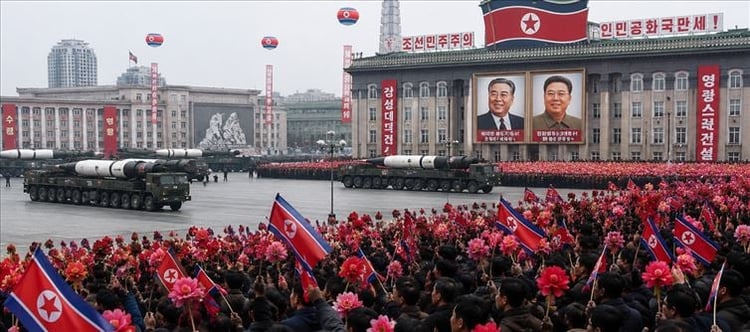


Most people treat birthdays as deeply personal moments — a rare day that belongs entirely to them.
Not in North Korea.
If you were born on July 8 or december 17, you’re effectively out of luck. Those dates mark the deaths of former leaders Kim Il-sung and Kim Jong-il, and under North Korea’s rigid political culture, any form of celebration on those days is heavily discouraged or outright forbidden.
Think about how surreal that is for a second.
Your own birthday becomes politically inconvenient.
THE STATE ALWAYS COMES FIRST
This rule perfectly captures the deeper reality of life inside North Korea: the individual is never more important than the regime.
The deaths of Kim Il-sung and Kim Jong-il are treated as sacred national mourning periods. Citizens are expected to show grief, loyalty, and solemn respect — not joy, excitement, or personal celebration.
Which means birthday parties, cakes, music, gatherings, and cheerful events become socially unacceptable on those dates.
Even if it’s your actual birthday.
THE MOST DISTURBING PART? IT FEELS NORMAL THERE
That’s what makes systems like this so unsettling.
When people grow up inside intense personality cults, extraordinary restrictions slowly become ordinary life. Entire generations are conditioned to prioritize devotion to leadership over personal identity itself.
Outside the country, the idea sounds absurd.
Inside the country, it’s simply reality.
MORE THAN JUST A RULE
This isn’t really about birthdays.
It’s about control.
Because when a government can dictate how citizens mourn, celebrate, speak, dress, think, and even emotionally behave on specific days, it reveals something much larger than politics.
It reveals the power of ideology over everyday life.
And perhaps the strangest part of all is this:
Somewhere in north korea right now, some people have never truly celebrated their own birthday — simply because history assigned them the “wrong” date.
 click and follow Indiaherald WhatsApp channel