
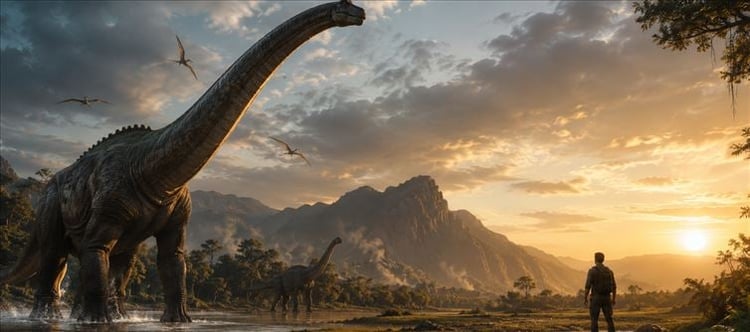


Human beings often act as if we are the center of Earth’s story. We build cities, reshape landscapes, launch satellites into space, and debate the future of civilization as though the planet began when we arrived. But a single number is enough to shatter that illusion.
Dinosaurs roamed Earth for roughly 165 million years. Humanity, by comparison, has existed for only a tiny fraction of that time—about 0.1% of the dinosaurs’ reign.
Let that sink in for a moment.
For tens of millions of years, giant predators stalked ancient forests, massive herbivores thundered across vast plains, and entire ecosystems rose and fell long before the first human ever walked the planet. Continents shifted. Oceans changed shape. Species evolved, thrived, and vanished. Through it all, dinosaurs remained the dominant force on Earth.
Then came the asteroid.
One catastrophic event ended a dynasty that had lasted longer than humans can truly comprehend. The rulers of the prehistoric world disappeared, clearing the stage for mammals and, eventually, us.
What makes this comparison so astonishing is how much humanity has managed to accomplish in such a microscopic slice of time. In just a few hundred thousand years, humans went from primitive survival to agriculture, industry, computers, artificial intelligence, and space exploration. On the geological clock, our entire civilization occupies less than a heartbeat.
Yet there is also a humbling lesson hidden inside that timeline. The dinosaurs once seemed unstoppable. Their dominance lasted for over 165 million years. Today, they survive only as fossils and distant descendants in the form of birds.
Earth’s history is far longer than any species. Dinosaurs ruled it for an unimaginable span of time. Humans are newcomers—ambitious, transformative, and remarkably successful—but still just a brief chapter in a story that began long before us and will likely continue long after us.
 click and follow Indiaherald WhatsApp channel