
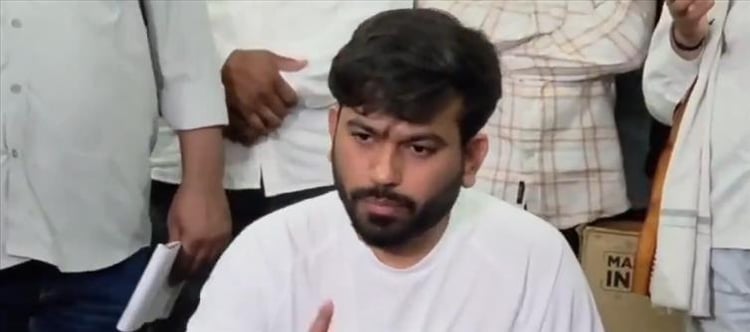


The most powerful moments in political debates are often the simplest ones. No complicated statistics. No carefully crafted talking points. Just one uncomfortable question and an answer that cuts straight to the heart of the issue.
That is exactly what happened when Abhijeet Dipke was asked what comes next if the education minister refuses to resign.
His response was immediate and uncompromising.
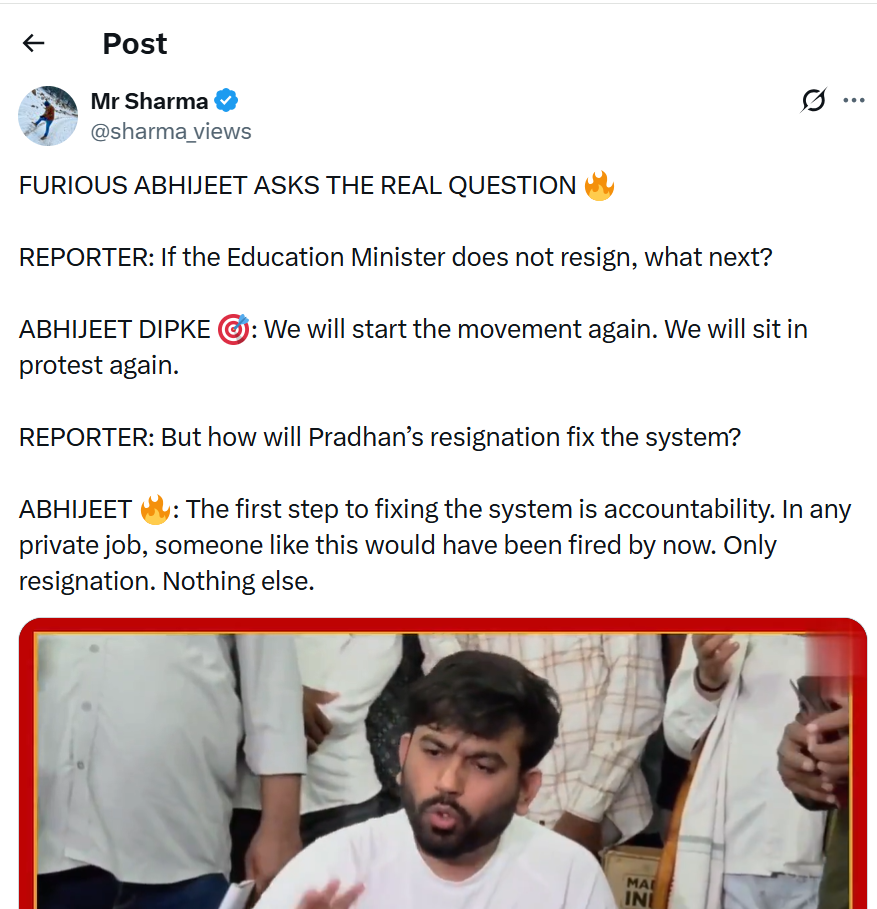
If the resignation does not happen, the movement will return. The protests will resume. The pressure will continue.
But it was the follow-up question that truly ignited the exchange.
A reporter asked how the resignation of a single minister would actually fix a larger systemic problem. It's a question that governments often rely on when faced with public outrage: why focus on one person when the issue is much bigger?
Abhijeet's answer was blunt.
According to him, accountability is not the final step in fixing a broken system—it is the first one.
His argument was simple enough for anyone to understand. In the private sector, if someone presided over a major failure, there would be consequences. There would be accountability. There would likely be termination. Yet in politics, responsibility often seems to disappear into endless committees, investigations, and promises of reform.
That contrast is what struck a chord with many observers.
For Abhijeet, the demand is not merely about one individual. It is about setting a precedent. If those in positions of authority face no consequences when things go wrong, public trust inevitably erodes. Accountability becomes a slogan rather than a principle.
Whether one agrees with his position or not, the core message was crystal clear: meaningful reform cannot begin unless responsibility is acknowledged first.
His final words captured that sentiment perfectly.
No diversions. No half measures. No symbolic gestures.
"Only resignation. Nothing else."
And with that, the debate shifted from politics to a far bigger question: if accountability doesn't start at the top, where exactly does it start?
 click and follow Indiaherald WhatsApp channel