


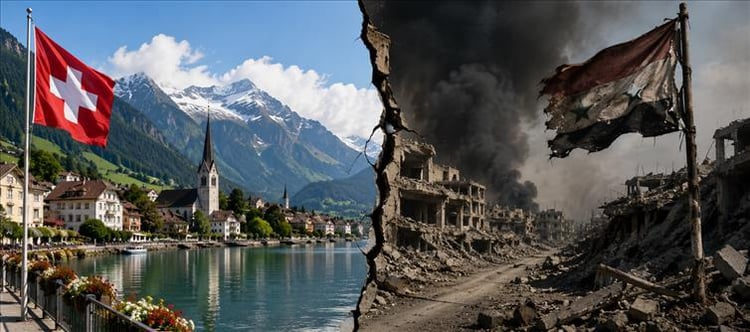

Iran's proposal for gulf countries to jointly levy tolls on Strait of Hormuz transit — projecting up to $40 billion in revenue — uniquely exposes india, which simultaneously buys Iranian crude under sanctions pressure and pays transit costs for Gulf-sourced energy. New delhi faces a double bind no other major economy confronts at this scale.
Here is a question no one in South Block wants to answer out loud: what happens when the country that sells you sanctioned crude and the countries that supply the rest of your energy agree to put a tollbooth on the only sea lane connecting the two? That is the precise knot iran has just tied by proposing that gulf littoral states jointly levy transit fees on the Strait of Hormuz — and india, more than any other major economy, is the one left holding both ends of the rope.
According to News18, Tehran is projecting a potential $40 billion windfall from the scheme, pitching it to gulf Cooperation Council nations as a shared-sovereignty revenue stream rather than unilateral coercion. Iran's chief negotiator has declared that the Strait will "never return to its previous status," a phrase that sounds diplomatic but reads, to anyone tracking Hormuz tensions, like a line drawn in permanent ink.
Strip away the revenue projections and the multilateral language, and what remains is a classic geopolitical sorting exercise. The toll proposal forces every gulf state to answer a binary question: are you with Tehran on shared sovereignty over Hormuz, or with Washington on unimpeded freedom of navigation? The united states has already answered. Secretary of State Marco Rubio has stated bluntly that iran will not be permitted to charge tolls on the strait, according to widely reported remarks.
India's External Affairs Ministry has not publicly commented on the toll proposal as of this report. That silence is itself telling — and strategically precarious.
For india the calculus is agonisingly layered. New delhi is the world's third-largest oil importer and depends on the Strait of Hormuz for an estimated 60 percent of its crude and LNG imports, according to data compiled by the international Energy Agency. Any toll, even a modest per-barrel surcharge, translates directly into higher import bills at a time when the government is already managing fuel-price politics ahead of state elections. According to international energy analysts cited in multiple reports, even a $1-per-barrel toll would add billions annually to India's energy import tab.
That alone would be painful. What makes it uniquely uncomfortable is the other side of India's ledger: despite successive rounds of US-led sanctions, india has continued to purchase Iranian crude through various payment and shipping arrangements, as documented by Reuters and India's Directorate General of Commercial Intelligence and Statistics trade data. New delhi has maintained this balancing act by arguing — with some success — that its energy security imperatives are distinct from its strategic alignment with Washington.
Iran's toll proposal detonates that careful ambiguity. If india publicly opposes the toll, it alienates a supplier it has quietly kept in its energy basket. If it stays silent or acquiesces, it risks infuriating Washington at a moment when the US is actively rallying gulf allies against the scheme. And if gulf states like saudi arabia and the uae — India's largest energy partners — begin negotiating with Tehran on the toll framework, New delhi could find itself paying the surcharge while being excluded from the conversation that sets it.
This is not hypothetical. Lloyd's List, the maritime intelligence service, has reported that oil tankers have begun exploring alternative routing through the strait amid IRGC warnings to vessels — a sign that the operational reality on the water is shifting regardless of what diplomats decide in conference rooms.
The Legal Grey Zone iran Is Exploiting
Can iran legally block or toll the Strait of Hormuz? The answer is murkier than most commentary acknowledges. Under the United Nations Convention on the Law of the sea (UNCLOS), the strait qualifies for transit passage — meaning vessels have the right to continuous and expeditious passage that cannot be suspended. iran, however, has never ratified UNCLOS. Tehran's position, advanced consistently since the 1980s, is that it holds sovereign rights over its territorial waters within the strait and that passage is a privilege it can condition. international legal scholars remain divided on whether a multilateral toll framework — as opposed to a unilateral blockade — would violate customary international law, particularly if gulf states on both shores consented to it.
This legal ambiguity is precisely the space Tehran is trying to occupy. By framing the toll as a joint gulf enterprise rather than an Iranian diktat, it complicates the American counter-narrative of unilateral aggression. It is, in strategic terms, rather elegant — and rather dangerous.
What India's Playbook Looks Like Now
New Delhi's immediate diplomatic challenge is threefold. First, it must ensure that any toll framework does not disproportionately burden Indian-flagged or Indian-bound vessels — a real risk given the volume of India-bound traffic through Hormuz. Second, it must manage the optics of its continued Iranian crude purchases in a context where the US is drawing harder lines. Third, and most consequentially, it must decide whether to seek a seat at the gulf negotiating table or remain a price-taker on the outside.
India's External Affairs Ministry has historically preferred to manage gulf crises through bilateral quiet diplomacy rather than multilateral positioning. That playbook may not survive a scenario where the rules of the strait itself are being rewritten by a consortium that india is neither invited to join nor able to ignore.
The $40 billion number Tehran is floating may be aspirational — revenue projections from a country under heavy sanctions deserve scepticism. But the strategic architecture underneath the number is real. iran is not merely proposing a toll. It is proposing a new governance model for the world's most consequential chokepoint, and it is daring every country that depends on that chokepoint to either participate or pay without a voice.
For india, that dare lands harder than for anyone else. And the clock, unlike a diplomatic communiqué, does not wait for consensus.
Key Takeaways
- Iran has proposed that gulf littoral states jointly impose transit tolls on the Strait of Hormuz, projecting up to $40 billion in revenue, according to News18.
- India is uniquely exposed — it depends on Hormuz for roughly 60% of its crude and LNG imports, according to international Energy Agency data, while also maintaining Iranian crude purchases under sanctions pressure.
- The US has explicitly opposed the toll; Secretary of State Marco Rubio has stated iran will not be permitted to charge for Hormuz transit, per widely reported remarks.
- India's External Affairs Ministry has not publicly commented on the toll proposal as of this report.
- Iran has not ratified UNCLOS, creating legal ambiguity around whether a multilateral toll framework would violate international law.
- Lloyd's List has reported that oil tankers have begun exploring alternative routing through the strait amid IRGC warnings to vessels.
- India faces a strategic trilemma: opposing the toll risks alienating Tehran; acquiescing risks angering Washington; silence risks being excluded from the framework that sets the price.
Frequently Asked Questions
Can iran legally block or toll the Strait of Hormuz?
The legal picture is contested. UNCLOS guarantees transit passage through international straits, but iran has never ratified the convention. Tehran argues it holds sovereign rights over its territorial waters within the strait. A multilateral toll agreed by gulf states on both shores would further complicate the legal analysis, according to international law scholars.
Why is india uniquely exposed by Iran's Hormuz toll proposal?
india is the world's third-largest oil importer and depends on the Strait of Hormuz for roughly 60% of its crude and LNG imports, according to international Energy Agency data. Simultaneously, india has continued purchasing Iranian crude despite US-led sanctions — as documented by Reuters and indian trade data — leaving New delhi unable to cleanly oppose or support the toll without jeopardising a critical relationship on either side.
Is the Strait of Hormuz controlled by Iran?
The strait lies between iran and Oman, with both countries holding territorial waters within it. Under international maritime law, the strait is classified as an international waterway subject to transit passage rights, though iran disputes this framework since it has not ratified UNCLOS.
How much oil passes through the Strait of Hormuz?
Approximately 20% of the world's daily oil supply transits the Strait of Hormuz, making it the single most critical maritime chokepoint for global energy markets.
Has india officially responded to Iran's Hormuz toll proposal?
As of this report, India's External Affairs Ministry has not publicly commented on the toll proposal. india has historically managed gulf maritime disputes through bilateral quiet diplomacy rather than public multilateral positioning.
 click and follow Indiaherald WhatsApp channel