


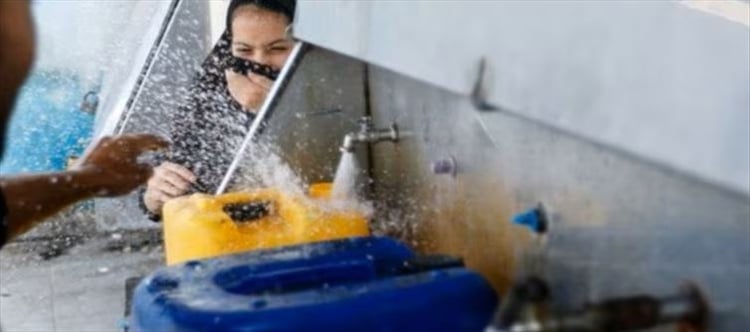

We had not taken a shower in days. You have to wait in queue even to use the lavatory', Hamid told AFP. Residents of the enclave to the north were advised by Rmy on friday to go south "for their safety". "No food is available. Not all products are in stock, and the price of those that are has increased. cheese and tuna cans are the only foods we find.
"I feel like a burden, unable to do anything."
About a million people have been displaced, according to UN estimates, since israel started bombarding Gaza nonstop with planes in retribution for Hamas's fatal attack on october 7.
Over 1,400 Israelis were killed in the Hamas onslaught, the majority of them were civilians.
At least 2,670 Palestinians, mostly commoners, have perished in the ceaseless bombing on the Gazan side.
Israel also shut off the heavily populated coastal enclave's food, energy, and water supplies. On Sunday, water was restored to the south.
The 55-year-old Mona Abdel Hamid departed from her Gaza City residence in favour of her family' home in Rafah.
Rather, she discovered herself in the abode of strangers.
"I'm embarrassed and humiliated. I'm trying to find safety. We don't have much clothing, and the majority of it is already filthy because there isn't any water to wash it," she said.
"No water, no electricity, and no internet. I think my humanity is eroding."
'Lives in displacement'
"Not being able to locate water is the worst and most harmful thing. We're not taking baths right now since there's so little water," she told AFP.
"We received guests who were displaced from the Gaza City area, the Al-Rimal neighborhood, and Tal al-Hawa," said Esam from his house in Khan Yunis, which is close to a school sponsored by the UN organization that supports Palestinian refugees.
However, according to the 23-year-old, who wished to remain anonymous, "water is a problem".
People who have taken up residence at UNRWA classrooms are in dire need of food and water.
Juliette Touma, the head of communications for the UN agency, told AFP that "as people continue to leave their homes," more people are expected to become displaced.
Israel is assembling troops and armaments near the Gaza border in anticipation of a planned military assault.
There were airstrikes in the south, particularly at Rafah, where a local said a doctor's house was hit, in defiance of the Israeli evacuation order.
According to Khamis Abu Hilal, "the entire family was wiped out."
Alaa al-Hams drew attention to the recent indications of shelling in a Rafah suburb.
"I observe the immense devastation. It is said that terrorism exists here. He said, "Where is the humanity they speak of?"
"All are civilians here, with nothing to do with any organizations, but they died... no one is left alive."
Standing on the rubble of her former Rafah house, Samira Kassab asks, "Where will we go? The Arab countries are where?
"We have lived in constant relocation our entire lives. All of my children lived in our home when it was struck... Nothing remains after we slept on the street," the woman remarked.
"We are by ourselves. I am unable to take my kid to the hospital since she has cancer. diabetes and hypertension affect me personally."
But she lifted her hand, boldly, like a victorious symbol.
She declared, "I won't leave no matter what, even if I die," as she stood surrounded by her grandkids. We beg our neighbors for food, but we won't give up even a single grain of sand.
 click and follow Indiaherald WhatsApp channel