

-

Bharatiya Janata Party
-
Calcutta
-
court
-
Elections
-
gold
-
Government
-
House
-
India
-
Indian
-
Indians
-
Kalyan Banerjee
-
Kolkata
-
Leader
-
local language
-
Loksabha
-
Mahua Moitra
-
Mamata Benerjee
-
Minister
-
MP
-
News
-
Party
-
Pran
-
prasad
-
Prime Minister
-
ram mandir
-
ram pothineni
-
READ
-
Silver
-
social media
-
temple
-
trinamool congress
-
WATCH
-
West Bengal - Kolkata
-
workers

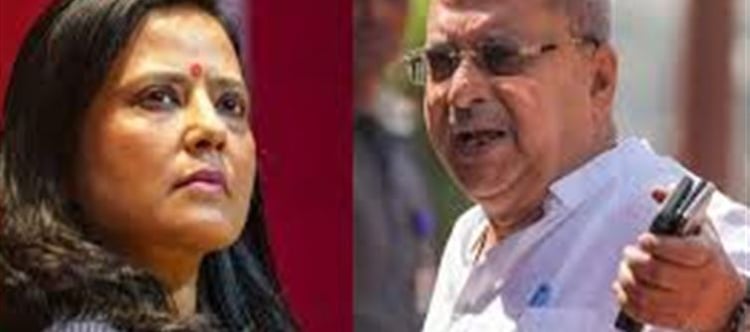
Mahua Moitra has alleged that donations worth 70 kg of silver and 1,250 kg of gold given by devotees to the Ram Mandir Trust remain unaccounted for. The Trust confirmed General Secretary Champat Rai's resignation and insists donated items are safe, but the political damage lies in BJP's inability to distance itself from a temple it made its crowning achievement.
The 5W+H: Who, What, When, Where, Why, How
- Who: TMC MP Mahua Moitra levelled the allegations; the Shri Ram Janmabhoomi Teerth Kshetra Trust confirmed General Secretary Champat Rai's resignation, according to Hindustan Times.
- What: Moitra accused the Centre of presiding over 'theft' of Ram Mandir donations including 70 kg silver and 1,250 kg gold, while the Trust said donated silver bricks and ornaments are safe, per Hindustan Times.
- When: The allegations and the Trust's response emerged in late May 2026, with the Trust confirming Rai's resignation in the same period, as reported by Hindustan Times.
- Where: The controversy centres on the Ram Mandir in Ayodhya, Uttar Pradesh, with the political fallout playing out nationally.
- Why: The Opposition sees financial opacity at the Trust as an opportunity to challenge BJP's moral ownership of the Ram Mandir narrative ahead of upcoming state elections, according to Hindustan Times reports.
- How: Moitra cited specific figures of unaccounted donations and framed them as 'theft' under the Centre's watch; the Trust responded by confirming Rai's exit and asserting the safety of donated materials, per Hindustan Times.
Seventy kilograms of silver. One thousand two hundred and fifty kilograms of gold. These are not the inventory of a bullion vault or a sovereign treasury. These are, according to TMC MP Mahua Moitra, the devotional offerings that faithful Indians placed at the feet of Lord Ram — and which, she charges, have gone missing under the watch of the very government that built the temple as the centrepiece of its civilisational promise.
The numbers are staggering enough to stop a scroll. But the real story is not about silver bricks and gold ornaments. It is about what happens when a ruling party's greatest political asset — the Ram Mandir — becomes the site of its most awkward interrogation. And why BJP, for once, finds itself on the wrong side of a temple door.
The Allegation and the Awkward Confirmation
Moitra's broadside was characteristically blunt. She accused the Centre of presiding over the 'theft' of donations made by crores of devotees to the Shri Ram Janmabhoomi Teerth Kshetra Trust, according to Hindustan Times. The specific figures she cited — 70 kg of silver and 1,250 kg of gold — were designed for maximum impact, and they landed. In a country where even a gram of temple gold carries enormous emotional weight, the implication that thousands of kilograms have gone unaccounted is politically incendiary.
The Trust's response, reported by Hindustan Times, was revealing in what it chose to address and what it left alone. It confirmed the resignation of General Secretary Champat Rai — a figure closely associated with BJP's temple project from its inception — and stated that donated silver bricks and ornaments 'are safe.' Note the careful framing: the Trust said the items are safe, not that every donation has been publicly audited or accounted for. That gap between 'safe' and 'accounted for' is precisely where the Opposition intends to set up camp.
Why BJP Cannot Simply Counter-Attack
In most political controversies, BJP's playbook is well-rehearsed: label the attack as anti-Hindu, frame the attacker as hostile to faith, and let the party's formidable social media machinery do the rest. But the Ram Mandir donation issue inverts the usual dynamics in a way that should keep BJP strategists awake at night.
Consider the bind. The Ram Mandir is not a government project in the conventional sense — it is managed by a Trust. Yet BJP claimed full political credit for its construction, consecration, and the emotional catharsis it delivered to millions. Prime Minister Modi's presence at the Pran Pratishtha ceremony was the defining image of 2024's political calendar. The party cannot now say, 'This is a Trust matter, not ours.' The electorate will not accept that distinction because the party never drew it when the credit was being distributed.
This is the classic ownership trap in politics: you cannot take the applause and refuse the audit. Every rupee, every tola of gold donated by a devotee carries not just monetary value but devotional intent. When Moitra frames missing donations as 'theft,' she is not speaking the language of a CAG report — she is speaking the language of sacrilege, and doing it to the party that made itself the custodian of that very sanctity.
Champat Rai's Exit: Resignation or Sacrifice?
The timing of Champat Rai's resignation, confirmed by the Trust per Hindustan Times, is instructive. In Indian political grammar, a resignation at the moment of maximum controversy is rarely voluntary in the true sense. It is either a pre-emptive firewall — insulating the larger structure from the individual — or a concession that the questions have become unanswerable without a visible head rolling.
For BJP, Rai's departure is a double-edged move. It addresses the immediate optics: someone has been held accountable. But it also validates the premise of the questioning. If nothing was wrong, why did the General Secretary leave? The Trust's statement that donated items 'are safe' only deepens this paradox. Safe from whom? Safe since when? And if they were always safe, what necessitated Rai's exit?
The Opposition, particularly Moitra, will read this as blood in the water. Every subsequent Trust statement will now be parsed not for reassurance but for gaps.
Moitra's Gambit: Electoral Calculus, Not Just Outrage
It would be a mistake to read Moitra's attack as mere provocation. She is among the Opposition's sharpest tactical operators, and the timing of this salvo is not accidental. With state elections on the horizon, the Ram Mandir donation controversy achieves something the Opposition has struggled to do for years: it forces a conversation about BJP and the Ram Mandir that is not on BJP's terms.
Since 2019, every Ram Mandir discussion has been a net positive for BJP — the court verdict, the construction, the consecration. The Opposition could either celebrate along or stay silent. Moitra's move reframes the temple not as faith fulfilled but as faith potentially betrayed. That is a fundamentally different political conversation, and it targets the most devout voter — the very base BJP considers unshakeable.
This is not without risk for Moitra or the Opposition. As Hindustan Times reported, figures like a priest associated with the temple have already hit back, challenging critics like former UP minister Swami Prasad Maurya who raised similar questions. The counter-narrative — that questioning the temple's finances is itself an act of disrespect — is potent and will be deployed aggressively. But the Opposition appears to have calculated that the specific, quantified nature of the allegation (70 kg silver, 1,250 kg gold) gives it enough concrete ground to withstand the inevitable pushback.
The Silence That Speaks
What makes the next 48 to 72 hours critical is not what anyone says — it is the architecture of the response. If the Trust releases a full, itemised audit of all donations received since the temple's construction, the controversy dies. If it issues broad assurances without specifics, the Opposition has its campaign line for the next six months. And if BJP distances itself from the Trust — 'this is an independent body, let it answer' — it surrenders the very ownership that made the Ram Mandir its most potent electoral weapon.
Party insiders, speaking to reporters across beats, have quietly acknowledged that the donation question occupies uncomfortable territory. It sits at the intersection of faith and finance — two domains where Indian voters tolerate no ambiguity. You can fudge a GDP number. You can spin a defence procurement delay. You cannot tell a grandmother from Gorakhpur who donated her bangles to Lord Ram that the accounts are 'being maintained' without showing her the ledger.
The Deeper Fault-Line
Beneath the gold and silver, this controversy exposes a structural vulnerability that BJP has not fully reckoned with: the transition of the Ram Mandir from a campaign promise to an institution. Campaign promises live on emotion. Institutions live on governance. The moment the temple was consecrated, it ceased to be a slogan and became an entity with finances, employees, maintenance costs, and — inevitably — accountability obligations.
BJP built the temple. Now it must answer for how the temple is run. That is not an Opposition attack; that is the natural consequence of taking credit. And the longer the Trust's financial disclosures remain opaque, the wider the window Moitra and others have to define the narrative.
The question that will linger long after this news cycle ends is not whether 70 kg of silver is missing. It is whether the party that staked its identity on building the house of Ram can now be trusted to keep its accounts. For a party whose brand is built on devotion, that is not a political question. It is an existential one.


By the Numbers
- 70 kg of silver and 1,250 kg of gold — the specific donation figures Mahua Moitra alleges are unaccounted for at the Ram Mandir Trust, per Hindustan Times.
- Champat Rai's resignation as General Secretary was confirmed by the Trust itself, as reported by Hindustan Times.
Key Takeaways
- Mahua Moitra alleged 70 kg of silver and 1,250 kg of gold donated to Ram Mandir Trust are unaccounted for, framing it as 'theft' under BJP's watch, per Hindustan Times.
- The Trust confirmed General Secretary Champat Rai's resignation and said donated silver bricks and ornaments are 'safe' — but has not released a detailed public audit, according to Hindustan Times.
- BJP faces an 'ownership trap': having claimed full political credit for the Ram Mandir, it cannot credibly distance itself from accountability for the Trust's finances.
- The Opposition's strategy is to reframe the Ram Mandir conversation from faith fulfilled to faith potentially betrayed — targeting BJP's core devotional voter base.
- The Trust's response in the next 48-72 hours — full audit vs. broad assurance — will determine whether this becomes a lasting campaign issue for upcoming state elections.
Frequently Asked Questions
What are the Ram Mandir donation allegations by Mahua Moitra?
TMC MP Mahua Moitra alleged that donations of 70 kg of silver and 1,250 kg of gold made by devotees to the Ram Mandir Trust are unaccounted for, calling it 'theft' under the Centre's watch, according to Hindustan Times.
Has Champat Rai resigned from the Ram Mandir Trust?
Yes, the Shri Ram Janmabhoomi Teerth Kshetra Trust confirmed the resignation of General Secretary Champat Rai, while stating that donated silver bricks and ornaments are safe, as reported by Hindustan Times.
Why is this a political problem for BJP?
BJP claimed full political credit for building and consecrating the Ram Mandir, making it impossible to distance itself from questions about the Trust's financial transparency without surrendering the electoral ownership that made the temple its most powerful symbol.
What has the Ram Mandir Trust said about the missing donations?
The Trust stated that donated silver bricks and ornaments are 'safe' but has not released a detailed public audit of all donations received, per Hindustan Times reports.
How could this affect upcoming state elections?
If the Trust fails to produce a transparent audit, the Opposition gains a campaign line that reframes the Ram Mandir narrative from faith fulfilled to faith potentially mismanaged — directly targeting BJP's core devotional voter base ahead of state polls.
 click and follow Indiaherald WhatsApp channel