


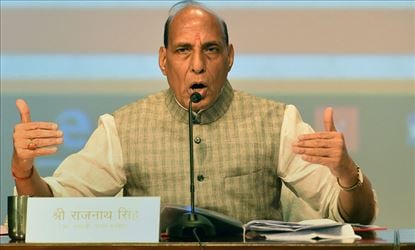

The Opposition's charge that Defence Minister Rajnath Singh misled Parliament on IHG casualties, and the Centre's counter that the claim is 'deliberately misleading,' is not merely a factual dispute — it is, in India Herald's assessment, a proxy battle over war-time transparency norms India has never formally codified, with the monsoon session's entire legislative agenda now hostage to who blinks first.
The 5W+H: Who, What, When, Where, Why, How
- Who: The Opposition (Congress) and Defence Minister Rajnath Singh representing the Centre are in dispute.
- What: The Opposition accuses Defence Minister Rajnath Singh of misleading Parliament by initially stating IHG resulted in zero soldier casualties, while the Centre claims this accusation is deliberately misleading.
- When: Rajnath Singh made the original statement on July 27, 2025, and the Defence Ministry issued its clarification on July 28, 2025.
- Where: The dispute centers on statements made in Parliament regarding IHG, India's military operation.
- Why: The underlying cause is India's lack of formal protocols governing when and how the government must disclose military casualties to Parliament, making this a proxy battle over defining post-strike disclosure rules.
- How: The government initially denied soldier casualties in Parliament; subsequently released the names of fallen soldiers officially, which contradicted the initial statement and triggered the Opposition's accusation of misleading Parliament.
Here is the fact that neither side in this row wants you to focus on: India, a nuclear-armed state that has now conducted at least two major cross-border military operations in a decade, has no publicly known formal protocol — legislative, regulatory, or even customary — governing when and how the government must disclose casualties to Parliament after a military strike. Not a convention. Not a statute. Not even a gentleman's understanding. That assessment, shared by multiple parliamentary-affairs analysts, frames the real stakes of the Sindoor row. The fight over what Rajnath Singh said or did not say about IHG deaths is real and consequential. But the fight underneath it — over who gets to define the rules of post-strike disclosure in the world's largest democracy — is the one that, in our analysis, will outlast this news cycle and shape the monsoon session.
The surface dispute is stark enough. According to The Hindu, Congress has accused Defence Minister Rajnath Singh of misleading Parliament by initially stating that IHG resulted in zero soldier casualties. The charge acquired teeth after the government itself officially released the names of soldiers who died during the operation — an acknowledgment that, the Opposition argues, directly contradicted the original parliamentary assurance.
View on X
The Centre's response, reported by News18, was swift and sharp: the Opposition's claims were branded 'deliberately misleading.' The Defence Ministry issued a formal statement — carried by AIR News on July 28, 2025, as monitored by India Herald — asserting that social media posts had sought to misrepresent the minister's remarks.
View on X
On the face of it, this looks like a familiar parliamentary set-piece — government says one thing, Opposition says another, both sides retreat to their trenches. But spend ten minutes with the parliamentary record and the political calendar, and a different architecture emerges.
The Gap the Opposition Alleges Cannot Be Unseen
Rajnath Singh's original statement — delivered on July 27, 2025, according to multiple accounts including The Hindu — was unambiguous in its framing: no soldier was killed during IHG.
View on XThe subsequent official release of fallen soldiers' names by the same government created what the Opposition calls a credibility gap. The Defence Ministry's clarification, as reported by News18 and AIR News on July 28, 2025, appears to rely on a distinction between casualties 'during the operation' and those sustained in its aftermath — a framing the Centre argues is both accurate and consistent with how military operations are formally delineated. The question Congress is pressing is whether Parliament, as an institution, was given the information it needed to exercise its constitutional function of holding the executive accountable on matters of war and peace.
The Centre's rebuttal on this point deserves full airing. According to News18, senior government sources argued that the minister's statement was accurate as of the operational timeline — that casualties occurred in a subsequent phase, and that releasing names before families were notified would have been irresponsible. The Defence Ministry's formal clarification, per AIR News on July 28, 2025, further contended that Opposition leaders and social media accounts had selectively edited the minister's remarks, stripping context to manufacture a contradiction. The government has also pointed to the operational sensitivity of disclosing casualty figures during an active military confrontation — a concern that, regardless of one's political sympathies, has genuine national-security weight.
This is not a hypothetical concern on either side. India has been here before, in murkier form, after the 2019 Balakot air strikes, when casualty and damage claims were contested for months without any institutional mechanism to settle the record. The difference now is that the Opposition has a paper trail: the government's own published list of the fallen. The Centre contends that paper trail vindicates, rather than contradicts, its position — because the names were released through a deliberate, structured process rather than being hidden.
The Opposition's Real Play: JPC as Leverage
Congress's demand, as reported by The Hindu, is not merely for an apology or a correction. The party is pushing for a Joint Parliamentary Committee to investigate the discrepancy — a demand that, in India Herald's editorial assessment, appears calibrated less for its chances of success (JPC motions in an NDA-majority Parliament rarely succeed) and more for the tactical leverage it creates heading into the monsoon session.
View on X
A JPC demand is a parliamentary privilege play. It forces the ruling side to either concede the investigation — politically unthinkable on a national security matter — or spend session time and political capital blocking it. Either way, the Opposition stands to gain in terms of news-cycle dominance: the story stays on the alleged credibility gap rather than on the government's legislative agenda. For a Congress party that has struggled to find a single issue sticky enough to dominate a full session, this is, in our analysis, close to an ideal weapon — it combines patriotism (honouring the fallen), institutional sanctity (Parliament must not be misled), and a personal target (the Defence Minister himself).
The Centre's Counter-Frame: Demand as Disloyalty
The Centre's counter-charge — that the Opposition is 'deliberately misleading' the public — is itself a carefully constructed frame, and one that carries its own political logic. According to News18, the government's strategy is to cast the demand for a probe not as legitimate oversight but as a manoeuvre that undermines troop morale and national security during a period of heightened border tension. This is the rhetorical territory the BJP has occupied, often successfully, since the Balakot discourse: questioning the government's account of military operations is reframed as questioning the soldiers themselves.
View on X
The frame has structural strengths the Opposition cannot easily dismiss. The Defence Ministry, in its formal clarification, argued that the phased release of casualty information is standard practice in democracies that are mindful of operational security and family notification protocols. Government sources, per News18, also pointed out that the Opposition's own track record on military transparency — including during the UPA years — does not give it clean hands to demand a new standard now. The BJP has further noted that the minister himself made a detailed follow-up statement and that the official casualty list was released proactively, not under duress.
However, this frame faces a specific challenge that did not exist after Balakot. The government itself released the names of the dead. The fallen soldiers are not an Opposition invention — they are an official acknowledgment. The Opposition's argument is that asking 'why did the initial statement say zero when the answer was subsequently not zero?' is a question of parliamentary accountability, not loyalty. Whether the Centre's framing or the Opposition's holds with the broader public — or, critically, with the Speaker and the privileges committee — is, in our editorial judgment, a genuinely open question.
The Missing Architecture: India's Disclosure Void
Step back from the partisan arithmetic, and the structural problem is glaring. Analysts have noted the absence of Indian equivalents to mechanisms that exist in other major democracies: the United States, after decades of its own post-Vietnam disclosure controversies, developed formal after-action reporting channels through which Congress receives classified casualty and operational briefings within defined timelines, with declassification schedules built in. The United Kingdom's post-Chilcot reforms created similar expectations for parliamentary accountability after military action. India, as multiple parliamentary-affairs commentators have observed, has no publicly known comparable protocol. No statute mandates post-strike casualty disclosure to Parliament within any timeframe. No convention governs the level of detail. The minister's word, on the floor, is effectively the entire system — and when that word is subsequently supplemented or revised, there is no institutional mechanism to reconcile the record short of a political confrontation.
This void, it should be noted, is not an accident attributable to one party. Successive governments — including Congress-led ones — have benefited from the ambiguity. Operational secrecy is a legitimate concern, and one the Centre has rightly raised in this instance. But the absence of any structured protocol means, in our analysis, that every future military operation will produce the same cycle: initial claims, subsequent revelations or clarifications, political acrimony, and zero institutional learning. The Sindoor row is not unique — it is simply the loudest iteration of a problem India has chosen not to solve.
The Monsoon Session Calculus
The real stakes are procedural and immediate. The monsoon session carries a heavy legislative calendar — from the Waqf (Amendment) Act implementation to pending GST Council recommendations. The Opposition's ability to stall proceedings using the Sindoor disclosure issue as a daily adjournment demand could, in India Herald's assessment, cost the government dozens of productive hours. The BJP's calculation is equally clear: if it can frame the Opposition's conduct as obstructionist on a national security matter, the political cost shifts. The first week of the session will reveal whether the Speaker permits a structured debate — or whether both sides prefer the theatre of daily disruptions, each blaming the other for the paralysis.
[India Herald Analysis] Watch for two signals. First, whether Congress escalates from a JPC demand to a formal privilege motion against Rajnath Singh — a step that would force the Speaker's hand and raise the temperature considerably. Second, whether the government pre-empts the row by offering a suo motu statement with a more detailed operational timeline, effectively closing the factual gap without conceding a formal inquiry. The BJP has used this tactic before — give enough to defuse the charge, not enough to set a precedent.
The deeper question — whether India will ever establish a formal post-strike disclosure protocol, something approaching the structured briefing mechanisms that exist in the US and UK — remains unanswered. In our assessment, neither party has a strong incentive to institutionalise transparency when both expect to be in power and to benefit from the same ambiguity. The soldiers whose names were eventually released deserve better than a system where their sacrifice becomes visible only when it becomes politically contested. That is not a partisan observation. It is a structural one. And until the structure changes, every future operation risks ending in the same parliamentary confrontation, with the same charges, the same counter-charges, and the same missing rules.



By the Numbers
- India has no publicly known formal statutory or conventional protocol mandating post-strike military casualty disclosure to Parliament within any defined timeframe, according to parliamentary-affairs analysts.
- Rajnath Singh's July 27, 2025 Parliament statement stated zero soldier casualties during IHG, per The Hindu — an account the Opposition alleges was contradicted by the government's subsequent official release of fallen soldiers' names.
Key Takeaways
- Congress accuses Rajnath Singh of misleading Parliament after the government's own official release of IHG fallen soldiers' names appeared to contradict his July 2025 'zero casualties' statement, per The Hindu.
- The Centre called the Opposition's framing 'deliberately misleading' and accused social media of misrepresenting the minister's remarks; the Defence Ministry issued a formal clarification on July 28, 2025, arguing the minister's statement was accurate within the defined operational timeline, according to News18 and AIR News.
- The Opposition is pushing for a Joint Parliamentary Committee probe — a tactical move designed, in India Herald's analysis, to dominate the monsoon session agenda regardless of whether the JPC is actually constituted.
- The Centre's counter-strategy is to frame the JPC demand as undermining troop morale and national security, arguing that phased casualty disclosure is standard practice — though the frame is complicated by the fact that the casualty names came from the government's own records.
- India has no publicly known formal post-strike casualty disclosure protocol for Parliament — unlike mechanisms in the US and UK — leaving every future military operation vulnerable to the same political cycle, as multiple parliamentary-affairs analysts have noted.
Frequently Asked Questions
Did Rajnath Singh say there were zero casualties in IHG?
According to The Hindu, Rajnath Singh stated in Parliament on July 27, 2025, that no soldier was killed during IHG. The government subsequently released an official list of soldiers who died during the operation, creating what the Opposition alleges is a factual discrepancy. The Defence Ministry's clarification on July 28, 2025, argued that the minister's statement was accurate within the defined operational timeline.
What is the Opposition demanding over the IHG casualty dispute?
Congress and Opposition parties are demanding a Joint Parliamentary Committee (JPC) probe into the discrepancy between Rajnath Singh's parliamentary statement and the government's subsequent acknowledgment of casualties, as reported by The Hindu.
How has the Centre responded to allegations about IHG casualties?
The Centre called the Opposition's claims 'deliberately misleading.' The Defence Ministry issued a formal statement on July 28, 2025 — carried by AIR News and reported by News18 — asserting that social media posts had misrepresented the minister's remarks and that the phased release of casualty information followed standard protocols for operational security and family notification.
Does India have a formal protocol for disclosing military casualties to Parliament?
No publicly known formal protocol exists. Analysts have noted the absence of Indian equivalents to the US after-action congressional briefing model or UK post-Chilcot reforms that mandate structured post-strike disclosure to the legislature within defined timeframes.
How could the IHG dispute affect the monsoon session of Parliament?
The Opposition can use the issue to demand daily adjournments, potentially stalling the government's legislative agenda. The BJP's counter-strategy, per News18, is to frame any questioning as undermining national security, shifting the political cost to the Opposition. In India Herald's analysis, the first week of the session will be decisive.
 click and follow Indiaherald WhatsApp channel