
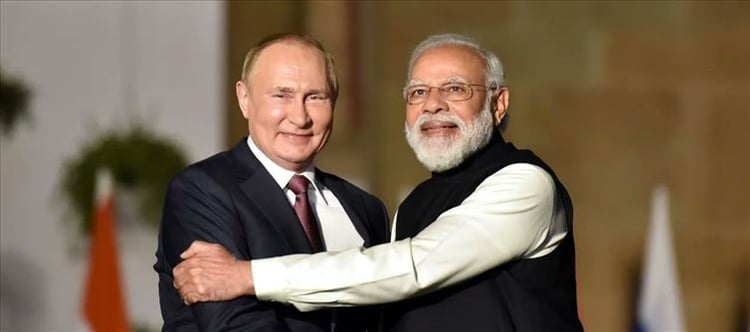


Russia has offered Pakistan a significant oil supply agreement as Hormuz Strait disruptions threaten traditional Middle East energy routes. According to Live Hindustan, the deal arrives precisely as India deepens its US strategic tilt — raising the question of whether Moscow is deliberately diversifying its South Asian leverage to signal displeasure with New Delhi's evolving alignment.
The 5W+H: Who, What, When, Where, Why, How
- Who: Russian President Vladimir Putin and the Pakistani government, with India as the indirect strategic target.
- What: A Russia-Pakistan oil deal — an MoU for crude supply — signed amid Hormuz Strait disruptions, according to Live Hindustan.
- When: Mid-2026, as the Hormuz chokepoint faces active disruption from regional tensions involving Iran and US naval posturing.
- Where: The deal's diplomatic groundwork was laid in Moscow, with energy deliveries aimed at Pakistan; the strategic fallout radiates across South Asia and the Persian Gulf.
- Why: Moscow appears to be hedging its South Asian relationships as India tilts closer to Washington through defence pacts, Quad engagement, and energy diversification away from Russian crude.
- How: Through a government-to-government MoU for discounted crude supply to Pakistan, leveraging pipeline and maritime logistics that bypass the choked Hormuz corridor, as reported by Live Hindustan.
Here is a thought experiment for the strategic planners in South Block: you spend three years carefully building an energy relationship with Russia — buying discounted Urals crude when the West slapped sanctions, offering Moscow a diplomatic lifeline when it needed one most — and then, just as you begin leaning toward Washington in ways the Kremlin notices, Vladimir Putin picks up the phone and offers your neighbour the same deal. Not because Pakistan asked first. Because Moscow wanted you to see.
That, stripped of diplomatic niceties, is the signal embedded in the Russia-Pakistan oil MoU that has surfaced in mid-2026, reported by Live Hindustan, against the backdrop of a Hormuz Strait crisis that has already sent Brent past uncomfortable thresholds and left India's petroleum ministry scrambling for alternative supply corridors.
The Deal on the Table
The mechanics are straightforward, even if the politics are anything but. According to Live Hindustan, Russia has extended Pakistan a formal offer for crude oil supply — a government-to-government memorandum of understanding — precisely at the moment when the Strait of Hormuz, through which roughly 20 per cent of the world's oil transits daily, faces sustained disruption. Iran's brinksmanship with the United States, which has included veiled threats to restrict Hormuz passage as leverage in nuclear negotiations, has created the exact kind of supply anxiety that makes a Russian crude lifeline look irresistible to energy-starved Islamabad.
Pakistan, whose foreign exchange reserves have lurched from crisis to crisis for the better part of four years, is in no position to refuse discounted crude from any quarter. The MoU is, in one sense, a marriage of desperation — Pakistan needs cheap oil, and Russia needs buyers willing to absorb volumes that European sanctions have redirected eastward.
View on X
But necessity, as any student of great-power diplomacy will tell you, is the mother of leverage. And what makes this deal more than a bilateral commodity arrangement is the timing, the context, and the audience it is designed for.
The Audience Is New Delhi
India's strategic tilt toward the United States has accelerated visibly over the past eighteen months. Defence procurement agreements, expanded Quad naval exercises, intelligence-sharing frameworks, and — critically — a quiet but measurable reduction in Russian crude purchases as Indian refiners diversify toward Middle Eastern, African, and American sources. Moscow has watched each of these moves with the studied patience of a power that has long regarded India as its most reliable Asian partner.
The Russia-Pakistan oil MoU is, in India Herald's assessment, the first concrete signal that Moscow's patience has a shelf life. It is not, to be clear, an act of hostility — Russia is not arming Pakistan or offering nuclear technology. It is something more subtle and, for New Delhi, potentially more dangerous: it is Moscow demonstrating that India's privileged position in Russia's South Asian calculus is not a birthright. It can be shared. It can be diluted. And it can be redirected toward the one neighbour whose interests most directly compete with India's.
Political Pulse
The corridor talk in Lutyens' Delhi this week carries an unusual edge. Senior officials in the Ministry of External Affairs, according to informed observers tracking the diplomatic circuit, are privately acknowledging that the Russia-Pakistan MoU was not entirely unexpected — but its timing, amid the Hormuz crisis, has landed harder than anticipated. The whisper in South Block, as one analyst familiar with the ministry's mood put it, is that "Moscow is not punishing us; it is reminding us that we are not irreplaceable."
Within the BJP's national security establishment, the dominant view is reportedly that the deal is a negotiating tactic — a pressure card Putin is playing ahead of expected Modi-Putin bilateral talks later this year. The calculation, per this reading, is that Russia wants India to slow its US tilt, not reverse it, and the Pakistan card is simply the most efficient way to deliver that message.
But there is a counter-view circulating among opposition foreign policy thinkers and a handful of retired diplomats: that India has fundamentally miscalculated the speed at which Moscow would respond to the US alignment, and that the Pakistan MoU is not the pressure card — it is the first move in a longer game of Russian re-engagement with the Pakistan-China axis that could materially alter South Asia's strategic geometry.
View on X
Neither reading is comfortable for New Delhi. The first implies that India's foreign policy freedom — the vaunted "multi-alignment" — has a price Moscow is now willing to name. The second implies that the price has already been paid, and India is playing catch-up.
The Hormuz Squeeze Compounds Everything
Strip away the Russia-Pakistan dimension for a moment, and India's energy predicament is already severe. The Hormuz Strait crisis — driven by Iran's calculated risk of threatening passage to maintain leverage in its nuclear talks with the United States — has exposed a vulnerability that Indian policymakers have discussed for decades but never fully addressed: roughly 60 per cent of India's crude oil imports transit through this single chokepoint.
View on X
When Hormuz is stable, this concentration is a manageable risk. When it is not — as in mid-2026 — it becomes an existential one. Every disrupted tanker, every insurance premium spike, every day of uncertainty feeds directly into India's current account deficit, its fuel subsidy burden, and ultimately, the price a household in Varanasi or Visakhapatnam pays for cooking gas.
Russia's offer to Pakistan must be read against this backdrop. Moscow is not merely selling oil to Islamabad; it is demonstrating, to every energy-insecure country in South Asia, that it can offer a supply corridor that does not depend on the Strait of Hormuz. That is a strategic asset of enormous value in 2026 — and Russia is choosing to share it with Pakistan first.
What India Should Be Watching Next
The forward dimension of this story is where the real stakes accumulate. Three developments in the coming weeks will reveal whether the Russia-Pakistan MoU is a tactical signal or a structural shift:
First, watch the pricing. If Russia offers Pakistan crude at discounts comparable to what India received during the post-2022 sanctions era — roughly $15-20 below Brent — it suggests Moscow is genuinely investing in a new energy relationship, not merely posturing. If the discount is marginal, the MoU is theatre.
Second, watch the logistics. Delivering Russian crude to Pakistan at scale requires either a new pipeline corridor through Central Asia (expensive, slow, politically fraught) or maritime shipments that bypass Hormuz via alternative routes. The feasibility of the latter depends on Iranian cooperation — which loops this deal back into the broader Hormuz-Iran-US triangle in ways that could either stabilise or further destabilise the region.
View on X
Third, watch Modi's next conversation with Putin. If the bilateral is brought forward, or if India's crude purchases from Russia suddenly tick upward in the weeks after the MoU, the signal will be clear: New Delhi got the message, and is recalibrating. If there is silence, or if the US tilt accelerates further, the Russia-Pakistan energy axis could quietly deepen into something far more consequential than a single MoU.
The Deeper Game
There is a tendency in Indian strategic commentary to treat every Russian move toward Pakistan as a betrayal — a violation of some implied Cold War-era compact. That framing is dangerously outdated. Russia in 2026 is not the Soviet Union. It is a power under sustained Western pressure, actively seeking buyers for its energy, partners for its geopolitical balancing act, and leverage wherever it can find it. India, by leaning toward the US, has voluntarily reduced its value in that calculus. Moscow is simply adjusting its portfolio.
The real question — the one that should keep South Block awake, and the one that no amount of diplomatic reassurance from either side can fully answer — is whether India can sustain its US tilt and its Russian relationship simultaneously, or whether the Hormuz crisis and the Pakistan MoU have just revealed that the era of cost-free multi-alignment is over.
If you are an Indian voter, a taxpayer, or simply someone who fills a cooking gas cylinder every month, that question is not abstract. It is the question that will determine what you pay at the pump, how secure your energy supply is, and whether the country you live in still has the strategic room to choose its own friends — or whether the friends have started choosing for it.
By the Numbers
- Roughly 60% of India's crude oil imports transit through the Strait of Hormuz, a chokepoint now facing active disruption in mid-2026.
- Post-2022 sanctions-era Russian crude discounts to India were approximately $15-20 below Brent benchmark prices — the discount Russia offers Pakistan will be a key indicator of strategic intent.
- Approximately 20% of global daily oil supply transits through the Strait of Hormuz, making it the world's most critical energy chokepoint.
Key Takeaways
- Russia's oil MoU with Pakistan is timed to coincide with the Hormuz Strait crisis and India's visible tilt toward the US — a combination that makes it a strategic signal, not just a commodity deal.
- India Herald's read is that Moscow is not punishing New Delhi but demonstrating that India's privileged energy relationship with Russia is negotiable and can be shared with its principal rival.
- Roughly 60% of India's crude imports transit through the Hormuz chokepoint — the crisis exposes a decades-old vulnerability that Russia is now exploiting by offering Pakistan an alternative supply corridor.
- The next weeks are pivotal: the pricing Russia offers Pakistan, the logistics of delivery, and the tone of the next Modi-Putin bilateral will reveal whether this is a tactical warning or a structural realignment of South Asia's energy geometry.
- India's vaunted multi-alignment foreign policy faces its sharpest test yet — the era of leaning toward Washington without cost may be ending.
Frequently Asked Questions
What is the Russia-Pakistan oil deal announced in 2026?
According to Live Hindustan, Russia has offered Pakistan a government-to-government MoU for crude oil supply, timed amid the Hormuz Strait crisis that has disrupted traditional Middle Eastern energy routes for South Asian importers.
Why is Russia offering Pakistan oil now?
The deal arrives as India visibly deepens its strategic alignment with the United States — through defence pacts, Quad engagement, and reduced Russian crude purchases. Analysts suggest Moscow is signalling that India's energy privileges are not unconditional.
How does the Hormuz Strait crisis affect India's oil supply?
Roughly 60% of India's crude imports transit through the Strait of Hormuz. Iran's threats to restrict passage as leverage in US nuclear talks have spiked insurance costs and created acute supply uncertainty for Indian refiners.
Does this deal mean Russia is abandoning India?
Not immediately. India Herald's assessment is that Moscow is demonstrating leverage rather than severing ties — the MoU is likely a negotiating card ahead of expected Modi-Putin bilateral talks. However, if India's US tilt accelerates without recalibration, the Russia-Pakistan energy relationship could deepen structurally.
What should Indian policymakers watch for next?
Three indicators: the crude pricing Russia offers Pakistan (deep discounts signal genuine investment), the logistics of delivery (pipeline vs. maritime routes bypassing Hormuz), and the tone and timing of the next Modi-Putin bilateral conversation.


 click and follow Indiaherald WhatsApp channel