
-

Army
-
Assembly
-
Beijing
-
Bharatiya Janata Party
-
Bobby
-
Box office
-
China
-
citizenship amendment act
-
Delhi
-
East
-
Election
-
Event
-
Hanu Raghavapudi
-
India
-
Indian
-
Indians
-
INTERNATIONAL
-
June
-
local language
-
malavika mohanan
-
Mamata Benerjee
-
media
-
Mohan
-
Panama
-
politics
-
Population
-
Press
-
Punjabi
-
raja
-
READ
-
REVIEW
-
social media
-
TDP
-
WATCH
-
West Bengal - Kolkata

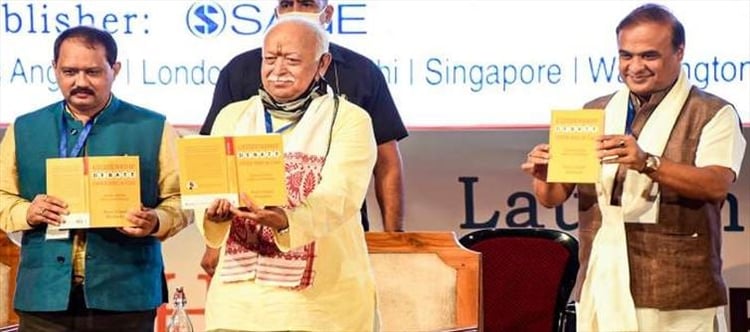
RSS chief Mohan Bhagwat declared that people who came to India after the 1947 Partition were not refugees but 'warriors of struggle,' according to ThePrint and Dainik Jagran. India Herald's read is that this language shift is a deliberate attempt to reframe the moral and political vocabulary around post-Partition Hindu migration, strengthening the ideological scaffolding beneath CAA-NRC ahead of crucial elections.
The 5W+H: Who, What, When, Where, Why, How
- Who: RSS Sarsanghchalak Mohan Bhagwat, speaking at a public event honouring displaced communities, according to ThePrint and PTI.
- What: Bhagwat stated that people who migrated to India after the 1947 Partition were 'warriors of struggle' (sangharsh ke yoddha), not refugees (sharanarthi), as reported by Dainik Jagran and ThePrint.
- When: The remarks were made in late June 2025, per PTI reports and Dainik Jagran's coverage.
- Where: India; Bhagwat was addressing a gathering focused on displaced communities, according to ThePrint.
- Why: The reframing elevates post-Partition Hindu migrants from passive victims to active claimants of nationhood, strengthening the ideological case for CAA-linked citizenship and the RSS's broader Hindutva narrative, according to India Herald's political analysis.
- How: By substituting 'warrior' for 'refugee' in official RSS discourse, Bhagwat creates a moral hierarchy of migration — those who chose India out of civilisational commitment versus those who merely fled — which aligns with the legal architecture of CAA that distinguishes persecuted minorities from other migrants, as analysed by India Herald.
A single word, swapped in a single speech, and the entire architecture of belonging tilts. RSS Sarsanghchalak Mohan Bhagwat did not stumble into his vocabulary when he declared that people who came to India after the 1947 Partition were not refugees — sharanarthi — but warriors of struggle, sangharsh ke yoddha. According to ThePrint and PTI, Bhagwat made the remarks at a public event honouring displaced communities, praising the resilience and sacrifice of those who crossed the new border into India nearly eight decades ago.
View on X
On the surface, this sounds like a tribute. A warm nod to grandparents who rebuilt lives from the wreckage of Partition. But in the RSS's deeply deliberate lexicon — where every phrase is road-tested in shakhas before it reaches a microphone — this is not sentiment. It is strategy. And the strategy is aimed squarely at the most contested frontier in Indian politics today: who belongs, who deserves to belong, and on what moral terms.
The Word That Does the Heavy Lifting
Consider what the word 'refugee' carries. It implies victimhood, dependence, the need for another's charity. International law defines a refugee as someone who has fled persecution and seeks protection — a supplicant. For decades, post-Partition Hindu migrants, particularly in West Bengal, have lived under that label. The Matua community — roughly 30 lakh voters, overwhelmingly Namasudra Dalits who migrated from East Pakistan — has organised its entire political identity around the demand to move beyond that label, to be recognised as full citizens rather than permanent guests in the country they chose.
Now, Bhagwat hands them something far more potent. A warrior is not a guest. A warrior chose. A warrior's claim to the land is earned through sacrifice, not granted through pity. According to Dainik Jagran, Bhagwat specifically praised the sangharsh — the struggle — of those who came, framing migration not as flight but as an act of civilisational commitment. That single rhetorical move does three things at once: it dignifies the migrant, it implies a hierarchy among different kinds of migrants, and it lays moral groundwork that maps perfectly onto the legal architecture of the Citizenship Amendment Act.
View on X
Political Pulse
Here is what the press release will not tell you. In the corridors where RSS pracharaks and BJP strategists trade notes, the talk — according to political observers tracking Sangh-BJP coordination — is that the 'warrior' framing is being quietly tested as a campaign-ready vocabulary for states where post-Partition Hindu migration is an electoral fault-line. Bengal is the obvious theatre. The Matua vote has swung between the TMC and the BJP for three election cycles, and the community's central grievance — citizenship and dignity — remains unresolved despite CAA's passage. CAA rules were notified in 2024, but on-the-ground implementation, particularly the actual granting of citizenship to applicants, has moved at a pace that has left Matua leaders publicly frustrated.
The whisper in BJP circles, say analysts tracking the party's Bengal outreach, is that 'warrior' is the word that converts CAA from a bureaucratic process into an emotional covenant. You do not make a warrior wait in a queue; you honour a warrior's claim. The framing pressures the Centre to accelerate implementation while simultaneously giving BJP leaders a vocabulary that transcends the defensive posture they have been stuck in — explaining CAA's fine print — and replaces it with an offensive, pride-based pitch.
But Bengal is not the only map this touches. Sindhi and Punjabi Hindu communities — dispersed across Rajasthan, Gujarat, Maharashtra, and Delhi — carry their own Partition memories. For Sindhis, who lost an entire homeland with no princely state to absorb them, the 'warrior' label is an identity salve that the BJP has never quite managed to offer before. For Punjabi Hindus who crossed the Radcliffe Line, it reframes the trauma as triumph. In each case, the political dividend is the same: emotional consolidation of communities whose votes the BJP already largely holds, but whose intensity of loyalty can be dialled higher.
View on X
The Hierarchy Nobody Is Saying Out Loud
India Herald's read of what is really driving this is the unstated corollary of Bhagwat's framing — and this is the dimension the rest of the coverage is not examining closely enough. If post-Partition Hindu migrants are 'warriors', then what are other migrants? What are Rohingya refugees? What are Bangladeshi Muslims who crossed the border in subsequent decades? The 'warrior' label does not exist in a vacuum; it creates a moral gradient. Warriors are above refugees. And refugees, in this ordering, are above infiltrators.
This maps with uncomfortable precision onto the CAA-NRC architecture. CAA distinguishes persecuted religious minorities (Hindus, Sikhs, Buddhists, Jains, Parsis, Christians) from Muslim migrants from the same three countries (Pakistan, Bangladesh, Afghanistan). The legal framework creates a formal hierarchy of eligibility. Bhagwat's vocabulary now gives that hierarchy a moral and emotional spine. A warrior's child does not need to prove they belong; their very presence is proof of civilisational allegiance. A 'refugee' — or, worse, an undocumented entrant without the warrior's moral halo — sits lower on the ladder.
This is not an academic distinction. It has consequences for how courts, bureaucrats, and most importantly voters, think about citizenship claims. When the NRC's National Register is eventually implemented — and the RSS has never walked back its demand for a nationwide NRC — the question of who counts as a legitimate resident will come down to exactly this kind of moral framing. Warriors get the benefit of the doubt. Others do not.
View on X
The Legal Language India Is Still Fighting Over
It is worth noting — sharply — that Indian law does not use the word 'warrior' anywhere in its citizenship framework. The Citizenship Act, 1955, amended by CAA in 2019, speaks of 'illegal migrants', 'persons of Indian origin', and now the specific religious communities covered by the amendment. The Constitution's Article 5-11, which governed citizenship at the founding, used the language of domicile and registration — bloodless, procedural terms designed to avoid exactly the kind of emotional hierarchy Bhagwat is constructing.
That procedural neutrality was deliberate. The Constituent Assembly, which included members who had themselves crossed the Partition line, chose bureaucratic language precisely because they understood the danger of ranking citizens by the emotional intensity of their arrival. Bhagwat's intervention — whether he intends it or not — is a direct challenge to that constitutional restraint. He is proposing a moral vocabulary that sits above the legal one, and in Indian politics, the moral vocabulary almost always wins the longer war.
What Comes Next — The Forward Read
Watch for three things in the weeks ahead. First, whether BJP leaders in Bengal — particularly those managing the Matua outreach — begin adopting the 'warrior' framing in their public language. If they do, it will confirm that this was a coordinated vocabulary rollout, not an off-the-cuff remark. Second, watch for RSS-affiliated publications and social media channels amplifying the 'yoddha' framing around CAA implementation stories — the speed of adoption will reveal how much organisational weight is behind this. Third, and most importantly, watch for the Opposition's response. The TMC's Mamata Banerjee has walked a tightrope on Matua citizenship for years, promising what she cannot constitutionally deliver at the state level; the 'warrior' framing forces her to either match the emotional register or look like she is diminishing the community's struggle. Neither option is comfortable.
If this holds — if 'warrior' replaces 'refugee' in the Sangh's working vocabulary — the implications stretch well beyond Bengal. It sets the rhetorical table for a nationwide NRC debate in which the RSS has already defined who sits at the head. It creates a pre-built emotional defence for CAA against legal challenges that argue the law discriminates by religion. And it gives BJP candidates in every state with a significant post-Partition migrant community a one-word pitch that does more work than a hundred policy documents.
One word. That is all it takes to rewrite who belongs. The question India has not yet answered — the question Bhagwat is betting no one will ask in time — is this: once you rank citizens by the nobility of their arrival, where exactly do you stop?
By the Numbers
- The Matua community comprises roughly 30 lakh voters in West Bengal, predominantly Namasudra Dalits who migrated from East Pakistan after Partition, making them the single largest post-Partition migrant vote bloc in Indian electoral politics.
- CAA 2019 covers six religious communities — Hindus, Sikhs, Buddhists, Jains, Parsis, and Christians — from three countries (Pakistan, Bangladesh, Afghanistan), creating a formal legal hierarchy of eligibility among migrants.
Key Takeaways
- Bhagwat's 'warrior' framing is a deliberate RSS vocabulary shift that elevates post-Partition Hindu migrants from passive recipients of shelter to active claimants of nationhood, directly strengthening the moral case for CAA-NRC.
- The reframing creates an unstated hierarchy of belonging — warriors above refugees above 'infiltrators' — that maps onto CAA's legal architecture distinguishing persecuted minorities from other migrants.
- The immediate political target is Bengal's Matua community (~30 lakh voters), but the framing also consolidates Sindhi and Punjabi Hindu identity politics across Rajasthan, Gujarat, Maharashtra, and Delhi.
- The Constitutional Assembly deliberately chose procedural, emotionless citizenship language to avoid ranking citizens by the intensity of their arrival — Bhagwat's moral vocabulary challenges that founding restraint.
- Watch for BJP Bengal leaders and RSS media channels adopting the 'yoddha' framing around CAA stories in coming weeks — adoption speed will reveal whether this was a coordinated rollout or a standalone remark.
Frequently Asked Questions
What exactly did Mohan Bhagwat say about Partition migrants?
According to ThePrint and PTI, RSS chief Mohan Bhagwat said that people who came to India after the 1947 Partition were not refugees (sharanarthi) but 'warriors of struggle' (sangharsh ke yoddha), praising their resilience and sacrifice at a public event honouring displaced communities.
How does Bhagwat's 'warrior' framing connect to CAA and NRC?
The Citizenship Amendment Act distinguishes persecuted religious minorities from other migrants, creating a legal hierarchy of eligibility. Bhagwat's 'warrior' label gives that hierarchy a moral and emotional dimension — elevating post-Partition Hindu migrants above other claimants and potentially strengthening the ideological case for both CAA implementation and a future nationwide NRC.
Which voter communities are most affected by this reframing?
The most immediate impact is on West Bengal's Matua community (~30 lakh voters), Namasudra Dalits who migrated from East Pakistan and have demanded full citizenship recognition. Sindhi and Punjabi Hindu communities across Rajasthan, Gujarat, Maharashtra, and Delhi — who carry their own Partition displacement narratives — are also likely targets of this vocabulary shift.
Does Indian citizenship law use the word 'warrior' or create a moral hierarchy of migrants?
No. The Citizenship Act, 1955 and the Constitution's Articles 5-11 use procedural terms like 'illegal migrant', 'person of Indian origin', and domicile-based criteria. The Constituent Assembly deliberately chose emotionless legal language to avoid ranking citizens by the nature of their arrival — Bhagwat's framing challenges that constitutional restraint by proposing a moral vocabulary that sits above the legal one.




 click and follow Indiaherald WhatsApp channel