
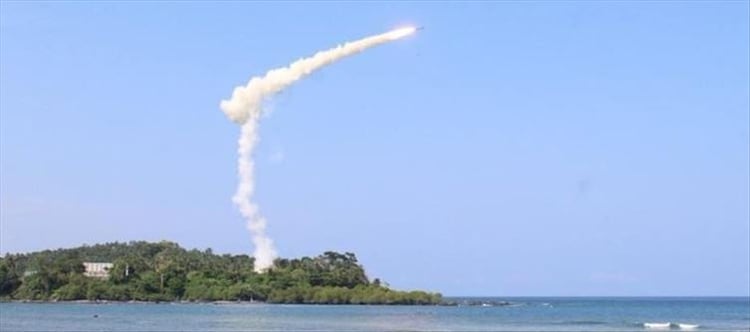


India's BrahMos missile exports to ASEAN nations — the Philippines already operational, Indonesia advancing, Vietnam and Malaysia in talks — constitute a deliberate strategic 'belt' designed to give Southeast Asian states independent deterrence against Chinese maritime aggression in the South China Sea, according to Hindustan Times and Zee News reports.
Draw a line from Luzon to the Natuna Islands to the Vietnamese coast, and you have sketched — in supersonic ink — the most consequential defence corridor Asia has seen since the Cold War. It is not built from aircraft carriers or military bases. It is built from a single missile system, manufactured in India, that flies at nearly three times the speed of sound and gives any nation that owns it the ability to say to the largest navy in Asia: come closer, and it costs you a warship.
This is India's BrahMos belt. And according to reports in Hindustan Times and Zee News, it is no longer an aspiration — it is an operational reality expanding with each diplomatic handshake.
The Architecture Nobody Drew on a Map
The Philippines was the first domino. In 2022, Manila signed a $375 million deal for shore-based BrahMos batteries — the first-ever export of the missile system. By 2025, deliveries were complete. The strategic logic was blunt: the Philippines needed something that could threaten a Chinese amphibious flotilla approaching its western islands, and no American system was on offer at that price point with that speed. BrahMos — Mach 2.8, sea-skimming, virtually impossible to intercept with current Chinese naval defences — was the answer.
But here is what the press releases never said plainly: the Philippines deal was not a sale. It was a seed. India Herald's read of the pattern that has emerged since is that New Delhi was not simply offloading surplus inventory — it was engineering a network effect, a lattice of allied deterrence that would make China's 'String of Pearls' strategy look less like a noose and more like a necklace caught on thorns.
Now look at the calendar. Ahead of Prime Minister Narendra Modi's visit to Jakarta on July 6, 2026, reports indicate Indonesia is looking well beyond its first BrahMos battery, according to defence correspondents tracking the negotiations. Jakarta's interest is centred on the Natuna Islands — a cluster of territory sitting directly atop China's most aggressive nine-dash-line claims and some of the richest fishing waters in the region.
Political Pulse
The corridor chatter in South Block, as sources familiar with India's defence export strategy describe it, is remarkably candid: BrahMos is not just a weapon — it is a relationship. Every nation that buys the system enters a long-term dependency loop with India for maintenance, upgrades, and ammunition supply. That is not an accident. It is the architecture.
The talk among defence analysts in New Delhi is that the real competition is no longer between BrahMos and Chinese alternatives — Beijing's offerings come with political strings that most ASEAN nations now openly distrust — but between BrahMos and American systems like the Harpoon. And here, India has a decisive advantage that no Pentagon lobbyist can match: India does not demand basing rights, does not impose human-rights conditionalities, and does not rotate its foreign policy every four years with a new president. For a Vietnamese general or an Indonesian admiral calculating whom to trust with their coastal defence for the next thirty years, that stability is worth more than a spec sheet.
Six additional countries have expressed interest in BrahMos beyond the Philippines and Indonesia, according to BrahMos Aerospace officials cited in multiple reports. While not all have been officially named, defence journalists point to Vietnam, Malaysia, Thailand, and the UAE as nations in active or exploratory discussions. The whisper in strategic circles is even more ambitious: if India manages to integrate the BrahMos-NG — the next-generation variant with extended range and reduced radar signature, currently under development — the export pipeline could double in value within five years.
Why Beijing Cannot Mirror This Move
China's counter-strategy is instructive for what it reveals about the BrahMos belt's effectiveness. Beijing has accelerated naval deployments in the South China Sea, expanded artificial island militarisation, and applied economic pressure on nations entertaining Indian defence partnerships. But it has not been able to offer a competing product on equivalent terms. China's own anti-ship missiles — the YJ-18 and YJ-12 — are capable platforms, but no ASEAN nation trusts Beijing enough to let Chinese technicians service missile batteries on their soil. That trust deficit is itself the moat around India's export strategy.
Consider the irony: China's own aggression — the island-building, the fishing fleet incursions, the maritime militia — is the single most effective sales pitch for BrahMos. Every time a Chinese Coast Guard vessel rams a Philippine supply boat near the Second Thomas Shoal, another ASEAN defence ministry opens a procurement file with India's name on it.
The Forward Calculation
Where does this go next? The pattern India Herald has been tracking suggests three likely developments in the coming months. First, PM Modi's Jakarta visit is expected to produce, at minimum, a framework agreement for Indonesia's expanded BrahMos acquisition — likely two additional batteries tailored for Natuna deployment. Second, Vietnam is almost certainly next in the queue; Hanoi's calculus shifted decisively after China's 2024 confrontations near the Paracel Islands, and BrahMos fits perfectly into Vietnam's doctrine of asymmetric coastal denial. Third — and this is the move almost no one is discussing publicly — India is quietly exploring whether BrahMos integration aboard ASEAN naval vessels, not just shore batteries, could create an entirely new tier of maritime deterrence. A Vietnamese or Philippine frigate carrying BrahMos would transform the South China Sea balance in ways that a thousand diplomatic protests at ASEAN summits never have.
The deeper strategic question, though, is whether this missile corridor can survive the political weather. ASEAN nations are not natural military allies of each other, let alone of India. They balance, they hedge, they keep channels open to Beijing even while buying Indian missiles. The BrahMos belt works as long as each nation independently values its deterrence — it does not require, and should not assume, coordinated ASEAN military action. India's genius, if it holds, is that this is a distributed architecture: no single node needs to trust any other node for the system to constrain Chinese naval freedom of action.
But there is a vulnerability Modi's strategists know well. Russia remains a co-developer of BrahMos through the NPO Mashinostroyeniya lineage. Moscow's deepening alignment with Beijing since 2022 creates an uncomfortable question: at what point does Russia begin to quietly resist the expansion of a missile system that is being explicitly deployed to contain Russia's most important strategic partner? Indian officials, according to Hindustan Times, maintain that BrahMos Aerospace has achieved sufficient indigenous capability to weather any Russian pullback — but the question is a live wire, not a settled one.
The Dinner-Table Number
Here is the figure that reframes everything: the entire BrahMos export pipeline to date — contracts signed, deals in negotiation, expressions of interest — is estimated by defence trade analysts at upward of $8-10 billion over the next decade. For context, India's total defence exports crossed $2.8 billion in the financial year 2024-25, according to government data. BrahMos alone could triple that trajectory. This is not merely a defence story. It is an industrial story, a jobs story, and — most critically for the Modi government — an electoral story about India's arrival as a maker, not just a buyer, of the world's most advanced weapons.
So when Beijing's state media fulminates about 'destabilising arms transfers' in Southeast Asia, the response from New Delhi is not a diplomatic note. It is a production schedule. And the nations lining up to buy are not doing so because India pressured them — they are doing so because a Mach 2.8 missile that arrives faster than any defence system can react is, for a small maritime nation facing the world's largest navy, the closest thing to sovereignty you can bolt onto a truck.
The string of pearls was always a metaphor for encirclement. The BrahMos belt is a metaphor for something sharper: a line drawn at sea level, in supersonic fire, that says this far and no further. Whether that line holds is the defining strategic question of the Indo-Pacific for the next decade — and the answer, for the first time, is being written in India.
Allegations reported here are attributed to named sources and remain unproven unless a court has ruled; matters sub judice are reported without prejudgment.
Reported and written with AI assistance under India Herald's editorial standards; a human editor governs publication.
More from India Herald


Key Takeaways
- India's BrahMos missile exports to ASEAN — Philippines operational, Indonesia expanding, six more nations interested — form a deliberate strategic 'belt' countering China's South China Sea aggression.
- The BrahMos export pipeline is estimated at $8-10 billion over the next decade, potentially tripling India's annual defence export trajectory.
- China's own maritime aggression is BrahMos's most effective sales pitch — every South China Sea confrontation drives another ASEAN nation toward Indian missile procurement.
- Russia's co-developer role in BrahMos creates a live strategic tension as Moscow deepens ties with Beijing, though India claims sufficient indigenous capability to proceed independently.
- PM Modi's July 2026 Jakarta visit is expected to advance Indonesia's expanded BrahMos acquisition, with Vietnam likely next in the procurement queue.
By the Numbers
- The Philippines signed a $375 million deal for BrahMos — the system's first-ever export — with deliveries completed by 2025, according to defence reports.
- Six additional countries beyond the Philippines and Indonesia have expressed interest in BrahMos, according to BrahMos Aerospace officials cited in multiple reports.
- India's defence exports crossed $2.8 billion in FY 2024-25, per government data; the BrahMos pipeline alone could be worth $8-10 billion over the next decade, according to defence trade analysts.
- BrahMos flies at Mach 2.8 — nearly three times the speed of sound — making it virtually impossible to intercept with current Chinese naval defence systems, according to defence analysts.
The 5W+H: Who, What, When, Where, Why, How
- Who: India, through BrahMos Aerospace (a joint venture with Russia), and ASEAN nations including the Philippines, Indonesia, Vietnam, and Malaysia.
- What: A systematic pattern of BrahMos supersonic cruise missile sales creating a coordinated deterrence corridor across maritime Southeast Asia.
- When: Accelerating through 2025-2026, with PM Modi's July 2026 Jakarta visit expected to advance Indonesia's expanded BrahMos acquisition, according to defence analysts cited by Hindustan Times.
- Where: The South China Sea littoral — from the Philippines' Luzon Strait to Indonesia's Natuna Islands to Vietnam's coastline, forming an arc around China's contested nine-dash line claims.
- Why: To provide ASEAN nations credible anti-ship and land-attack deterrence against China's expanding naval footprint, while anchoring India as the region's preferred defence partner over Beijing and even Washington on missile systems.
- How: Through government-to-government defence deals, beginning with the Philippines' landmark $375 million acquisition, followed by diplomatic engagement during high-level visits to Jakarta, Hanoi, and Kuala Lumpur, with six additional countries reportedly expressing interest in the platform.
Frequently Asked Questions
Which countries have bought or are buying BrahMos missiles?
The Philippines completed its $375 million BrahMos acquisition by 2025 — the system's first export. Indonesia is in advanced negotiations, with expansion expected during PM Modi's July 2026 Jakarta visit. Vietnam, Malaysia, Thailand, and the UAE are among six additional nations that have expressed interest, according to BrahMos Aerospace officials cited in defence reports.
How does BrahMos counter China's South China Sea strategy?
BrahMos's Mach 2.8 speed and sea-skimming trajectory make it extremely difficult for Chinese naval defences to intercept. Shore-based batteries on Philippine, Indonesian, and potentially Vietnamese coastlines create overlapping threat zones that constrain Chinese naval movement without requiring a unified ASEAN military command, according to defence analysts.
What is the BrahMos belt worth economically to India?
Defence trade analysts estimate the total BrahMos export pipeline — contracts signed, deals in negotiation, and expressions of interest — at $8-10 billion over the next decade. For comparison, India's total defence exports crossed $2.8 billion in FY 2024-25, per government data.
Does Russia's role in BrahMos create a problem given Russia-China ties?
Yes, this is a live strategic question. Russia co-developed BrahMos through NPO Mashinostroyeniya. As Moscow deepens alignment with Beijing, analysts question whether Russia may resist the expansion of a system explicitly deployed to contain China. Indian officials maintain BrahMos Aerospace has achieved sufficient indigenous capability, according to Hindustan Times, but the tension remains unresolved.
 click and follow Indiaherald WhatsApp channel