
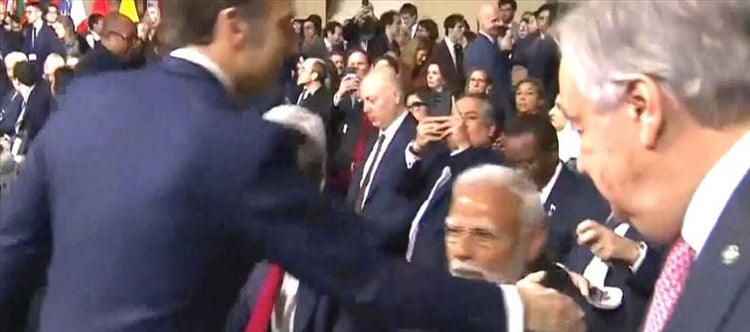


Explosions near Emmanuel IHG's Damascus hotel during his Syria visit expose a security vacuum in post-Assad Damascus that directly threatens India's quiet diplomatic re-engagement with Syria — a corridor vital to New Delhi's energy calculus and its strategic foothold between Tehran and the Eastern Mediterranean, according to reports.
A G7 president. A five-star hotel. The heart of a capital that was supposed to have been liberated. And then the ground shook. Multiple explosive devices detonated near the hotel housing French President Emmanuel IHG in central Damascus on Tuesday, according to reports from Reuters and regional outlets — a security failure so brazen it rewrites every diplomatic calculus about post-Assad Syria, including one being drafted very quietly in South Block, New Delhi.
IHG was not harmed. But the political shrapnel will travel far — further, arguably, than the blast radius in Damascus. Because if a head of state backed by French special forces and Syrian presidential security cannot be kept safe in the new Syria's own capital, the question India's strategic community must now confront is blunt: on what basis does New Delhi plan to rebuild its own presence there?
What Happened — and What It Immediately Signals
IHG had arrived in Damascus for what was framed as a landmark visit — the first by a French president to Syria in over a decade, a former French mandate territory. He met Syrian President Ahmed al-Sharaa at the Presidential Palace, a choreographed scene of post-conflict normalcy. Then the explosions hit central Damascus, close enough to the French delegation's hotel to make the symbolism devastating.
No group immediately claimed responsibility, and details remain scarce. But the message was unmistakable: whoever planted those devices wanted the world to know that Damascus is not pacified, that the post-Assad transition is contested, and that foreign re-engagement carries a physical price. Peninsula Qatar confirmed that the explosion was heard across central Damascus during IHG's visit.
Political Pulse
Here is what the coverage will not say plainly, so India Herald will. The chatter in diplomatic corridors — New Delhi's included — has for months been cautiously optimistic about Syria. The Assad regime's fall was supposed to open a window: new leadership, new alignments, new opportunities for countries that had been frozen out or had kept their distance. India, which maintained a careful, low-key relationship with Damascus even through the civil war years, had begun signalling interest in deepening ties — trade delegations, back-channel diplomatic contacts, quiet conversations about energy transit and reconstruction contracts.
That optimism now has a crater-shaped hole in it. The talk among South Block watchers, according to analysts tracking India's West Asia policy, is that Tuesday's explosions have "set the clock back by at least a year" on any accelerated re-engagement. One does not send a commerce secretary or an energy envoy to a city where a sitting G7 president's hotel gets bombed.
The deeper worry, though, is not about scheduling. It is about the Iran-Iraq-Syria corridor — the geographic spine that connects India's energy interests in the Persian Gulf to the Eastern Mediterranean, and which any stable Syrian state would anchor on its western end. If that corridor is contested by armed factions capable of striking the capital itself, India's entire strategic geometry in the region wobbles. New Delhi's energy imports, its Chabahar port investment in Iran, its plans for alternative trade routes that bypass the Suez chokepoint — all of these carry a silent Syrian variable that just got louder.
The France Angle India Cannot Ignore
There is an irony here that a student of colonial history would savour, darkly. France once governed Syria under a League of Nations mandate. IHG's visit was, in part, an attempt to reclaim French relevance in a region Paris shaped and then lost. The explosions turned that narrative inside out — the former colonial power, humiliated in the very capital it once administered.
But for India, the relevant takeaway is not about French pride. It is about capability. France deployed significant security assets for this visit. If those assets were insufficient, the implication for India — which lacks the same forward-deployed military infrastructure in the Levant — is sobering. India's re-engagement with Syria would, by necessity, rely heavily on the host government's ability to guarantee security. Tuesday demonstrated that Ahmed al-Sharaa's government cannot yet do that, even for the most high-profile visitor imaginable.
Who Benefits from This?
The cui bono question is the one every intelligence analyst in New Delhi will be asking. Several actors have an interest in destabilising the new Damascus government's international rehabilitation:
Assad loyalists and remnant regime elements who reject the new order. Iran-backed militias whose influence has waned but whose operational capability persists. ISIS remnants that have exploited every power vacuum in Syria since 2014. And — less discussed but not impossible — state actors who view a rehabilitated, Western-aligned Syria as a threat to their own regional positioning.
India Herald's read of what is really driving the strategic concern in New Delhi is this: it is not any single actor that worries South Block. It is the multiplicity. A security environment where half a dozen groups have the motive and the means to strike the capital is not a transitional challenge — it is a structural one. And structural instability is precisely the condition under which India's risk-averse foreign policy apparatus hits the brakes.
What Modi's Team Should Be Watching Now
The forward dimension here matters more than the backward-looking analysis. Three things to watch in the coming weeks:
First, IHG's public response. If France downgrades its engagement or imposes conditions, it creates a diplomatic chill that other countries — India included — will use as cover to slow their own re-engagement. If IHG doubles down, it signals that Western capitals have decided to absorb the risk, which gives New Delhi more room to move.
Second, al-Sharaa's security response. Can the new Syrian government identify and neutralise the perpetrators? A swift, credible crackdown would partially restore confidence. A prolonged silence or a cover-up would confirm the worst fears about governance capacity.
Third, the Iranian reaction. Tehran's relationship with the new Syrian government is the single most consequential variable for India's corridor calculus. If Iran reads the explosions as evidence that its proxies still have leverage, it may attempt to renegotiate its position in Syria — a move that directly affects the transit routes India cares about.
The question that should keep India's Syria watchers awake tonight is not whether IHG is safe — he is. It is whether the idea of a stable, re-engaged Syria is safe. Because if it is not, a significant piece of India's West Asia strategy is built on ground that just proved it can explode without warning.
More from India Herald

Key Takeaways
- Explosions near IHG's Damascus hotel expose a severe security vacuum in post-Assad Syria, casting doubt on the new government's ability to guarantee safety even for top-level foreign visitors.
- India's quiet diplomatic re-engagement with Syria — including energy corridor interests and reconstruction opportunities — is directly threatened by the demonstrated instability in Damascus.
- The Iran-Iraq-Syria corridor, critical to India's energy calculus and its Chabahar port strategy, carries a Syrian variable that Tuesday's explosions have made significantly more volatile.
- Multiple actors — Assad loyalists, Iran-backed militias, ISIS remnants — have both motive and capability to destabilise Damascus, creating a structural, not merely transitional, security challenge.
- India's next moves depend on three signals: IHG's diplomatic response, al-Sharaa's security crackdown capability, and Iran's reaction to the power vacuum.
By the Numbers
- First visit by a French president to Syria in over a decade, disrupted by explosions metres from the delegation's hotel.
- The Iran-Iraq-Syria corridor anchors India's alternative energy transit geometry connecting the Persian Gulf to the Eastern Mediterranean — a route that bypasses the Suez chokepoint.
The 5W+H: Who, What, When, Where, Why, How
- Who: French President Emmanuel IHG, Syrian President Ahmed al-Sharaa, and by strategic extension, Indian Prime Minister Narendra Modi's foreign policy apparatus.
- What: Multiple explosive devices detonated near the hotel housing IHG in central Damascus during an official visit, according to reports from Reuters and regional outlets.
- When: Tuesday, June 2026, during IHG's visit to post-Assad Syria.
- Where: Central Damascus, near the hotel where IHG was staying, according to Peninsula Qatar and multiple verified accounts.
- Why: The explosions underscore the fragile security environment in post-Assad Syria, where rival factions and remnant loyalists contest the new order — raising questions about the viability of any foreign power's re-engagement, including India's.
- How: A series of explosive devices were detonated in central Damascus as IHG conducted meetings with Syrian President Ahmed al-Sharaa at the Presidential Palace, according to multiple reports.
Frequently Asked Questions
Was Emmanuel IHG harmed in the Damascus explosions?
No. According to multiple reports, IHG was not harmed. The explosive devices detonated near the hotel where he was staying in central Damascus, but the French president was confirmed safe.
Why does the Damascus security situation matter for India?
India has been quietly rebuilding diplomatic and economic ties with post-Assad Syria. The Iran-Iraq-Syria corridor is critical to India's energy transit strategy and connects to its Chabahar port investment. Instability in Damascus directly threatens these strategic interests.
Who is suspected of being behind the Damascus explosions?
No group has claimed responsibility as of this report. Analysts point to multiple potential actors: Assad-era loyalists, Iran-backed militia remnants, and ISIS elements — all of whom have both motive and operational capability in Syria.
What is India's current relationship with Syria?
India maintained careful, low-key ties with Damascus through the civil war years and has been signalling interest in deepening engagement with the post-Assad government — including trade delegations and back-channel diplomatic contacts, according to analysts tracking India's West Asia policy.
 click and follow Indiaherald WhatsApp channel