
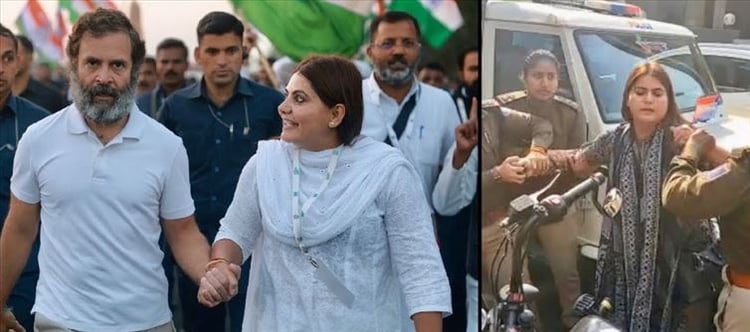


The Kerala Mahila Congress president tonsured her head and resigned from her post after the party denied her a ticket for the Kerala Assembly Elections, turning a private humiliation into a public indictment of Congress's internal democracy and its treatment of women leaders within the party's own ranks.
A woman who spent years building the Congress party's women's wing in Kerala — rallying booth workers, fronting campaigns on women's safety, echoing the high command's empowerment slogans at every mandal meeting — finally discovered where she stood in the party's actual hierarchy: outside the door, holding someone else's banner.
The Kerala Mahila Congress president's decision to tonsure her head and resign from her post after being denied an assembly election ticket is not merely a dramatic personal protest. It is a surgical exposure of the gap between Congress's public posture on women's leadership and the ruthless, closed-room arithmetic that actually decides who gets to contest. According to reports in leading Indian media outlets, the tonsuring — a culturally loaded act of mourning and defiance in Kerala — came after her repeated representations to the state and central leadership were ignored during the ticket distribution process for the Kerala Assembly Elections.
The Ticket Machine and Its Invisible Levers
Ticket allocation in Indian political parties, and Congress in particular, has never been a meritocratic exercise. It is a negotiation between faction leaders, caste arithmetic, donor networks, and the quiet preferences of a handful of power brokers who rarely appear on any official committee. The women's wing — Mahila Congress — exists in this ecosystem as a rhetorical asset: useful for press conferences on women's rights, indispensable at rallies, and entirely disposable when the real seats are carved up.
What makes the Kerala episode devastating is not just the denial, but the silence that preceded it. According to reports, the Mahila Congress chief had been a loyal organisational worker, not a parachute candidate or a last-minute entrant. Her claim to a ticket rested on precisely the kind of grassroots credential Congress publicly celebrates. Yet when the final lists emerged, her name was missing — replaced, as is the pattern, by candidates whose proximity to the local power broker or the factional boss outweighed any metric of women's representation.
[EMBED-SUGGESTION:tweet]
Political Pulse
The whisper in Congress corridors in Thiruvananthapuram, according to party insiders speaking to national media, is less about sympathy and more about damage control. The talk, as one state-level functionary put it to reporters, is that "everyone knew this would happen — the only surprise is that she went public." That sentence alone tells the story. The expectation within Congress is that women leaders, when denied, will absorb the humiliation quietly — perhaps accept a "consolation" post, perhaps wait for the next cycle, perhaps simply fade away. The tonsuring broke that unwritten contract.
Among rival parties, the CPI(M)-led Left Democratic Front and the TMC's nascent Kerala unit are reportedly watching closely. A senior woman leader publicly humiliated by her own party is a recruitment opportunity that writes itself. The Left, which has its own mixed record on women's tickets, nevertheless gains a talking point: Congress cannot even keep its own women's wing chief loyal, let alone empower women in governance. The TMC, which has aggressively positioned itself as a home for Congress rebels in southern states, may see an opening to poach not just the individual but the network she built.
(This reflects political corridor chatter and unverified speculation from party circles, not confirmed fact.)
The Arithmetic Behind the Rhetoric
India Herald's read of what is really driving this goes beyond one denied ticket. The structural problem is measurable. Across Indian state elections in recent cycles, women candidates from national parties have consistently comprised less than 10-12% of total tickets distributed, according to data compiled by the Association for Democratic Reforms (ADR). Congress, despite its frequent invocations of Indira Gandhi's legacy and its vocal support for the Women's Reservation Bill in Parliament, has not materially outperformed this dismal average at the state level. The party's women's wings exist in every state — but the percentage of Mahila Congress or women's cell leaders who actually receive tickets to contest remains vanishingly small.
The Kerala Assembly, with 140 seats, has historically seen women's representation hover in single digits. The 2021 assembly, according to ADR data, returned only 11 women MLAs — roughly 8% of the house. Congress's contribution to that number was modest. The denial of a ticket to the very person tasked with leading the party's women's outreach is not an accident or an oversight; it is the system working exactly as designed.
A Razor, a Resignation, and a Question for the High Command
The cultural weight of a public tonsuring in Kerala should not be underestimated. It is not a stunt. In the state's social vocabulary, shaving one's head in protest carries echoes of mourning, of renunciation, of a last resort when all institutional channels have failed. That a Congress woman leader felt compelled to reach for this gesture — rather than, say, a press conference or a strongly worded letter — tells you exactly how much faith she had left in the party's internal grievance mechanism. The answer, evidently, was none.
Her resignation from the Mahila Congress presidency is the quieter but arguably more consequential act. It strips the party of its most visible women's organiser in the state at precisely the moment it needs one — in the heat of election season, when every booth-level women's meeting, every self-help group outreach, every campus event requires the Mahila Congress machinery. The party now faces a choice it would rather not make publicly: replace her quietly and hope voters forget, or address the systemic failure that produced the revolt. Congress's track record strongly suggests the former.
What Comes Next — and Who Should Be Watching
The real question this episode forces is not whether one leader gets justice. It is whether Congress's national leadership — Mallikarjun Kharge, Rahul Gandhi, the AICC's organisational apparatus — treats this as a localised embarrassment to be managed, or as evidence of a structural rot that will keep costing the party women leaders, grassroots energy, and moral authority. The Women's Reservation Bill, which Congress championed in Parliament, reserves one-third of seats for women in legislatures. Yet the party cannot bring itself to reserve even a fraction of its own tickets for the women who run its own wings.
Watch for three things in the coming days. First, whether the CPI(M) or TMC make a public overture to the resigned leader — that would convert a Congress embarrassment into a rival's recruitment win. Second, whether any other women leaders within Congress Kerala break their silence and echo the protest — a single tonsuring is containable; a chorus is not. Third, and most telling, whether the AICC issues any statement at all — silence from Delhi will confirm what the corridors already believe: that the high command considers this an acceptable cost of doing business.
The woman who shaved her head did not just protest a denied ticket. She held up a mirror. Congress's problem is not that the mirror exists — it is that the reflection is exactly what everyone expected to see.
More from India Herald

Key Takeaways
- The Kerala Mahila Congress president tonsured her head and resigned after being denied a ticket for the Kerala Assembly Elections — a culturally loaded act of protest that exposed the gap between Congress's women's empowerment rhetoric and its internal seat-allocation reality.
- Women candidates across Indian state elections have consistently received less than 10-12% of total tickets from national parties, according to ADR data — Congress has not materially outperformed this average despite championing the Women's Reservation Bill in Parliament.
- Rival parties, particularly the CPI(M)-led Left and the TMC, are reportedly watching for a recruitment opportunity — a publicly humiliated Congress women's leader and her grassroots network represent an easy poach.
- The incident forces a test of Congress's national leadership: will the AICC treat this as a systemic failure requiring reform, or as a local embarrassment to be quietly managed? The party's silence in the coming days will be the answer.
By the Numbers
- Women candidates from national parties have comprised less than 10-12% of total tickets in recent Indian state elections, per ADR data.
- The 2021 Kerala Assembly returned only 11 women MLAs out of 140 seats — roughly 8% — according to the Association for Democratic Reforms.
The 5W+H: Who, What, When, Where, Why, How
- Who: The president of Mahila Congress Kerala, the women's wing of the Indian National Congress in the state.
- What: Tonsured her head in public protest and resigned from her post after being denied a ticket for the Kerala Assembly Elections by the Congress leadership.
- When: During the ticket allocation phase ahead of the Kerala Assembly Elections, 2026.
- Where: Kerala, India — within the internal seat-allocation process of the Indian National Congress for the state assembly polls.
- Why: She protested what she described as the party's failure to honour its stated commitment to women's representation, alleging that closed-door power brokers overrode her candidacy despite her grassroots work and loyalty.
- How: After repeated representations to the party leadership went unheard, she publicly tonsured her head — a drastic cultural gesture of mourning and protest — and submitted her resignation from the Mahila Congress presidency, making the internal revolt visible to voters and rival parties.
Frequently Asked Questions
Why did the Kerala Mahila Congress chief tonsure her head?
She tonsured her head as a public protest after being denied a ticket by the Congress party for the Kerala Assembly Elections, despite her years of grassroots organisational work as the president of the party's women's wing in the state.
How many women MLAs does the Kerala Assembly typically have?
The Kerala Assembly has historically seen very low women's representation. The 2021 assembly returned only 11 women MLAs out of 140 seats — roughly 8% — according to data from the Association for Democratic Reforms.
Could the TMC or Left parties recruit the resigned Mahila Congress leader?
Political observers and party insiders believe both the CPI(M)-led Left Democratic Front and the TMC's Kerala unit may see a recruitment opportunity. A publicly humiliated Congress women's leader with a grassroots network is a ready-made asset for rival parties.
What is Congress's record on giving tickets to women candidates?
Despite championing the Women's Reservation Bill in Parliament, Congress has not materially outperformed the national average of less than 10-12% women candidates in state elections, according to ADR data. Women's wing leaders who run the party's grassroots outreach rarely receive tickets themselves.
 click and follow Indiaherald WhatsApp channel