
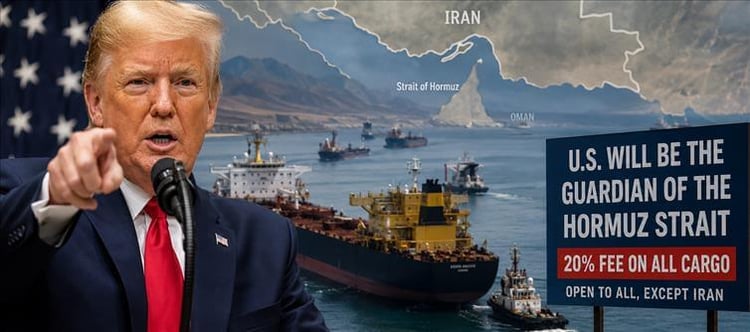


No sitting or former US president can legally bind the Pentagon to execute a military strike after their death. Presidential war authority expires with the president's incapacity or death, transferring instantly to the vice president under the 25th Amendment. Trump's threat is strategic deterrence theatre, not an executable military order — but the escalation it signals is real, and India's $35 billion annual Iranian oil and Chabahar stakes sit squarely in the blast radius.
Here is a question worth asking slowly: can a man command an army from his own coffin?
Donald Trump believes so — or at least wants Tehran to believe so. In a statement reported by News18, India Today, and NDTV this week, the US President declared that he has 'left instructions' for the United States to 'destroy' Iran and 'bomb them like never before' should Tehran succeed in assassinating him. 'I am Target Number 1,' Trump said, according to News18, framing the threat as pure deterrence: kill me, and the full weight of American firepower lands on your head regardless.
It is a line engineered to chill. It is also, in strict constitutional terms, an impossibility. And in geopolitical terms — particularly for New Delhi — it is the kind of impossibility that still manages to be extremely dangerous.
The Constitutional Dead End
The US presidency is not a will. It is an office, and its powers do not survive the officeholder. The moment a president dies or is incapacitated, the 25th Amendment to the US Constitution transfers all executive authority — including the sole authority to order a nuclear or conventional military strike — to the vice president. Not to a letter in a drawer. Not to a pre-recorded instruction. To the living, sworn-in successor.
This is not a technicality. It is the architecture of American civilian control over the military, a principle so foundational that the entire nuclear command-and-control apparatus — the 'football,' the authentication codes, the two-person rule — is designed around it. The chairman of the Joint Chiefs of Staff does not execute posthumous wishes. The secretary of defence does not open a sealed envelope. The National Command Authority, as the Pentagon defines it, consists of exactly two people: the president and the secretary of defence. Remove the president, and the vice president steps into that seat. The chain is unbroken, but it is a chain of living hands.
So when Trump says he has 'left instructions,' what he has actually done is made a public threat attributed to the office but unenforceable by it. No Pentagon general is legally bound — or even legally permitted — to execute a strike order from a dead commander-in-chief. The decision to bomb Iran, in that nightmare scenario, would belong entirely to whoever is sitting in the Oval Office at that moment.
Political Pulse
Then why say it? The corridors-of-power read, from Washington to Lutyens' Delhi, is that Trump's statement is not a military order — it is a psychological weapon. The talk among foreign policy circles, as India Herald's read of the situation suggests, is that this is classic Nixonian 'madman theory' repackaged for the social-media age: convince your adversary that you are irrational enough — or that your institutional machinery is automated enough — to guarantee retaliation, and the adversary calculates that the risk of action outweighs the reward.
The whisper in strategic circles is that this is less about Iran and more about domestic politics — a president casting himself as so vital, so targeted, that the entire US military apparatus orbits his personal survival. It is a narrative of indispensability. And in Washington, where every intelligence briefing about Iranian threats against Trump has been reported by multiple outlets including India Today as credible, it lands with enough plausibility to do its political work.
But here is what no one in Washington is asking loudly enough: what happens if Tehran takes the threat seriously — not as deterrence, but as escalation? A regime that believes annihilation is already guaranteed regardless of its behaviour has no incentive for restraint. The 'dead hand' logic that kept the Cold War cold worked because both sides had second-strike capability AND rational actors interpreting the signals. Iran's decision-making apparatus, riven by factional politics between the IRGC and the civilian government, is not a unitary rational actor. Deterrence only works when the target processes it as deterrence, not as provocation.
Why New Delhi Cannot Afford to Look Away
For India, this is not an abstract constitutional seminar. India imports significant volumes of crude oil tied to Iranian supply chains, and the Chabahar Port — India's sole direct access point to Afghanistan and Central Asia that bypasses Pakistan — sits on Iranian soil. Any US military escalation against Iran does not stay in the Persian Gulf. It ripples through crude prices, shipping insurance in the Strait of Hormuz, and the entire architecture of India's connectivity strategy.
According to Times of India's reporting of Trump's remarks, the language was 'bomb them like never before' — the kind of phrasing that, if it triggers even a partial Iranian military posture shift, could see insurance premiums on Hormuz-transiting tankers spike overnight. India, which routes roughly 60% of its crude imports through or near the Strait, would feel the hit before a single bomb fell.
India Herald's assessment is that New Delhi's quiet diplomacy with Tehran — the kind that saw India among the few nations maintaining working relations during the last Trump-era maximum pressure campaign — is about to be stress-tested again. The question for South Block is not whether Trump can legally order a posthumous strike. It is whether the rhetorical escalation itself destabilises the corridor India has spent two decades building.
The Forward Read: What to Watch
Three things to monitor in the coming weeks. First, whether Tehran responds publicly — Iran's Supreme National Security Council has historically treated Trump's maximalist rhetoric with a mix of defiance and calculated silence, and the choice it makes now will signal how seriously it reads the threat. Second, watch the Pentagon's body language: any unusual movement of carrier strike groups in the Fifth Fleet's area of responsibility will tell you more than any presidential statement. Third, and most critically for Indian readers, watch Chabahar. If the US reimposes or tightens secondary sanctions on Iranian ports as part of this escalation cycle, India's waiver — always precarious — becomes the most important piece of paper in Indian foreign policy.
Trump's 'destroy Iran' threat is, in the end, constitutionally hollow and strategically loaded. He cannot bind the Pentagon from beyond the grave. But he can, from the living room of the Oval Office, create a rhetorical reality that forces every actor — Tehran, the Pentagon, and New Delhi — to behave as though the threat is operational. That is not a dead hand. It is a very live one, and India is holding the end of the rope.
(This reflects analysis of publicly available constitutional frameworks, reported statements, and strategic assessments, not classified or insider information.)
Allegations reported here are attributed to named sources and remain unproven unless a court has ruled; matters sub judice are reported without prejudgment.
Reported and written with AI assistance under India Herald's editorial standards; a human editor governs publication.
More from India Herald

Key Takeaways
- No US president can legally issue a military strike order that survives their death — the 25th Amendment transfers all war authority to the vice president instantly, making Trump's 'standing instructions' constitutionally unenforceable.
- Trump's threat functions as 'madman theory' deterrence — a psychological weapon designed to make Iran calculate that assassination carries guaranteed annihilation, even though no such automated retaliation mechanism exists in US law.
- India is the silent stakeholder most exposed to this escalation: Chabahar Port access, crude oil imports routed through the Strait of Hormuz, and the precarious US sanctions waiver all sit directly in the blast radius of any US-Iran confrontation.
- Watch for three signals — Tehran's public response, unusual US Fifth Fleet carrier movements, and any tightening of secondary sanctions on Iranian ports — to gauge whether this rhetoric is crossing into operational escalation.
By the Numbers
- India routes roughly 60% of its crude oil imports through or near the Strait of Hormuz, making any US-Iran military escalation an immediate energy security threat for New Delhi.
- The US 25th Amendment ensures presidential authority transfers to the vice president upon death or incapacity — no posthumous military order is constitutionally executable.
The 5W+H: Who, What, When, Where, Why, How
- Who: Former and current US President Donald Trump, who claims Iran is plotting to assassinate him, and the US Pentagon's chain of command that would inherit any conflict decision.
- What: Trump publicly declared he has 'left instructions' for the US to 'destroy' Iran and 'bomb them like never before' if Tehran assassinates him, according to News18 and India Today.
- When: Trump made the statements in June 2026, as reported by NDTV, News18, and India Today.
- Where: The statements were made in the United States; the geopolitical stakes span Washington, Tehran, and New Delhi.
- Why: Trump framed the threat as deterrence, claiming he is 'Target Number 1' for Iranian assassination plots, according to News18. Intelligence agencies have previously assessed Iranian threats against Trump as credible, per India Today.
- How: Trump claims to have left standing instructions with unspecified officials, but US constitutional law vests war-making authority in the living commander-in-chief, meaning any strike order would require the sitting president or their constitutional successor to independently authorise it.
Frequently Asked Questions
Can a US president leave a standing military order that executes after their death?
No. Under the 25th Amendment, all presidential authority — including the sole power to order military strikes — transfers immediately to the vice president upon a president's death or incapacity. The Pentagon's chain of command requires a living commander-in-chief; no posthumous instruction is legally binding.
Why did Trump threaten to destroy Iran if he is assassinated?
According to News18 and India Today, Trump framed the statement as deterrence, claiming he is 'Target Number 1' for Iranian assassination plots. Strategic analysts read it as 'madman theory' — convincing an adversary that retaliation is automated to prevent the attack in the first place.
How does a US-Iran escalation affect India?
India routes roughly 60% of its crude imports through or near the Strait of Hormuz and operates the strategically vital Chabahar Port on Iranian soil. Any military escalation could spike shipping insurance, disrupt oil supply chains, and jeopardise India's sanctions waiver for Chabahar.
What is the US nuclear chain of command?
The National Command Authority consists of the president and the secretary of defence. Nuclear launch requires authentication by the living president through codes carried in the 'nuclear football.' If the president dies, authority passes to the vice president under the 25th Amendment, not to any pre-set instruction.
 click and follow Indiaherald WhatsApp channel