


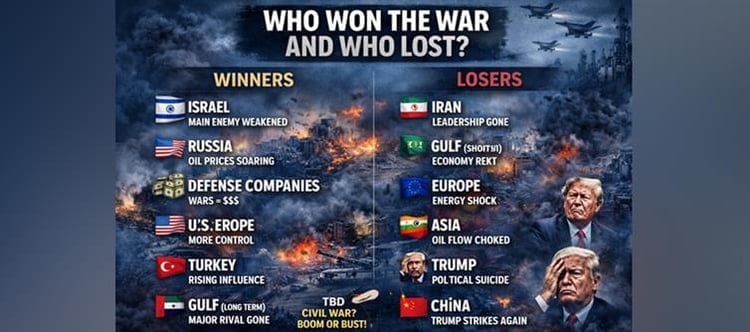

The war That Is Reshaping the Global Power Map
Wars rarely produce clean victories.
Instead, they scramble the global order — weakening some players, empowering others, and leaving entire regions scrambling to adapt.
The current confrontation involving iran, israel, and the united states is doing exactly that.
Energy routes are disrupted, economies are trembling, and geopolitical alliances are shifting in real time. The crisis around the Strait of Hormuz alone threatens roughly 20% of the world’s oil supply, sending prices higher and shaking global markets.
And like every major war, it has already produced a brutal scoreboard of winners and losers.
LOSERS
1. 🇮🇷 iran — The Country Paying the Heaviest Price
No nation has taken a bigger hit than Iran.
Military strikes have damaged infrastructure, energy facilities, and strategic installations across the country. Previous conflicts already showed how devastating such strikes can be, slashing oil exports and causing billions in losses.
Beyond physical destruction, the political consequences could be even more dangerous.
Leadership turmoil, economic collapse, and rising internal tensions raise the specter of instability — or even a prolonged domestic crisis.
For Tehran, this war is not just a battlefield challenge.
It’s an existential one.
2. 🇸🇦 The gulf States — Economic Shock in the Short Term
Countries like Saudi Arabia, the United Arab Emirates, and Qatar have built their prosperity on energy exports.
But war in their backyard disrupts the entire system.
Shipping through the gulf has slowed dramatically, insurance costs have surged, and oil infrastructure has become a target.
Even if production continues, uncertainty alone is costing billions in lost trade and investment.
3. 🇪🇺 europe — The Energy Nightmare Returns
For Europe, this crisis feels like déjà vu.
After the shock of the ukraine war energy crisis, europe finally began stabilizing its gas markets.
Now the Middle east conflict threatens to reopen the same wound.
Gas prices have surged again, and analysts fear another brutal competition for global LNG supplies.
Industries, households, and governments across the continent may once again face soaring energy costs.
4. 🇮🇳 Asia — The oil Lifeline Under Threat
Asian economies rely heavily on gulf energy.
Countries such as India and China import massive volumes of oil and gas from the Middle East.
When shipping through Hormuz stalls, the consequences ripple across the entire region.
Refineries begin cutting output, supply chains tighten, and the risk of inflation skyrockets.
For energy-hungry economies, this war is a direct economic threat.
5. 🇨🇳 china — Strategic Headaches Multiply
For China, the conflict is another geopolitical headache.
The country imports huge quantities of energy from the gulf and depends heavily on stable shipping routes.
With tankers stalled and shipping insurance withdrawn, china faces rising costs and potential energy shortages.
In strategic terms, instability in the Middle east complicates Beijing’s long-term economic planning.
WINNERS
6. 🇮🇱 israel — The Strategic Target Weakens
From a military standpoint, Israel may see one of the biggest strategic advantages.
iran has long been its primary regional adversary.
If Tehran’s military capabilities, leadership network, or proxy forces weaken significantly, Israel’s strategic environment changes dramatically.
For years, Israeli defense planners have argued that neutralizing Iran’s military reach would reshape regional security.
This conflict could move that goal closer.
7. 🇷🇺 russia — The oil Windfall
When wars disrupt energy markets, producers benefit.
And few countries benefit more than Russia.
Higher oil prices mean higher revenue for Moscow’s energy sector.
With global supply constrained, Russian exports suddenly become even more valuable.
For the Kremlin, geopolitical chaos in the Middle east can translate directly into financial gains.
8. 🇺🇸 The united states — Strategic Leverage
Despite being deeply involved in the conflict, the United States is relatively insulated from the energy shock.
Domestic oil and gas production provides a buffer that many countries simply do not have.
That gives Washington strategic flexibility — and influence over how global energy flows are stabilized.
But the political consequences at home remain unpredictable.
9. 💰 Defense Companies — The Silent Beneficiaries
Whenever global tensions rise, defense contractors see demand surge.
Companies producing missile systems, drones, fighter jets, and surveillance equipment suddenly find themselves at the center of military procurement.
For the global arms industry, geopolitical crises often translate into enormous contracts.
war, unfortunately, is also a business.
10. 🇹🇷 turkey — The Opportunistic Power
Regional conflicts often create space for ambitious middle powers.
For Turkey, instability across the Middle east opens opportunities to expand diplomatic and strategic influence.
From energy transit routes to regional diplomacy, Ankara may find itself playing a larger role in shaping the region’s future balance of power.
STILL UNCERTAIN
🇱🇧 lebanon — Collapse or Comeback?
No country sits closer to the edge than Lebanon.
The future of the country may hinge on the fate of Hezbollah, Iran’s most powerful regional ally.
If Hezbollah weakens dramatically, lebanon could either plunge deeper into instability…
Or finally open a path toward economic recovery.
Right now, the outcome is impossible to predict.
The Bottom Line
Wars don’t just destroy cities and armies.
They reorder the global system.
Some countries lose power, others gain leverage, and the balance of influence quietly shifts.
The iran conflict is already reshaping energy markets, alliances, and regional power dynamics.
And the most brutal truth of geopolitics remains unchanged:
In every war, someone wins.
Someone loses.
And the real consequences often take years to fully unfold.
 click and follow Indiaherald WhatsApp channel