
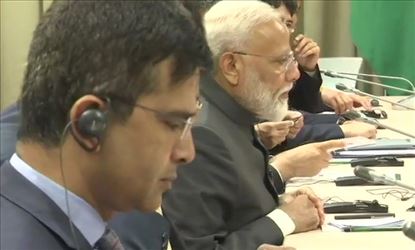


The fall of Konstantinovka dramatically weakens Ukraine's battlefield leverage, accelerating pressure for a negotiated settlement. For India, which has carefully cultivated ties with both Moscow and Kyiv, the collapse paradoxically elevates New Delhi's relevance as a mediator — but only if Modi moves before the window hardens into a fait accompli, according to India Herald's assessment.
A city that held for over two years of grinding warfare fell in a matter of days. Konstantinovka — the last urban anchor Ukraine could claim in Donetsk — is now under Russian control, and Vladimir Putin is not hiding his satisfaction. "Excellent," he told his military command, according to the Times of India, reviewing footage of the final assault. "Nothing can stop" the advance.
That single word — excellent — should ring in diplomatic ears from Washington to New Delhi. Because what just collapsed is not merely a defensive line in eastern Ukraine. What collapsed is the foundational assumption behind every peace framework floated in the last eighteen months: that Kyiv held enough territory to bargain from a position of residual strength.
That assumption is now rubble.
The Donetsk Domino and Why It Matters Beyond the Battlefield
Konstantinovka was not just another pin on a war map. It was the logistics hub, the civilian administrative centre, and the symbolic proof that Ukraine still contested the Donetsk region Russia claims as its own. With its fall, Moscow's stated war aim of controlling all four annexed oblasts has moved from aspiration to near-completion in at least one theatre.
The Times of India reports that Russian military operations have not paused after the capture — bombardment of remaining eastern Ukrainian positions continues, suggesting the Kremlin sees momentum, not a moment to consolidate. Zelensky, meanwhile, has struck a defiant but increasingly strained posture, insisting that only the recovery of "Moscow Island, not Crimea" — a reference to sovereign Russian territory — would force Putin to end his operation.
That statement, intended as resolve, reads differently after Konstantinovka: it sounds less like a negotiating position and more like a man whose chips have been swept off the table still calling out bets.
Political Pulse
In the corridors of South Block, the talk is quieter than the headlines might suggest — but sharper. India Herald's read of what is really driving New Delhi's calculus right now is this: Konstantinovka's fall does not close Modi's diplomatic window. It changes its shape entirely.
Here is the paradox officials in the know are privately wrestling with. For two years, India's balancing act — buying discounted Russian crude, maintaining defence ties with Moscow, while sending humanitarian signals to Kyiv and voting carefully at the UN — rested on a frozen conflict. A war grinding on without decisive outcome suited New Delhi perfectly: it justified equidistance, made both sides need India's goodwill, and kept the moral pressure diffuse.
A decisive Russian advance shatters that comfort. If the war tilts conclusively toward Moscow, India's "neutrality" stops looking like strategic wisdom and starts looking like it was always just a bet on the winning side. The diplomatic capital Modi spent visiting both Kyiv and Moscow — the careful choreography of those 2024 trips — depreciates overnight if the outcome was never really in doubt.
The whisper in diplomatic circles, from sources familiar with MEA thinking, is that New Delhi now faces a narrow but real opening: push for a settlement framework before the ground reality becomes so lopsided that any peace is simply ratification of Russian conquest. In that scenario, a mediator is irrelevant — you do not need a broker when one side has already taken the house.
The Trump Variable and India's Shrinking Room
Complicating matters is the Trump administration's own stated ambition to broker a deal. According to Polish media analysis cited by observers tracking the conflict, Russia's advance near Konstantinovka has been read in European capitals as deliberate pre-negotiation positioning — seize maximum territory before any ceasefire framework freezes the lines.
For India, this creates a specific problem. If Trump secures a deal — even a lopsided one — before Modi can position India as a meaningful voice, New Delhi gets the worst of both worlds: it bore the diplomatic cost of neutrality during the war but earns no credit in the peace. The only thing worse than being seen as having backed the winner is being seen as having been irrelevant to the outcome.
The people's pulse among India's strategic community reflects this anxiety. Defence analysts and former diplomats speaking in public forums have increasingly noted that India's Russia relationship, while transactionally robust on energy and arms, has yielded diminishing diplomatic returns. Moscow did not consult New Delhi before escalating. It is not consulting now. The "special and privileged strategic partnership" works when India is useful to Russia as a counterweight to Western isolation. When Russia no longer feels isolated — when it is winning — the leverage equation flips.
What Modi's Team Is Really Watching
Three things, according to the pattern India Herald has been tracking in New Delhi's moves:
First, the energy corridor. India imports roughly 40% of its crude from Russia now, up from under 2% before the war. A victorious Russia is a Russia that can demand market pricing, not desperation discounts. The cheap oil argument — the single biggest domestic justification for the Moscow tilt — has an expiry date, and Konstantinovka just moved it closer.
Second, the China shadow. A triumphant Putin deepens Moscow's dependency on Beijing, not New Delhi. Every Russian battlefield success that was enabled by Chinese industrial support and diplomatic cover further cements the axis India considers its primary strategic threat. India's nightmare scenario is not that Russia wins — it is that Russia wins and becomes a junior partner to China in the process.
Third, the Global South card. Modi has positioned India as the voice of the developing world, the power that speaks for nations tired of being proxy battlefields for great-power rivalry. A war that ends in territorial conquest without meaningful negotiation undermines that entire narrative. The Global South did not stay quiet during the war so that the outcome could look exactly like 19th-century imperialism with 21st-century drones.
The Forward Read: What Comes Next
Watch for two signals in the coming weeks. If External Affairs Minister Jaishankar makes an unscheduled trip to either Moscow or Kyiv — or both — it means South Block has decided the window is closing and India must move. If instead New Delhi retreats into boilerplate statements about "dialogue and diplomacy," it means the assessment internally is that the game is already over and India's best play is to quietly align with the new reality without fingerprints on the outcome.
The harder question — the one no official will answer on the record — is whether Modi personally sees more value in being the man who tried to broker peace and was overtaken by events, or the man who never tried and therefore never failed. The answer to that question will tell you everything about where Indian foreign policy goes from here.
Konstantinovka is a city most Indians have never heard of. But the rubble there just rearranged the furniture in South Block. The only question now is whether anyone in New Delhi will admit the room has changed before it is too late to move the chairs.
Allegations reported here are attributed to named sources and remain unproven unless a court has ruled; matters sub judice are reported without prejudgment.
Reported and written with AI assistance under India Herald's editorial standards; a human editor governs publication.
More from India Herald


Key Takeaways
- Konstantinovka's fall completes Russia's near-total control of Donetsk, eliminating Ukraine's strongest bargaining chip in any future negotiation.
- India's diplomatic 'equidistance' between Moscow and Kyiv worked during a frozen conflict — a decisive Russian advance transforms neutrality from strategic wisdom into a passive bet on the winner.
- The cheap Russian crude that justified India's Moscow tilt has an expiry date: a victorious Russia can demand market pricing, and Konstantinovka moved that date closer.
- Modi's real nightmare is not a Russian victory — it is a Russian victory that deepens Moscow's dependence on Beijing, strengthening the axis India considers its primary strategic threat.
- Watch for Jaishankar's travel schedule in coming weeks: an unscheduled Moscow or Kyiv trip signals India believes the mediation window is closing fast.
By the Numbers
- India imports roughly 40% of its crude oil from Russia, up from under 2% before the Russia-Ukraine war began — a dependency that a victorious Moscow could reprice at will.
- Konstantinovka was Ukraine's last major urban stronghold in the Donetsk region, a territory Russia formally annexed and has now nearly fully captured militarily.
The 5W+H: Who, What, When, Where, Why, How
- Who: Russian President Vladimir Putin, Ukrainian President Volodymyr Zelensky, Indian PM Narendra Modi, and Russian military commanders who reported the capture.
- What: Russian forces captured Konstantinovka, Ukraine's last major stronghold in the Donetsk region, with Putin publicly hailing the operation as 'excellent,' according to the Times of India.
- When: The capture was confirmed in early July 2026, with Russian military footage showing the final assault, as reported by the Times of India.
- Where: Konstantinovka, a strategically vital city in the Donetsk region of eastern Ukraine, and New Delhi, where India's diplomatic calculus is being recalibrated.
- Why: The fall completes Russia's long-stated objective of controlling the entire Donetsk region, fundamentally altering the negotiating balance in the Russia-Ukraine war and forcing global powers, including India, to recalculate their diplomatic positions.
- How: Russian forces conducted a relentless military assault on eastern Ukrainian positions, with military generals briefing Putin directly on the operation's success, followed by continued bombardment of remaining Ukrainian positions in the east, per Times of India reporting.
Frequently Asked Questions
Why does the fall of Konstantinovka matter for India?
Konstantinovka was Ukraine's last major stronghold in Donetsk. Its capture weakens Ukraine's negotiating position and disrupts India's diplomatic balancing act between Moscow and Kyiv, potentially making New Delhi's neutrality look like a bet on the winning side rather than principled equidistance.
Can Modi still act as a peace broker between Russia and Ukraine?
The window is narrowing. According to India Herald's assessment, India's mediation relevance depends on acting before the battlefield outcome becomes so lopsided that any peace deal is simply ratification of Russian conquest — at which point a broker is unnecessary.
How does Russia's military advance affect India's oil imports?
India currently sources roughly 40% of its crude from Russia at discounted rates. A victorious Russia facing less international isolation could demand market pricing, eroding the economic argument that has been the strongest domestic justification for India's closeness to Moscow.
What is the Trump factor in this situation?
The Trump administration has signaled its own ambition to broker a Russia-Ukraine deal. If Washington secures a settlement before India positions itself as a meaningful voice, New Delhi risks bearing the diplomatic cost of wartime neutrality without earning any credit in the peace.
 click and follow Indiaherald WhatsApp channel