
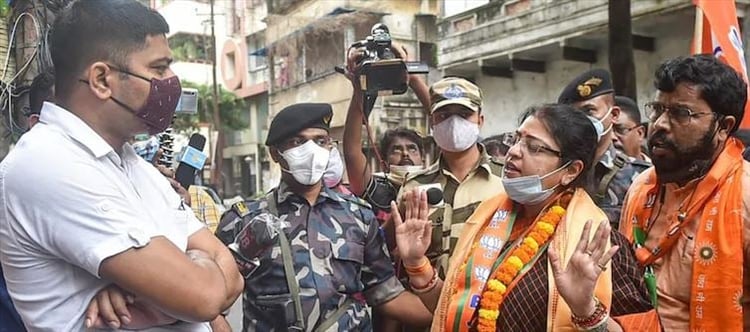


Madan Mitra, once among Mamata Banerjee's most flamboyant loyalists, has quit TMC and joined the rebel faction led by Ritabrata Banerjee, according to Amar Ujala. His exit swells a dissident bench that now includes enough veteran muscle to rattle the party machinery ahead of the 2026 Bengal municipal elections — and raises an urgent question about BJP's quiet courtship of TMC deserters.
Here is a man who once danced on camera outside a courtroom after getting bail in the Saradha chit-fund case, mugged for television crews while half of Bengal's political class pretended not to know him, and stayed loyal to Mamata Banerjee through a decade of controversies that would have buried lesser careers. Madan Mitra did not leave TMC because he suddenly discovered ideology. He left because the party he helped build stopped returning his calls — and that, more than any policy paper, tells you where Bengal's politics is headed in 2026.
According to Amar Ujala, Mitra has formally exited TMC and joined the rebel faction led by Ritabrata Banerjee, the former Rajya Sabha MP who was himself expelled from the party. The rebel camp is no longer a WhatsApp group of disgruntled backbenchers. With Mitra on board, it now has a face that municipal ward-level workers across Kolkata recognise — and, crucially, a man who knows where the party's organisational wiring runs.
That is the part Alipore Road should worry about most.
The Abhishek Fault-Line: Old Guard vs. New Machine
TMC insiders — and frankly, anyone who has watched Bengal politics with half an eye open — know that the party has been running a quiet generational purge for years. The rise of Abhishek Banerjee as the de facto organisational chief has come at a price: veteran leaders who built TMC's grassroots machinery in the 2000s find themselves frozen out of ticket distribution, committee positions, and the informal power circuits that matter more than any official designation in Bengal politics.
Mitra is not the first old-guard figure to feel the squeeze. But he is perhaps the most colourful, the most connected at the ward level, and the most willing to make noise. His exit, political observers in Kolkata note, is less about personal grievance and more about a systemic signal: TMC's internal escalator now moves in only one direction, and if you are not in the Abhishek orbit, you are furniture.
The Ritabrata faction has been framing itself as the "real TMC" — the party of street fighters and mass-contact leaders, as opposed to what they characterise as a corporate-style, top-down machine run by a younger leadership that has never won a municipal ward on its own. With Mitra, that narrative gains a face voters actually know.
Political Pulse
The corridor talk in Bengal's political circles, as India Herald's read of this moment suggests, is less about Mitra's personal future and more about who is making the phone calls. The whisper doing the rounds in Kolkata's political drawing rooms: BJP's Bengal unit has been quietly reaching out to disgruntled TMC veterans — not with ideological pitches, but with something far more effective: the promise of relevance.
The talk in political corridors is that BJP's central leadership has taken a keen interest in Bengal's dissident map ahead of 2026. The reasoning, according to those tracking the party's strategy, is straightforward: BJP cannot win Bengal on its own cadre strength alone. It tried in 2021, importing defectors wholesale before the assembly elections — and while that delivered seats, it also delivered chaos when many defectors returned to TMC after the results. The lesson BJP reportedly drew: do not import individuals, cultivate a faction.
A rebel TMC faction that retains its own identity — its own flags, its own ward-level networks, its own grievances against Abhishek Banerjee's leadership style — is tactically far more useful to BJP than a dozen individual defectors wearing saffron scarves at press conferences. It splits the anti-Mamata and anti-establishment vote less, and it splits the TMC ground machinery more.
Whether the Ritabrata-Mitra camp is genuinely independent or is being quietly shepherded toward a pre-election understanding with BJP is the question no one in Kolkata will answer on the record. But the arithmetic speaks: every TMC rebel who leaves with a ward-level network is a network Mamata cannot deploy in the municipals.
Why the Municipal Elections Are the Real Battleground
Bengal's municipal elections, expected later in 2026, are not a sideshow. They are the foundation of TMC's power. The party's dominance has always rested less on Nabanna (the state secretariat) and more on the thousands of municipal and panchayat-level office-holders who control local contracts, licences, and patronage networks. Lose the municipals, and the party's vascular system — the thing that gets out the vote, distributes benefits, and maintains the booth-level discipline — starts to collapse.
Mitra's defection matters precisely because he understands this architecture from the inside. He is not a parliamentary figure; he is a street-level operator who knows which ward president is unhappy, which contractor has been cut out, and which local leader is waiting for a signal to jump. That institutional knowledge, now sitting in the rebel camp, is a live wire that TMC's leadership cannot safely ignore.
A citable reality check: TMC swept the 2022 Kolkata Municipal Corporation elections with over 130 of 144 wards, according to Election Commission data reported widely at the time. That dominance was built on exactly the kind of grassroots loyalty that Mitra's exit now calls into question. Even a 15-20 ward swing in Kolkata — let alone across Bengal's other municipal bodies — would be a political earthquake for a party that has governed the state since 2011.
The BJP Calculus: Patience or Provocation?
BJP's public response to Mitra's exit has been characteristically pointed. Senior BJP leaders have seized the moment to attack Mamata Banerjee's leadership, framing the defection as proof that TMC is a sinking ship, as reported by Amar Ujala. The counter-attack is standard operating procedure — but the more interesting question is what BJP is doing privately.
India Herald's assessment of the strategic picture: BJP's Bengal 2026 playbook is unlikely to be a simple repeat of the 2021 defector-import model. The party's central strategists, chastened by the 2021 experience where imported leaders proved unreliable, appear to be cultivating a more patient approach — maintaining the rebel faction as a separate pressure point rather than absorbing it prematurely. A rebel TMC faction that contests municipals independently, even on a modest scale, could split enough TMC votes to hand BJP its first significant municipal foothold in Bengal without the party having to win those votes directly.
Mamata Banerjee's camp has not, as of 15 July 2026, issued a detailed public response to Mitra's departure beyond the party's general posture of dismissing rebels as irrelevant. That silence, in a leader known for her combative public style, is itself a data point. The absence of a full-throated attack on Mitra suggests either a calculation that attention would elevate the rebel camp, or — more worryingly for TMC — an uncertainty about how many more dominoes are waiting to fall.
The question that should keep Alipore Road up at night is not whether Madan Mitra matters. It is whether the next three defectors do — because at some point, a rebel bench becomes a rebel team, and a rebel team with municipal networks becomes an alternative. Bengal 2026 will not be decided by who shouts loudest at press conferences. It will be decided by who controls the ward.
Allegations and political claims reported here are attributed to named sources and remain part of ongoing political discourse; matters sub judice are reported without prejudgment.
Reported and written with AI assistance under India Herald's editorial standards; a human editor governs publication.
More from India Herald
Key Takeaways
- Madan Mitra's exit from TMC is not a lone grievance — it reflects a systemic generational rift between Abhishek Banerjee's new-guard machine and the old-guard street fighters who built the party's grassroots dominance.
- The rebel faction led by Ritabrata Banerjee now has institutional memory and ward-level networks, making it a genuine threat to TMC's municipal election machinery in 2026.
- BJP's Bengal strategy appears to have evolved from the failed 2021 defector-import model toward cultivating an independent rebel faction that can split TMC votes without the chaos of premature absorption.
- Bengal's municipal elections — not state assembly polls — are the real battleground: TMC's power rests on thousands of local office-holders, and even a modest ward-level swing could crack the party's organisational foundation.
- Mamata Banerjee's public silence on Mitra's departure may indicate a strategic calculation — or an unsettling awareness that more exits could follow.
By the Numbers
- TMC won over 130 of 144 wards in the 2022 Kolkata Municipal Corporation elections, per Election Commission data — dominance now directly threatened by grassroots-level defections.
- Madan Mitra is a former TMC minister with decades of ward-level organisational knowledge across Kolkata — institutional memory now sitting in the rebel camp.
The 5W+H: Who, What, When, Where, Why, How
- Who: Madan Mitra, veteran TMC leader and former minister, long considered a Mamata Banerjee loyalist — now joined to the Ritabrata Banerjee-led rebel camp.
- What: Mitra has formally left TMC and joined the rebel faction, adding significant veteran weight to an already growing dissident bench, as reported by Amar Ujala.
- When: The exit was reported on 15 July 2026, months ahead of the crucial Bengal municipal elections expected later in 2026.
- Where: West Bengal — the political theatre where TMC's dominance faces its first serious internal fracture in over a decade.
- Why: The move is widely attributed to the widening generational rift inside TMC, particularly the sidelining of old-guard leaders by the party's younger power centre around Abhishek Banerjee, per political observers.
- How: Mitra joined the rebel faction led by Ritabrata Banerjee, a former TMC Rajya Sabha MP himself expelled earlier, signalling that the dissident group now has institutional memory and grassroots heft beyond a single grievance.
Frequently Asked Questions
Why did Madan Mitra leave TMC?
According to Amar Ujala, Mitra joined the rebel faction led by Ritabrata Banerjee. The exit is widely attributed to the growing generational rift inside TMC, where old-guard leaders have been increasingly sidelined by the younger leadership around Abhishek Banerjee.
What is the TMC rebel faction and who leads it?
The rebel faction is led by Ritabrata Banerjee, a former TMC Rajya Sabha MP who was expelled from the party. The group positions itself as representing the original TMC grassroots ethos against what it calls a corporate-style, top-down party machine.
How could Madan Mitra's exit affect the 2026 Bengal municipal elections?
Mitra brings ward-level organisational knowledge and grassroots networks. His presence in the rebel camp could split TMC's vote in municipal wards across Kolkata, potentially enabling BJP or independent candidates to win seats in a body TMC has dominated since 2011.
Is BJP behind the TMC rebel faction?
There is no confirmed public evidence of a formal BJP-rebel faction alliance. However, political observers in Kolkata note that BJP's Bengal unit has been reaching out to disgruntled TMC veterans, and the party's response to Mitra's exit suggests strategic interest in the rebel camp's potential to weaken TMC.
 click and follow Indiaherald WhatsApp channel