


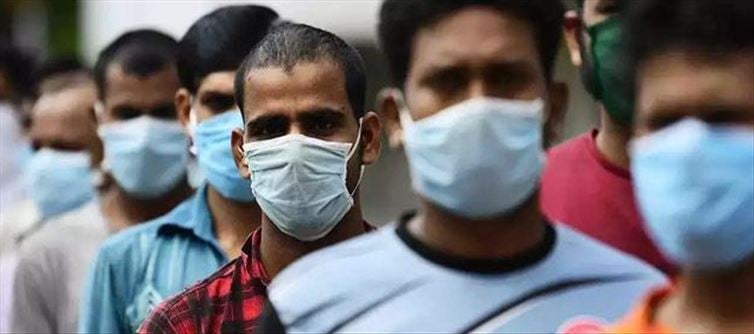

A novel N95 face mask that can not only stop the transmission of COVID-19 but also eradicate the SARS-CoV-2 virus has been created by researchers. According to the researchers, the mask may be worn for a longer period of time, resulting in less plastic waste because it won't need to be changed as frequently. According to Edmund Palermo of the US-based Rensselaer Polytechnic Institute, "We believe the effort represents a first step toward longer-lasting, self-sterilizing personal protective equipment, such as the N95 respirator.
According to Palermo, it "may help prevent transmission of airborne viruses generally." The team successfully grafted broad-spectrum antibacterial polymers onto the polypropylene filters used in N95 face masks in research that was just published in the journal Applied ACS Materials and Interfaces. N95 masks' active filtration layers are extremely sensitive to chemical alterations. They may no longer perform like N95s since it can make them less effective at filtering. They are constructed of polypropylene, a material that is challenging to chemically alter. The incredibly small network of fibres in these masks presents another issue because doing so could make it more difficult to breathe through them, Zha continued.
The team used ultraviolet (UV)-initiated grafting to attach antimicrobial quaternary ammonium polymers to the fibre surfaces of nonwoven polypropylene fabrics. The team included researchers from Massachusetts Institute of technology (MIT) in the US. According to Zha, "The method we devised uses a relatively straightforward chemical to produce this non-leaching polymer coating that can kill viruses and bacteria by essentially rupturing their outer layer." It's a pretty simple and maybe scaleable solution, said Zha. To make their procedure simple to use and broadly accessible, the scientists just utilised acetone and UV light.
The method does not require the creation of new polypropylene filters; rather, it may be used with ones that have already been produced, according to the researchers. When the procedure was performed directly to the filtration layer of N95 masks, the team did observe a reduction in filtering efficiency, but they said the fix is simple. According to the researchers, the user might wear an unaltered N95 mask behind a second polypropylene layer that has an antibacterial polymer on top. Future mask producers might add the antibacterial polymer to the top layer, according to the researchers.
According to Palermo, it "may help prevent transmission of airborne viruses generally." The team successfully grafted broad-spectrum antibacterial polymers onto the polypropylene filters used in N95 face masks in research that was just published in the journal Applied ACS Materials and Interfaces. N95 masks' active filtration layers are extremely sensitive to chemical alterations. They may no longer perform like N95s since it can make them less effective at filtering. They are constructed of polypropylene, a material that is challenging to chemically alter. The incredibly small network of fibres in these masks presents another issue because doing so could make it more difficult to breathe through them, Zha continued.
The team used ultraviolet (UV)-initiated grafting to attach antimicrobial quaternary ammonium polymers to the fibre surfaces of nonwoven polypropylene fabrics. The team included researchers from Massachusetts Institute of technology (MIT) in the US. According to Zha, "The method we devised uses a relatively straightforward chemical to produce this non-leaching polymer coating that can kill viruses and bacteria by essentially rupturing their outer layer." It's a pretty simple and maybe scaleable solution, said Zha. To make their procedure simple to use and broadly accessible, the scientists just utilised acetone and UV light.
The method does not require the creation of new polypropylene filters; rather, it may be used with ones that have already been produced, according to the researchers. When the procedure was performed directly to the filtration layer of N95 masks, the team did observe a reduction in filtering efficiency, but they said the fix is simple. According to the researchers, the user might wear an unaltered N95 mask behind a second polypropylene layer that has an antibacterial polymer on top. Future mask producers might add the antibacterial polymer to the top layer, according to the researchers.
 click and follow Indiaherald WhatsApp channel