

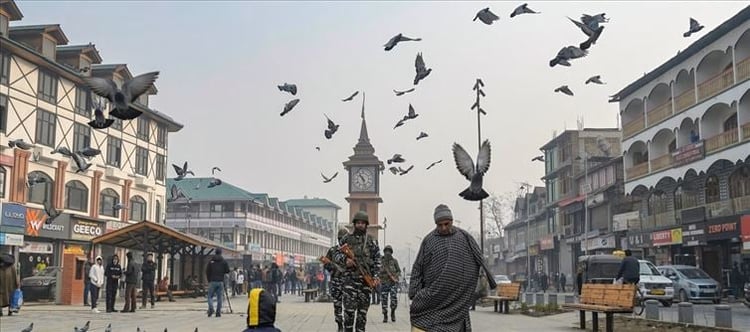

The Constitution bench's decision to repeal article 370 on monday resolved a slew of legal issues complicated by historical and political background and is tempered by the concept of "complete integration" of kashmir - SRINAGAR/JAMMU' target='_blank' title='jammu and kashmir-Latest Updates, Photos, Videos are a click away, CLICK NOW'>jammu and kashmir into India's constitutional structure. The 476-page decision on 23 petitions focused on historical treaties, constitutional and legal interpretation, procedural proprieties, and sovereignty principles before authoritatively establishing the parameters of the contested section.
The five-judge bench, comprising Chief Justice of india (CJI) Dhananjaya Y Chandrachud and justices Sanjay Kishan Kaul, Sanjiv Khanna, bhushan R Gavai and surya Kant, were unanimous in affirming the abrogation of article 370, holding the provision to be temporary and agreeing that the President has the power to nullify the special status of J&K under special circumstances that, the court held, were exclusively within the domain of the political executive to best judge.
A look at the primary concerns stated in support and opposition to the Centre's august 2019 action, as well as the replies provided by the Constitution bench, provides insight into the judicial process.
Article 370: Permanent or temporary? The petitioner's major point in court was that article 370 had been given permanent validity in the indian Constitution. They maintained that it was an illustration of the Dominion of India's constitutional pledge to the former princely state that it would retain its distinctive status notwithstanding its entry in october 1947. The petitioners contended that with the dissolution of J&K's constituent parliament on january 26, 1957, article 370 became a permanent law that could not be repealed by the President.
This argument was rejected by the court, which agreed with the Centre's contention that article 370 was a transient and temporary provision that served as a mechanism to gradually bring J&K on par with other states by applying various provisions of the indian Constitution in a step-by-step fashion and that this exercise was completed through abrogation.
"Article 370 prevented J&K residents from being treated equally with other indian citizens." Finally, equality was required. As a result, it could never have been meant to be a permanent arrangement," stated Justice Kaul's decision, pointing out that the clause was included in Part XXI of the Constitution, which is named "Temporary and Transitional Provisions."
The CJI's decision, written on behalf of himself and justices Gavai and Kant, also said in its concurring conclusion that article 370 was enacted to fulfill two reasons. "First, an interim arrangement until the constituent assembly of the state was formed and could take a decision on the legislative competence of the Union on matters other than the ones stipulated in the IoA (instrument of accession), and ratify the Constitution (transitional purpose); and second, an interim arrangement because of the special circumstances due to war-like conditions of the state (temporary purpose)".
The 1947 Instrument of Accession and Internal Sovereignty of J&K The petitioners cited the language of the IoA, underlining that by not signing a merger agreement like other princely states, Maharaja hari Singh kept internal autonomy for the former kingdom. The fact that J&K had its constitution and that article 370 was created in accordance with the conditions of the IoA were proof of the historical pledges made to J&K inhabitants about their internal autonomy.
The panel ruled 4-1 that article 370 was a hallmark of asymmetric federalism rather than sovereignty. "After the execution of the IoA and the issuance of the proclamation dated 25 november 1949 by which the Constitution of india was adopted, the state of kashmir - SRINAGAR/JAMMU' target='_blank' title='jammu and kashmir-Latest Updates, Photos, Videos are a click away, CLICK NOW'>jammu and kashmir retains no element of sovereignty." "The state of kashmir - SRINAGAR/JAMMU' target='_blank' title='jammu and kashmir-Latest Updates, Photos, Videos are a click away, CLICK NOW'>jammu and kashmir lacks 'internal sovereignty' that distinguishes it from the powers and privileges enjoyed by other states in the country," noted the CJI in his decision.
