




From Social Justice to Prime Property: A Debate That Won’t Stay Quiet
When reservations were first envisioned, the focus was clear: education and government employment — doors that had long been shut to historically disadvantaged communities. But now, a fresh controversy is shaking that understanding. The Lucknow Development Authority is reportedly extending reservation benefits to SC/ST/OBC categories in residential plot allotment schemes. And not modest housing — but plots that can run into crores.
That’s where the temperature rises.
Critics are asking a blunt question: when public schemes involve high-value real estate, does reservation still serve its original purpose of upliftment — or does it begin to look like wealth redistribution? If someone can afford to purchase a premium plot worth crores, what exactly is the marker of backwardness being addressed? Is social justice income-blind in such cases?
The debate intensifies around the “creamy layer” principle. The Supreme Court of India has repeatedly emphasized the need to exclude the economically advanced within backward classes from certain benefits. Yet, when high-value assets enter the picture, many argue that the creamy layer discussion cannot be brushed aside. Should there be an economic ceiling for eligibility in such schemes? Without one, critics fear the benefits may cluster among the already upwardly mobile rather than reach those still struggling.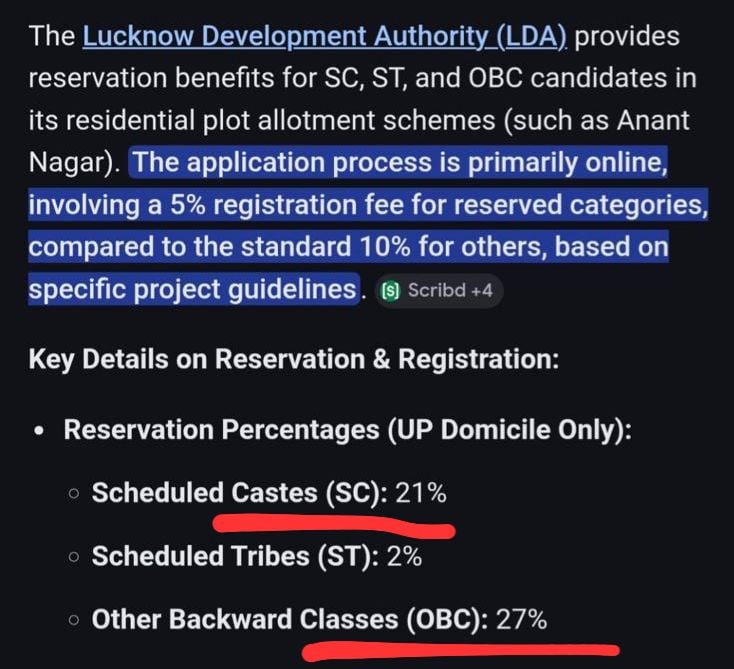
There’s also the slippery slope concern. Today, it’s allocation priority in residential plots. Tomorrow, will it mean price concessions? Subsidies? Differential terms? Opponents worry about policy creep — the gradual expansion of the reservation into domains never originally envisioned.
Supporters, however, frame it differently. They argue that land ownership has historically been tied to power, security, and generational wealth. If exclusion existed in that sphere too, then inclusion policies must follow. For them, this isn’t about creating billionaires — it’s about correcting structural imbalance.
But the emotional undercurrent cannot be ignored. Many feel the reservation net has widened so far that it now touches nearly every public policy space. education was understandable. Jobs, contentious but accepted. But premium residential real estate? That feels, to some, like a philosophical shift.
Overlaying all of this is a broader social narrative — one that blends caste, religion, constitutional safeguards, and political messaging. When policies are seen through identity lenses, trust erodes quickly. And once public trust erodes, even well-intentioned measures invite suspicion.
At its heart, this isn’t just about plots in Lucknow. It’s about the future direction of affirmative action in India. Should reservations evolve with time? Should economic criteria play a stronger role? Or does introducing strict income cut-offs dilute the core purpose of caste-based redress?
The outrage is loud. The defense is equally firm.
What’s missing is a deeper, transparent public conversation.
Because if policies meant to create equity start being perceived as instruments of privilege, the backlash won’t just be political — it will be social.
 click and follow Indiaherald WhatsApp channel