




Remember 2020? india was staring down a terrifying new virus, hospitals were overwhelmed, and people were scared out of their minds. And what did prime minister Narendra Modi do? He told the entire nation to step out on balconies and bang thaalis and ghantis for five minutes – supposedly to show solidarity and "drive away" the negativity.

It was sold as unity, but let's call it what it was: feel-good theater over real solutions. Then, in a twist that still makes jaws drop, a so-called research scholar from Galgotias university actually published a paper claiming those exact sound vibrations could kill the coronavirus. This wasn't satire – it was peak embarrassment, and the fact it got retracted doesn't erase the damage to India's scientific credibility.
It was sold as unity, but let's call it what it was: feel-good theater over real solutions. Then, in a twist that still makes jaws drop, a so-called research scholar from Galgotias university actually published a paper claiming those exact sound vibrations could kill the coronavirus. This wasn't satire – it was peak embarrassment, and the fact it got retracted doesn't erase the damage to India's scientific credibility.
Modi's Prime-Time Spectacle That Gripped the Nation

On march 22, 2020, Modi urged everyone to bang utensils at 5 PM as part of "Janata Curfew." Millions obeyed – balconies erupted in noise, from cities to villages. It was meant to thank healthcare workers, sure, but critics slammed it as distracting from actual needs like testing and PPE.
Enter Galgotias' "Genius" Hypothesis
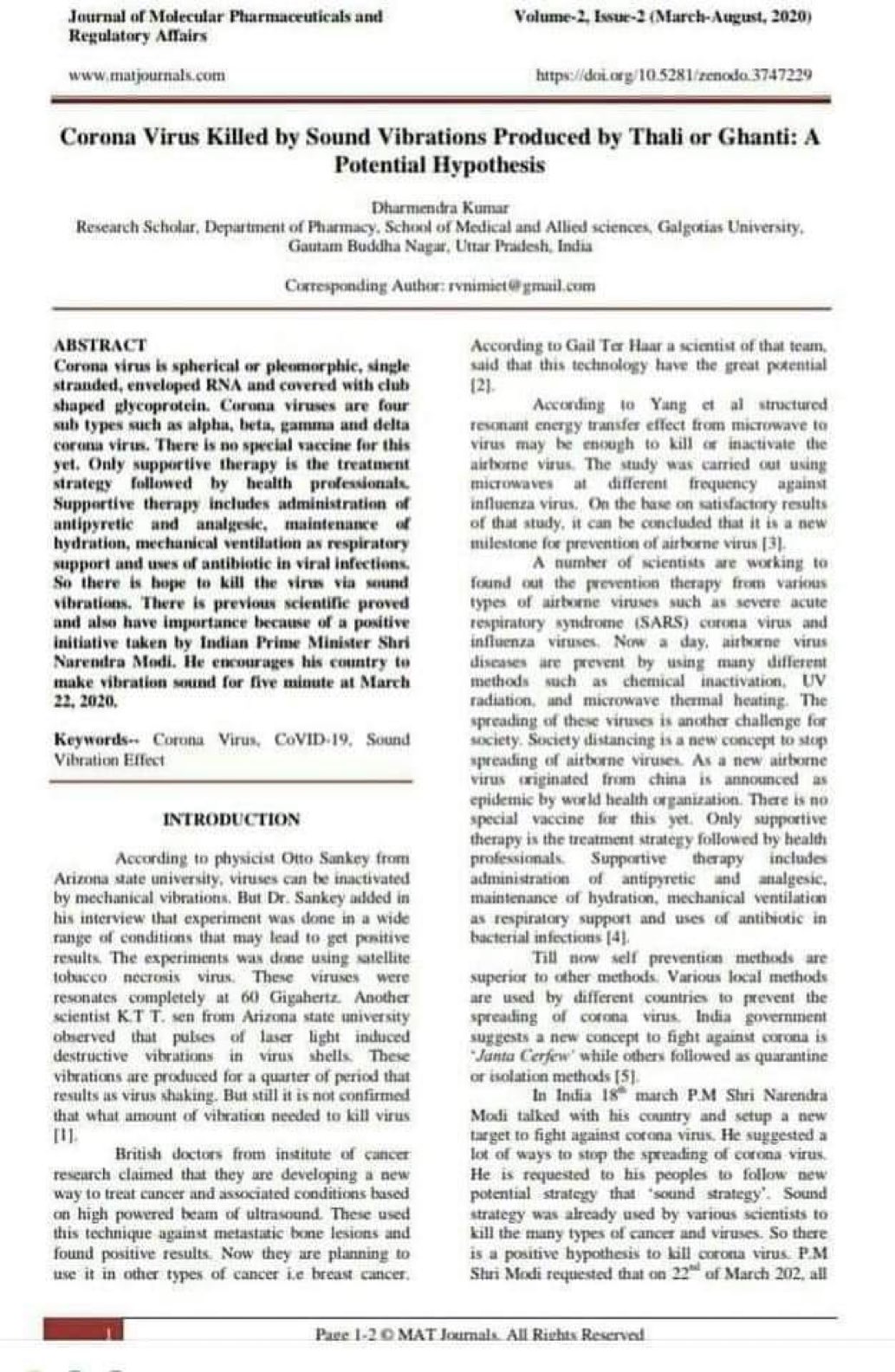 Riding the wave, dharmendra Kumar, a research scholar at Galgotias university, dropped a paper titled "Corona Virus Killed by Sound Vibrations Produced by Thali or Ghanti: A Potential Hypothesis." He seriously argued the clanging could disrupt the virus like microwaves. Pseudoscience dressed as research – and published in a shady journal.
The Backlash and Humiliating Retraction
The internet tore it apart – how does a private university churn out this nonsense? The journal yanked it, admitting a "technical glitch" led to misleading info causing "massive conflicts" in the scientific community. Too late; the damage spotlighted how superstition gets amplified in Modi's India.
Galgotias' Track Record of Shame
This is the same "university" that's back in headlines for passing off a Chinese robot as homegrown innovation. Pattern much? Flashy PR over real academia – and it all traces back to an ecosystem where Modi's symbolic stunts inspire junk over genuine science.
This is the same "university" that's back in headlines for passing off a Chinese robot as homegrown innovation. Pattern much? Flashy PR over real academia – and it all traces back to an ecosystem where Modi's symbolic stunts inspire junk over genuine science.
The Real Cost: Science Sacrificed for Symbolism
While the world raced for vaccines, india got thaali vibes and "research" backing it. Modi's silence on the paper spoke volumes – promoting feel-good rituals over evidence-based action. This fiasco remains a brutal reminder: when leaders peddle superstition, even "universities" follow suit, embarrassing the nation on a global stage.
 click and follow Indiaherald WhatsApp channel