


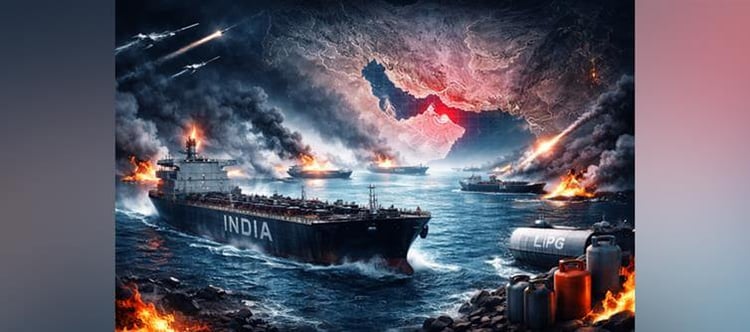

India Pays for a war It Didn’t Start
Wars are rarely contained to battlefields. They ripple through oil markets, shipping lanes, and household budgets thousands of kilometres away. And right now, India’s economy is standing uncomfortably close to the shockwave.
As tensions escalate between Washington, Tel Aviv, and Tehran, the most immediate battlefield for india isn’t military — it’s energy. And energy, in India’s case, is economic oxygen.
Here’s why this moment matters more than most people realise.
1. india Walked Away From Cheap Russian oil — And Into a Risk Zone
Over the past two years, india capitalised on discounted Russian crude. It was pragmatic. It kept inflation manageable. It softened the blow of global volatility.
Now, imports of discounted Russian oil have dropped to their lowest levels since early 2022. In their place? More expensive crude from the gulf and the United States.
That shift wasn’t just about diplomacy. It was about pressure, including U.S. tariff threats that reportedly went as high as 50%. The trade-off: scale back Russian purchases and get tariff relief.
But here’s the catch — cheaper oil reduced price risk. gulf oil increases supply risk.
And supply risk is far more dangerous.
2. The Strait of Hormuz: India’s Single Point of Failure
The world’s most fragile chokepoint just became India’s biggest vulnerability.
50% of India’s oil imports pass through the Strait of Hormuz.
60% of LNG imports flow through that same narrow waterway.
80–85% of India’s LPG — the cooking gas used in millions of homes — comes from the gulf and must transit Hormuz.
Unlike crude oil, india does not maintain strategic reserves of LPG. That means any disruption doesn’t just move markets — it hits kitchens.
A tanker blockade, a missile strike, or even prolonged instability could tighten supply almost overnight.
This isn’t theoretical. It’s structural.
3. Price Shock: Every $10 oil Spike Costs india $14 Billion
oil doesn’t need to stop flowing to hurt India. It just needs to get expensive.
Every $10 rise in crude prices adds roughly $13–14 billion to India’s annual import bill.
That translates into:
Higher fuel prices
Increased transport costs
Rising food inflation
Pressure on the rupee
A wider trade deficit
And when inflation rises, the Reserve bank faces tough choices. Growth slows. Consumers pull back. Businesses delay investment.
The ripple effect touches everyone.
4. From Price Risk to Supply Risk: A Strategic Bet
India’s energy recalibration effectively swapped one vulnerability for another.
Before:
Risk of diplomatic friction
Risk of fluctuating discounts
Now:
Exposure to one of the world’s most volatile maritime chokepoints
Heavy dependence on gulf shipping routes
Immediate sensitivity to Middle east escalation
If the conflict widens or tanker traffic faces disruption, india has limited room to manoeuvre quickly.
That’s the gamble.
5. Meanwhile, china Has Options
Here’s where the geopolitical contrast sharpens.
china can ramp up Russian oil and gas imports through overland pipelines. No chokepoint. No Hormuz exposure. No maritime bottleneck.
If gulf routes become unstable, beijing can pivot more easily.
In practical terms, India’s reduced Russian intake creates more room for china to absorb those supplies — potentially at favourable rates.
At a critical moment, strategic flexibility matters. And right now, china appears to have more of it.
6. Diplomacy Comes With a Bill
Public rhetoric may emphasise friendship and strategic partnership. But energy markets don’t care about political optics.
The economic reality is stark:
Reduced access to discounted Russian oil
Greater exposure to Hormuz
Higher vulnerability to price spikes
Direct inflationary pressure at home
If tensions escalate, india will feel the cost — regardless of its distance from the battlefield.
7. The Real Question: Was the Bet Worth It?
india is not choosing war. But it is navigating the consequences of alignment in a fractured world.
Energy security isn’t just about who you buy from. It’s about how many options you keep open when the world turns unstable.
Right now, nearly half of India’s oil and most of its LPG depend on a narrow stretch of water that has historically been one of the most combustible points on Earth.
One strait. One escalation. One disruption.
And the economic aftershocks would land in indian homes first.
The global order is shifting. Supply chains are being weaponised. Energy flows are political leverage.
In that environment, resilience is power.
The coming months will test whether India’s recalibrated energy strategy is a calculated risk — or a costly miscalculation.
 click and follow Indiaherald WhatsApp channel