


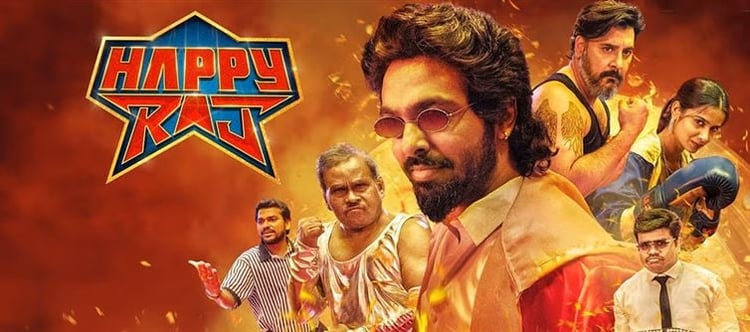

Happy raj Review: A Familiar Ride Saved by Performances and Occasional Laughs
Story & Setup
Happy Raj revolves around Anandh Raj, aka Happy, a well-meaning but socially awkward young man who has had little luck in love. His life takes a turn when he meets Kavya, a woman who genuinely likes him. However, her one condition—that both families must formally meet—sets off the central conflict. Happy’s eccentric and miserly father, Kathamuthu, a village school teacher with a notorious reputation, finds himself at odds with Kavya’s sophisticated, nri father, Rajiv. What follows is a culture clash that attempts to blend comedy, sentiment, and generational friction.
The premise has potential, but the execution struggles to trust the audience. The film opens with an overlong, heavily narrated exposition that spells out Kathamuthu’s backstory and the origin of his nickname. Instead of drawing viewers in, it distances them, making the first act feel like a tedious setup rather than an engaging start.
Narrative & Writing
The biggest issue with Happy Raj is its insistence on over-explaining everything. The storytelling lacks subtlety, often guiding the audience too explicitly through emotional beats and character motivations. What could have been discovered organically is instead handed out in a flat, almost instructional manner.
The writing also leans heavily on body-shaming humor, which starts as a character quirk but quickly becomes repetitive and uncomfortable. The joke overstays its welcome, turning mean-spirited rather than funny. Even as the story progresses into the central conflict between the two fathers, the screenplay relies on contrived situations and convenient setups that rarely feel authentic.
That said, once Happy moves to Bangalore and meets Kavya, the film briefly finds rhythm. The romantic track adds freshness, and the father-versus-father dynamic injects some energy—though even this track is stretched thin by exaggerated writing.
Performances
George Maryan emerges as the film’s backbone. His portrayal of Kathamuthu is committed and grounded, elevating even the weaker portions of the script. He brings sincerity to a character that could have easily slipped into caricature, and his scenes with gv prakash offer genuine emotional warmth.
gv prakash fits comfortably into the lovable-loser archetype. While the character itself is thinly written, he manages to extract enough humor and relatability to keep the narrative afloat. His comic timing works in parts, especially in the film’s lighter moments.
Abbas, making a return to tamil cinema, brings an effortless charm to the role of Kavya’s father. However, the character lacks depth, and the writing doesn’t give him enough space to leave a strong impact beyond nostalgia.
Sri Gouri priya delivers a steady performance, holding her ground without being particularly standout. The supporting cast—including Adhirchi Arun and Premji Amaran—injects intermittent humor that helps sustain the middle portions of the film.
Technical Aspects
Technically, Happy Raj is serviceable but unremarkable. Justin Prabhakaran’s music does its job without leaving a lasting impression. The background score supports the emotional beats but also contributes to the film’s tendency to overemphasize sentiment.
The cinematography and editing are functional, though the pacing suffers in the first half due to the heavy exposition and in the latter half due to repetitive emotional cues. The staging of certain key sequences—like the fathers’ confrontations—feels overly constructed rather than naturally evolving.
Analysis
At its core, Happy Raj tries to explore themes of love, family acceptance, and cultural differences. However, it falls into the trap of romanticizing tradition without questioning its meaning. The emotional arcs feel forced because they are constantly underlined rather than allowed to breathe.
The film works best when it leans into its characters instead of its message. The father-son relationship, in particular, has moments of authenticity that hint at what the film could have been with tighter writing and more restraint.
Unfortunately, the over-reliance on clichés, predictable narrative beats, and exaggerated characterizations dilutes its impact. The humor is inconsistent, the sentiment is overcooked, and the storytelling lacks confidence.
What Works
• George Maryan’s earnest and engaging performance
• Warm father-son moments that feel genuine
• A few well-timed comic sequences
• The initial spark in the romantic track
What Doesn’t
• Overlong, spoon-fed exposition in the opening
• Repetitive and uncomfortable body-shaming humor
• Contrived and unrealistic narrative developments
• Forced sentimentality and lack of subtlety
• Underwritten supporting characters
 click and follow Indiaherald WhatsApp channel