


1. Origin & Appearance
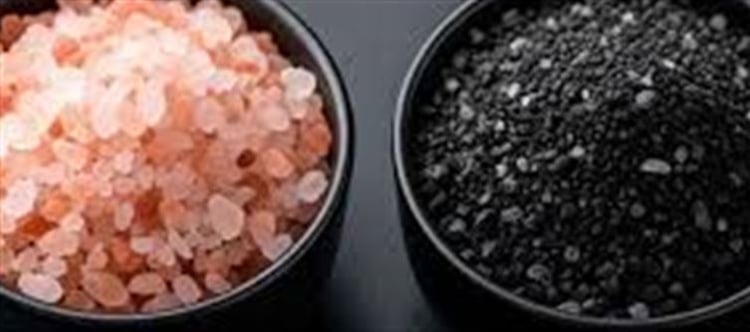
- Black salt (Kala Namak): Originally from Himalayan regions and South Asia, black salt is charcoal‑grey to dark reddish‑brown in color. When ground, it can appear pinkish‑grey.
- Pink salt (Himalayan Salt): Mined mainly from the Khewra salt mines near the Himalayas, it has a light pink to reddish hue due to trace minerals like iron.
2. Taste & Aroma
- Black Salt: Has a strong, pungent, sulfur‑rich taste and smell — often described as egg‑like or umami — due to sulfur compounds formed during processing.
- Pink Salt: Milder and more neutral in flavor, similar to regular salt, with no strong aroma.
3. Processing
- Black Salt: Traditionally involves heating raw salt with charcoal and herbs, which gives it its unique flavor and aroma.
- Pink Salt: Usually mined, washed and crushed with minimal processing, so its natural minerals are preserved.
4. Mineral Content
- Black Salt: Contains sulfur compounds and trace minerals — though scientific evidence for health benefits is limited. It may have slightly lower sodium content than regular salt by volume, which some consider useful for seasoning.
- Pink Salt: Rich in trace minerals like iron (which gives the color), magnesium, potassium and calcium — but these appear in very small amounts and don’t offer major nutritional benefits compared with overall diet.
5. Culinary Uses
- Black Salt: Widely used in indian and South Asian cuisine for chutneys, chaats, fruit salads, raitas and vegan recipes (e.g., to mimic egg‑like flavor).
- Pink Salt: Versatile for everyday cooking, seasoning, grilling, finishing dishes, and even decorative salt blocks.
6. health Claims
- Black Salt: Often associated with digestive benefits in traditional medicine, though scientific support is limited.
- Pink Salt: Popularly marketed as a “healthier alternative” due to trace minerals, but these are too small to make big health differences; also it lacks added iodine, which iodized table salt provides to prevent thyroid issues.
7. sodium and Safety
Both salts are mainly sodium chloride and can raise blood pressure if consumed in excess. Moderation is key regardless of the type you use.
Black salt might have slightly less sodium per teaspoon due to larger crystals, but overall it won’t avoid health risks if eaten in large amounts.
🧑🍳 Quick Summary
Feature
Black salt (Kala Namak)
Pink Himalayan Salt
Color
Grey‑black to reddish
Light pink
Flavor
Strong, sulfur/emami
Mild, neutral
Aroma
Noticeable
Minimal
Processing
Heated with herbs/charcoal
Mined and crushed
Minerals
Trace sulfur compounds
Trace minerals like iron, Mg
Taste Use
Best in snacks & South Asian dishes
Everyday seasoning
Health Claim
Digestive aid (traditional)
Mineral source (limited)
📌 Bottom Line
Both salts add distinct flavour and visual appeal to food, but scientific evidence doesn’t clearly prove one is significantly healthier than the other — and neither should replace iodized salt entirely in diets. Their real differences lie mostly in taste and culinary use, not dramatic health effects.
Disclaimer:
The views and opinions expressed in this article are those of the author and do not necessarily reflect the official policy or position of any agency, organization, employer, or company. All information provided is for general informational purposes only. While every effort has been made to ensure accuracy, we make no representations or warranties of any kind, express or implied, about the completeness, reliability, or suitability of the information contained herein. Readers are advised to verify facts and seek professional advice where necessary. Any reliance placed on such information is strictly at the reader’s own risk.
 click and follow Indiaherald WhatsApp channel