




Iran's IRGC Navy has warned that ships must obtain prior approval to transit the Strait of Hormuz or forfeit any security guarantee, according to Navbharat Times. For india — which routes roughly 60% of its crude imports through this 33-kilometre-wide chokepoint, according to the international Energy Agency — the ultimatum directly threatens energy security, pump prices, and the viability of the Chabahar corridor at a moment when the US-Iran ceasefire is already showing cracks. As of publication, neither India's Ministry of External Affairs nor the Ministry of Petroleum and Natural Gas has issued a public statement on Iran's latest warning.
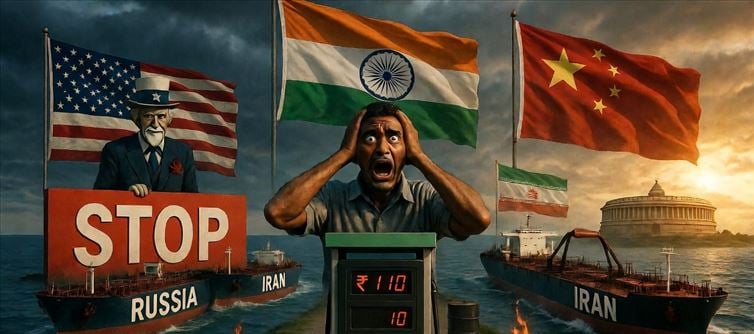
Three consecutive explosions near Sirik on Iran's southern coast. A confirmed drone strike on a container ship. And now, a cold, formal demand from the IRGC Navy: obtain permission before your vessel enters the Strait of Hormuz, or accept that iran guarantees nothing about your safety. For a billion indians whose cooking gas, petrol, and diesel flow through that 33-kilometre ribbon of water, this is not a faraway naval dispute — it is the sound of the pump price meter beginning to tick upward.
View on X
According to Navbharat Times, Iran's Revolutionary Guard Navy has declared that transit through the strategic Strait of Hormuz will henceforth be permitted only via routes approved by Iranian authorities. Vessels that do not comply, the IRGC warned, will receive no security guarantee — a phrase that, in our analysis, is one shade short of an explicit threat in the grammar of gulf brinkmanship.
View on X
The timing is no accident. The US-Iran ceasefire — signed with great fanfare — is, in our editorial assessment, already developing the structural integrity of wet cardboard. A U.S. official confirmed to PBS news in a june 2025 report that iran fired a drone hitting a container ship in the Strait of Hormuz — an act that sits uneasily beside any notion of de-escalation. On the Iranian side, Ebrahim Azizi, a senior political figure, declared bluntly that "the reality in the Persian gulf has changed" and that the strait is now "controlled by Iran." As of publication, neither India's Ministry of External Affairs (MEA) nor the Ministry of Petroleum and Natural Gas (MoPNG) has issued any public response to Iran's latest warning or the reported drone strike.
View on X
View on X
India's $120-Billion Artery, Pulsing Through a Chokepoint
Here is the number that should focus minds in South Block and every indian kitchen simultaneously: india imports approximately 85% of its crude oil, and according to international Energy Agency (IEA) data, an estimated 60% of those imports — a flow worth upwards of $120 billion annually as per India's Petroleum Planning and Analysis Cell (PPAC) trade data — transit the Strait of Hormuz. No other single geographic bottleneck matters as much to India's economy. Not the Suez Canal, not the Malacca Strait. Hormuz is the jugular.
When iran last rattled this sabre in 2019, during the tanker crisis triggered by US maximum-pressure sanctions, global oil prices spiked by over 15% within weeks, according to U.S. Energy Information Administration (EIA) price tracking data. india, which was then importing roughly 500,000 barrels per day of Iranian crude according to PPAC import records, was forced into an abrupt pivot — sourcing alternatives from Iraq, Saudi Arabia, and the spot market at premium prices. indian consumers felt the pinch at the pump within days. The 2019 lesson was supposed to be the wake-up call. What india did with the alarm clock since then is the real question.
Strategic Petroleum Reserves: Ten Days of Comfort, Then What?
India's Strategic Petroleum Reserve (SPR) facilities at Visakhapatnam, Mangalore, and Padur hold a combined capacity of roughly 5.33 million metric tonnes, according to the indian Strategic Petroleum Reserves Limited (ISPRL) — enough, by most estimates, for approximately 9.5 to 10 days of the country's crude oil consumption. Compare that with the United States' Strategic Petroleum Reserve, which even after drawdowns covers roughly 40 days according to the U.S. EIA, or China's reserves estimated at over 80 days per IEA assessments. India's buffer is, to put it diplomatically, a sprinter's head start in a marathon disruption.
The planned Phase-II expansion of India's SPR — adding another 6.5 million metric tonnes at Chandikhol in odisha and Padur — has been in various stages of proposal and delay for years. Against the backdrop of Iran's latest Hormuz warning, the gap between plan and reality is not an administrative footnote. It is a strategic vulnerability the size of a subcontinent's energy bill.
The Chabahar Complication: Delhi's Tightrope Gets Narrower
India's Chabahar port project — the crown jewel of Delhi's strategy to bypass pakistan and connect to afghanistan and Central Asia — sits barely 350 kilometres east of the Strait of Hormuz on Iran's Makran coast. Every escalation in Hormuz tensions raises the insurance costs, shipping risk premiums, and geopolitical complexity around Chabahar. The port's viability depends not just on physical infrastructure but on the perception that the waters around it are navigable without a warship escort.
View on X
Prime minister Modi's government has spent years cultivating a carefully calibrated relationship with Tehran — maintaining the Chabahar lifeline while not antagonising Washington, which has its own, often contradictory, demands on india regarding Iranian engagement. That balancing act is built on the assumption that the Hormuz chokepoint remains, however uneasily, open. If iran converts its warning into even intermittent enforcement — demanding clearances, delaying tankers, raising insurance costs — the whole calculus shifts. Chabahar becomes not just a logistics project but a geopolitical liability that every opposition politician from delhi to the state assemblies will weaponise.
The Ceasefire That Never Quite Started
What makes this moment distinctly more dangerous than 2019 is the context. There is, nominally, a ceasefire on the table. Both sides signed it. Both sides are accused — by their own allies — of violating it almost immediately. The public mood, tracked across indian social media and editorial commentary, reflects deep scepticism: the ceasefire is "cracking," observers note, with both parties "stepping on" the very terms they swore to keep.
For india, the worst-case scenario is not an all-out US-Iran war — that would trigger global mechanisms, NATO consultations, UNSC sessions, and coordinated SPR releases. The real nightmare is a grey-zone disruption: Iranian naval patrols slowing tanker traffic, periodic drone incidents, and insurance premiums for Hormuz-routed cargoes jumping sharply — illustratively, industry analysts have warned such premiums could spike by multiples of their current levels during sustained tension. indian oil marketing companies would absorb costs they cannot pass through without political fallout. This is the scenario that neither makes CNN headlines nor triggers international solidarity — but quietly bleeds the indian exchequer and every household budget.
What Delhi's Real Options Look Like
In the short term, India's petroleum ministry will likely accelerate spot purchases from non-Hormuz sources — West Africa, the Americas, Russia's Pacific-facing ports — though at premium prices. Diplomatic channels between delhi and Tehran will intensify; India's quiet leverage as one of Iran's few remaining major economic partners gives it some room for back-channel influence that Washington lacks. The Chabahar operational committee, reportedly meeting in the coming weeks, will face pointed questions about contingency routing.
But the structural answer — the one that makes india genuinely resilient rather than perpetually reactive — is the SPR expansion that has been on paper for half a decade. Every month of delay is a month in which a 33-kilometre-wide strait, controlled by a state with its own escalatory logic, holds India's energy future as a hostage of geography and geopolitics.
The india Herald Vantage
The Strait of Hormuz is not a new problem. iran has threatened to close or restrict it in 1984, 1988, 2008, 2012, 2018, and 2019. Each time, the world — and india — collectively exhaled when the crisis passed. But the IRGC's latest language is not a threat to close the strait. It is something subtler and, in our analysis, arguably more effective: a demand for permission. The difference between a blockade and a toll booth is enormous in international law and almost invisible in its economic effect. India's $120-billion artery is being asked to carry a permission slip — and the price of that slip, unlike the price of crude, is entirely at Tehran's discretion. Delhi's structural answer, the SPR expansion, remains on paper five years running. Until it is built in steel and filled with crude, india remains perpetually reactive to a chokepoint it has known about for decades. The question is no longer whether the strait will be tested — it is whether india will be ready when it is.
More from india Herald


Key Takeaways
- Iran's IRGC Navy has demanded prior permission for all ship transit through the Strait of Hormuz, warning of no security guarantee for non-compliant vessels, per Navbharat Times.
- Roughly 60% of India's crude oil imports — valued at over $120 billion annually per IEA and PPAC data — transit through this 33-km chokepoint, making it India's single most critical energy bottleneck.
- India's Strategic Petroleum Reserves cover only approximately 9.5–10 days of consumption according to ISPRL, compared to 40+ days for the US (EIA) and 80+ days for china (IEA estimates).
- The Chabahar port project, just 350 km from Hormuz, faces rising insurance and geopolitical risk with every escalation in strait tensions.
- The US-Iran ceasefire is already fraying, with a US official confirming to PBS news a drone strike on commercial shipping and explosions reported near the strait.
- Neither India's MEA nor MoPNG had issued a public response to Iran's latest warning as of publication.
Frequently Asked Questions
What has iran warned about the Strait of Hormuz?
Iran's IRGC Navy has declared that ships must obtain prior approval to transit the Strait of Hormuz via Iranian-approved routes, warning that non-compliant vessels will receive no security guarantee, according to Navbharat Times.
How much of India's oil passes through the Strait of Hormuz?
Approximately 60% of India's crude oil imports — worth over $120 billion annually according to IEA and India's PPAC trade data — transit through the Strait of Hormuz, making it India's most critical energy chokepoint.
How long can India's Strategic Petroleum Reserves last in a disruption?
India's SPR facilities at Visakhapatnam, Mangalore, and Padur hold about 5.33 million metric tonnes according to ISPRL, covering roughly 9.5 to 10 days of national crude consumption — far less than US (40+ days per EIA) or Chinese (80+ days per IEA estimates) reserves.
How does the Hormuz situation affect India's Chabahar port?
Chabahar sits just 350 km east of the Strait of Hormuz. Escalation raises shipping insurance costs, risk premiums, and geopolitical complexity, potentially undermining the viability of India's key connectivity project to Central Asia.
Is the US-Iran ceasefire holding?
Multiple reports suggest both sides are accused of violating the agreement almost immediately after signing. A US official confirmed to PBS news in a june 2025 report that iran fired a drone hitting a container ship in the strait, while explosions have been reported near Iran's southern coast.
Has the indian government responded to Iran's Hormuz warning?
As of publication, neither India's Ministry of External Affairs (MEA) nor the Ministry of Petroleum and Natural Gas (MoPNG) has issued any public statement on Iran's latest Strait of Hormuz warning or the reported drone strike on commercial shipping.
 click and follow Indiaherald WhatsApp channel