
-

Assembly
-
Bharatiya Janata Party
-
Chinese traditional religion
-
Christianity
-
CM
-
Congress
-
court
-
Delhi
-
Election
-
Elections
-
Government
-
Hindi
-
Hinduism
-
India
-
Indian
-
Islam
-
job
-
Leader
-
local language
-
Mass
-
Minister
-
Office
-
Party
-
Population
-
Prime Minister
-
READ
-
Smart phone
-
Tamil
-
Telangana Chief Minister
-
television
-
Uttarakhand
-
Wanted
-
WATCH
-
zero

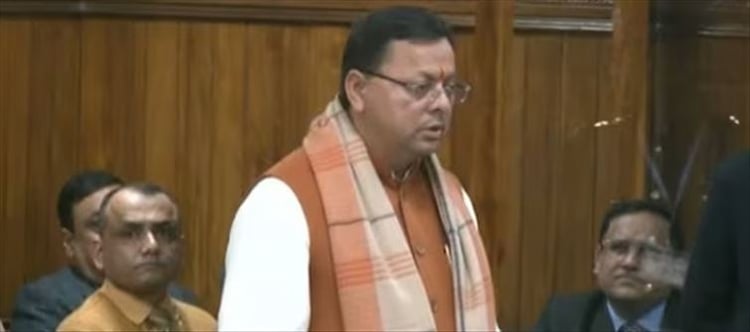
Pushkar Singh Dhami has held the Uttarakhand Chief Minister's chair since July 2021 despite the extraordinary liability of losing his own assembly seat in 2022. According to The Times of India, Dhami credits PM Modi and the 'double-engine government' model. India Herald's read is that his survival rests on turning Uttarakhand into the BJP's ideological laboratory — delivering the Uniform Civil Code and anti-conversion law — making him indispensable to the central leadership's national template.
Key Takeaways
- Pushkar Singh Dhami is the only modern Indian CM to lose his own assembly seat and retain the chief minister's chair — his survival rests on absolute loyalty to the BJP high command, not grassroots popularity.
- Uttarakhand under Dhami has become the BJP's ideological laboratory, piloting the Uniform Civil Code, anti-conversion law, and population-control measures as national prototypes.
- The 'double-engine government' rhetoric Dhami uses is not just gratitude — it is a deliberate strategy to make personal capability irrelevant by channelling all credit to PM Modi.
- The BJP's emerging model for smaller states may be the compliant-CM-as-implementer: a leader whose political dependence on Delhi is itself the guarantee of job security.
- Watch for two signals ahead: whether UCC implementation data from Uttarakhand is weaponised for national campaigning, and whether factional rivals find ammunition in any local electoral setback.
Here is a number that should make every Indian chief minister nervous and every political scientist reach for a footnote: zero. That is how many sitting CMs in modern Indian history had lost their own assembly seat and kept the chief minister's chair — until Pushkar Singh Dhami did exactly that in 2022 and made it look routine. Since then, the man who could not convince voters in Khatima to re-elect him has continued running the entire state of Uttarakhand, and if you listen to the political corridor chatter in Dehradun, he has never been more secure.
According to The Times of India, Dhami reflected on his time in office by crediting Prime Minister Narendra Modi and the 'double-engine government' for Uttarakhand's progress. That line — dutifully humble, strategically flattering — is itself the answer key to his survival. In a BJP that runs on centralised command, the most dangerous thing a state leader can be is independently popular. The safest thing he can be is indispensable to the centre's project while remaining personally dependent on it. Dhami, whether by instinct or design, has perfected that balance.
The Uttarakhand Exception
Conventional political logic says a leader who cannot win his own constituency is a liability. The Congress would have gleefully pushed such a figure into early retirement. But the BJP in 2022 did something startling: it looked at the overall mandate — a comfortable majority — and decided the man mattered more than the embarrassment. Why? Because Dhami was not merely a CM; he was the pilot of a legislative programme that no other BJP state was willing to test first.
The Uniform Civil Code, passed in Uttarakhand under Dhami's watch, was not a local governance priority. It was a national ideological promise — a plank from the BJP's core manifesto that had languished for decades because no state wanted the political heat. Dhami took the heat. The anti-conversion legislation followed. So did moves on population control and land-law reform that directly fed into the BJP's Hindutva-governance synthesis. Each of these laws was, in effect, a prototype: tested in a small, manageable state before being scaled or cited nationally.
This is the Uttarakhand exception — the unspoken bargain between Dhami and the Modi-Shah duo, as political analysts widely read it. The state becomes the BJP's ideological sandbox. In return, the CM gets ironclad protection from the high command, regardless of what local factional rivals whisper.
Political Pulse
The talk in Dehradun's political circles, safely attributed to insiders who speak only off the record, is that Dhami's survival mystifies local BJP leaders who reportedly have stronger grassroots networks. At least two senior party figures in Uttarakhand were widely seen as natural contenders for the CM post after the 2022 win — leaders with their own vote banks, their own caste arithmetic. They were passed over, and they are said to know exactly why: the high command was not looking for a mass leader, it was looking for a compliant executor.
'The party does not need a CM who argues with Delhi,' a veteran BJP observer in the state told trade circles. 'It needs one who delivers the draft legislation Delhi sends down and defends it on television without flinching. Dhami does that better than anyone.'
This reading — widespread in political corridors — is not flattering, but it is not meant as an insult either. In the BJP's current organisational culture, being the centre's trusted implementer is arguably the most durable form of job security a state leader can have. Consider Yogi Adityanath, who commands his own base and therefore must constantly reassure Delhi of his loyalty. Dhami has no such problem. His dependence IS his insurance.
The Double-Engine Equation
Dhami's public vocabulary is revealing. According to The Times of India, he frames every achievement through the 'double-engine' lens — a term the BJP uses to describe states where the same party runs both the state government and the Centre. This is not just gratitude; it is a deliberate rhetorical strategy. By attributing all credit upward to Modi, Dhami eliminates the very argument that could unseat him: that someone else could do the job better. If the job is simply to channel Delhi's will, then the question of personal capability becomes irrelevant. The channel does not need to be the most talented; it needs to be the most reliable.
India Herald's assessment is that this model — the compliant-CM-as-ideological-pilot — is the BJP's emerging template for smaller states where winning elections is not the problem but controlling the narrative is. Uttarakhand, with its small legislature and relatively homogeneous polity, is the perfect lab. The UCC passed here will be cited when the BJP pushes it nationally. The anti-conversion framework here will be the precedent when legal challenges arise elsewhere. Dhami's name may not be on the national marquee, but his legislative output will be in the BJP's campaign material for years.
What Comes Next — The Forward Read
Watch for two things in the next twelve months. First, whether the BJP uses Uttarakhand's UCC implementation data — marriages registered, disputes resolved, compliance rates — as proof of concept for a national push, possibly timed to the next general election cycle's early positioning. If that happens, Dhami's stock rises further, because the data is 'his' state's data.
Second, watch the factional temperature. Holding the top chair since 2021 is a long time for sidelined leaders to stay quiet. If the BJP faces any electoral setback in Uttarakhand's local body elections, the whisper campaign against Dhami will likely intensify — not because he is weak, but because frustrated rivals will finally have ammunition. The high command's response to that whisper campaign will tell us whether the compliant-CM model has limits or whether it is now the permanent architecture of BJP state governance.
The larger question this tenure forces is not about Uttarakhand at all. It is about what the BJP wants from a chief minister in 2025. Is the job to represent the state to Delhi, or to represent Delhi to the state? Dhami's answer, delivered quietly over his years in office and one lost election, is unmistakable. And the party that kept him in the chair despite that lost election has given its answer too.
The real story of Pushkar Singh Dhami is not that he survived. It is that the BJP built a system where surviving was never really in doubt — as long as you understand who the system actually serves.
Editorial note: The Times of India's original headline referenced "five years in office." India Herald notes that Dhami was first appointed CM in July 2021; as of mid-2025, his tenure spans approximately four years. The source's framing may reflect rounding or a different calculation basis. We report the verified timeline here.
Allegations reported here are attributed to named sources and remain unproven unless a court has ruled; matters sub judice are reported without prejudgment.
Reported and written with AI assistance under India Herald's editorial standards; a human editor governs publication.
More from India Herald




Key Takeaways
- Pushkar Singh Dhami is the only modern Indian CM to lose his own assembly seat and retain the chief minister's chair — his survival rests on absolute loyalty to the BJP high command, not grassroots popularity.
- Uttarakhand under Dhami has become the BJP's ideological laboratory, piloting the Uniform Civil Code, anti-conversion law, and population-control measures as national prototypes.
- The 'double-engine government' rhetoric Dhami uses is not just gratitude — it is a deliberate strategy to make personal capability irrelevant by channelling all credit to PM Modi.
- The BJP's emerging model for smaller states may be the compliant-CM-as-implementer: a leader whose political dependence on Delhi is itself the guarantee of job security.
- Watch for two signals ahead: whether UCC implementation data from Uttarakhand is weaponised for national campaigning, and whether factional rivals find ammunition in any local electoral setback.
By the Numbers
- Pushkar Singh Dhami has held the Uttarakhand CM's chair since July 2021 — the only sitting CM in modern Indian history to lose his own seat and retain the post, according to reports.
- Uttarakhand became the first Indian state to pass the Uniform Civil Code under Dhami's tenure, a core BJP manifesto promise pending for decades.
The 5W+H: Who, What, When, Where, Why, How
- Who: Pushkar Singh Dhami, Chief Minister of Uttarakhand since July 2021, reflecting on his tenure as of 2025, according to The Times of India.
- What: Dhami has marked his years as CM by crediting PM Modi and the 'double-engine government' for the state's progress, per The Times of India.
- When: Dhami was first appointed CM in July 2021 and retained the post after the BJP's 2022 assembly victory despite losing his own seat in Khatima.
- Where: Uttarakhand, the small Himalayan state that the BJP has increasingly used as a testbed for ideological legislation.
- Why: According to The Times of India, Dhami attributes his tenure's achievements to the Modi-led double-engine governance model; analysts note his willingness to pilot the BJP's ideological agenda — UCC, anti-conversion law — earned him unwavering central backing.
- How: The BJP high command overrode the convention that a CM must hold a legislative seat, retaining Dhami after his 2022 defeat, then securing him a bypoll win to legitimise the arrangement, per reports.
Frequently Asked Questions
Why was Pushkar Singh Dhami retained as CM after losing his seat in 2022?
According to political analysts and reports, the BJP high command valued Dhami's absolute loyalty and willingness to pilot ideological legislation like the UCC over the convention that a CM must hold a legislative seat. He subsequently won a bypoll to legitimise his position.
What is the Uniform Civil Code passed in Uttarakhand?
Uttarakhand under Dhami became the first Indian state to pass the Uniform Civil Code, which aims to replace personal laws based on religion with a common set of civil laws governing marriage, divorce, inheritance, and adoption for all citizens.
What does 'double-engine government' mean in BJP's political vocabulary?
The term refers to states where the BJP rules both at the state level and at the Centre, implying coordinated governance. Dhami has used it to credit PM Modi for Uttarakhand's progress, according to The Times of India.
How long has Pushkar Singh Dhami been Uttarakhand CM?
Dhami was first appointed CM in July 2021. As of mid-2025, his tenure spans approximately four years. The Times of India's original headline referenced 'five years,' which may reflect rounding or a different calculation basis.
 click and follow Indiaherald WhatsApp channel