
-

Air
-
Audience
-
Bharatiya Janata Party
-
Bihar
-
Chennai
-
Cheque
-
CM
-
Crush
-
Dargah Sharif
-
Delhi
-
District
-
Election
-
English
-
Event
-
Fire
-
gold
-
Government
-
Greenland
-
India
-
Indian
-
Jayalalithaa
-
job
-
Kumbakonam
-
Leader
-
M G Ramachandran
-
Marina Beach
-
Minister
-
Party
-
police
-
Population
-
READ
-
september
-
Tamil
-
Telangana Chief Minister
-
Tsunami
-
Vaishno Devi
-
WATCH
-
zero

CM Vijay visited Karur on July 10, 2026, met families of the September 2025 stampede victims, handed over 32 government job appointment orders, announced a memorial, and publicly blamed police for failing to inform him of the crowd size — a crisis response that combines populist compassion with bureaucratic scapegoating in a pattern Tamil Nadu's film-star CMs have perfected before him.
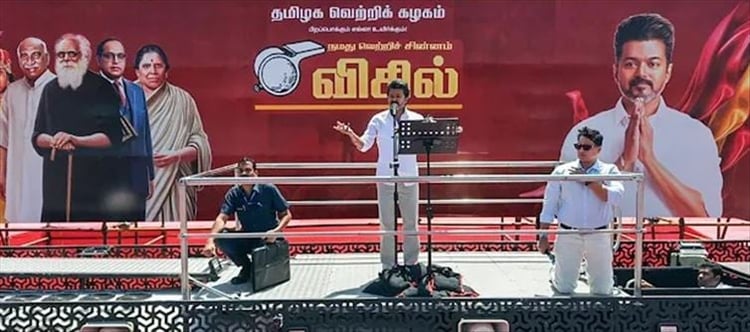
Nine months. That is how long the families of the Karur stampede dead waited for the Chief Minister of Tamil Nadu to sit across from them in their own district and say something — anything — about why their people died in a crowd that had gathered to see him. On July 10, 2026, CM Vijay finally came to Karur. He brought 32 government job appointment orders, the promise of a memorial, and a single sharp accusation aimed squarely at his own police force. According to The Hindu, Vijay publicly stated that the police had failed to inform him about the size of the crowd on September 27, 2025 — the day the stampede killed multiple people at a public event connected to his political rise.
It was, by any measure, a textbook crisis performance. Compassion for the families, material redress through permanent government employment, a monument to enshrine the dead in public memory, and — most critically — a villain who was not Vijay himself. The police. The faceless, transferable, perennially blame-absorbing Tamil Nadu police.
The question India Herald's read of this moment raises is not whether the grief is real. It almost certainly is. The question is whether this crisis playbook — comfort the victims, sanctify them with a memorial, blame the bureaucracy — is governance or choreography. And whether a superstar CM whose crowd-drawing power is itself the lethal variable can survive his own popularity without eventually owning the risk it creates.
The Karur Timeline: What Actually Happened
The stampede occurred on September 27, 2025, according to the Times of India. Large crowds had gathered at a public event in Karur associated with Vijay's political movement, which was then consolidating ahead of his eventual entry into the Chief Minister's office. The crush killed several people — ordinary citizens, many of them fans — in circumstances that pointed to a catastrophic failure of crowd management.
For months afterward, opposition voices and victims' families demanded accountability. Who authorised the event? Who assessed crowd capacity? Who failed to deploy adequate barriers and medical infrastructure? These questions hung in the air through the election cycle, through Vijay's swearing-in, and through the early months of his government. According to The Hindu, the CM's visit on July 10 was the first time he personally met the families in Karur since taking office.
32 Jobs and a Memorial: The Redress Package
According to The Hindu, Vijay handed over appointment orders for government jobs to 32 family members of the deceased — a significant gesture in a state where a permanent government post remains the gold standard of economic security. The Times of India confirmed the visit and the job announcements. Vijay also announced that a permanent memorial would be erected in Karur to honour the stampede victims.
The 32 jobs are not symbolic. In Tamil Nadu's political economy, a government job for a bereaved family is the most tangible, most valued form of state compassion. It signals that the state acknowledges a debt. Jayalalithaa used this instrument — government jobs for victims' kin — after the Kumbakonam school fire of 2004 and after multiple flood disasters. MGR, before her, understood the same arithmetic: a monthly salary outlasts a one-time ex gratia cheque in both economic impact and political memory.
The memorial announcement follows the same grammar. Tamil Nadu has a deeper tradition of political memorials than perhaps any other Indian state — from the Marina Beach stretch of leader monuments to district-level martyrdom markers. A memorial converts a moment of administrative failure into a permanent site of public reverence, and the CM who builds it becomes its custodian, not its cause.
Political Pulse
Here is what no one in Vijay's Tamilaga Vettri Kazhagam (TVK) will say on the record, but what the political corridors of Chennai are buzzing about: the police-blaming was not a spontaneous expression of anger. It was, according to the talk in ruling party circles, a carefully considered move designed to accomplish three things simultaneously.
First, it externalises the blame. The stampede happened at a Vijay-linked event. The crowd came for Vijay. In a strict accountability reading, the principal — the person whose presence created the risk — bears moral if not legal responsibility. By pointing at the police, Vijay shifts the frame from "your crowd killed people" to "the state apparatus failed to protect the people who came to see their leader." The distinction is enormous.
Second, it sends a message to the bureaucracy. According to News18's coverage of the visit, Vijay's remarks carried the implicit warning that his government would hold officials accountable for field-level failures. For a first-term CM whose entire administrative machinery is inherited from the previous DMK government, this public dressing-down serves as a loyalty test: are you with this government, or are you still operating on the old regime's playbook?
Third — and this is the dimension the rest of the coverage has missed — it pre-empts the opposition. The DMK, which lost power to Vijay's TVK, had been quietly building a narrative that the Karur stampede was proof of Vijay's inexperience, his inability to manage the consequences of his own celebrity. By visiting Karur, handing out jobs, and publicly naming the police as the failure point, Vijay has seized the narrative before the DMK could weaponise the anniversary.
The whisper in opposition circles, according to political observers tracking Tamil Nadu closely, is that Vijay's team studied how Jayalalithaa handled the 2005 tsunami aftermath — swift visits, visible compassion, blame directed at the Centre's delayed response — and reverse-engineered the playbook for Karur. Whether this is flattering or damning depends entirely on whether you believe crisis management is a performance or a policy. In Tamil Nadu politics, it has always been both.
(This reflects political corridor chatter and analytical inference, not confirmed strategic deliberations.)
The Deeper Problem Vijay Cannot Memorial Away
India Herald's assessment of what this moment truly exposes is uncomfortable for TVK: the Karur stampede was not a one-off administrative lapse. It was a structural consequence of Vijay's singular political asset — his ability to draw enormous, emotionally charged crowds. Every future TVK rally, every public darshan, every district tour carries the same latent risk. The police can be blamed once. They cannot be blamed every time.
Compare this to how MGR managed his own crowd phenomenon in the 1970s and 1980s. MGR's AIADMK developed, over time, a highly disciplined cadre-based crowd management system — party volunteers who doubled as marshals, pre-event coordination with district collectors, strict venue capacity limits. The system was not built out of administrative virtue; it was built because MGR understood that a dead fan is a political liability no amount of memorials can erase.
Vijay's TVK, by contrast, is a party still in its institutional infancy. According to political analysts quoted in multiple reports during the election cycle, TVK's organisational depth remains thin compared to the DMK or AIADMK. The Karur stampede was, in part, a symptom of that thinness — a party that could summon a massive crowd but could not manage one.
The 32 jobs and the memorial address the past. The question that should keep TVK strategists awake is the future: what happens at the next massive Vijay event when the crowd again exceeds every estimate? The police, having been publicly humiliated once, may now err toward excessive restrictions — which creates its own political problem for a leader whose power comes from proximity to the people.
What Comes Next
Watch for two things in the weeks ahead. First, whether the Tamil Nadu police association or senior officers push back — even quietly — against Vijay's public blame. A silent bureaucratic revolt, expressed through deliberate over-cautioning at future events or through strategic leaks to the press, would be the first real test of whether Vijay commands his own machinery or merely occupies its chair.
Second, watch whether the DMK pivots from the stampede itself to the nine-month delay in visiting Karur. The gap between September 27, 2025 and July 10, 2026 is politically exploitable — "he came only when it was convenient" is a line that writes itself. If Stalin's party deploys it effectively, the memorial visit could become evidence of calculation rather than compassion.
For now, CM Vijay has executed the oldest move in Tamil Nadu's film-star-to-politician playbook: absorb the grief, distribute the relief, blame the system, and walk away looking like the only person who cared. It works — until the next crowd gathers, and the same question returns with a body count attached to it.
More from India Herald


Key Takeaways
- CM Vijay visited Karur on July 10, 2026 — over nine months after the September 2025 stampede — and handed 32 government job appointment orders to victims' families, according to The Hindu.
- Vijay publicly blamed the Tamil Nadu police for failing to inform him about the crowd size, effectively externalising responsibility for the deaths away from his own political machinery.
- The memorial announcement and jobs package mirrors the crisis playbook used by Jayalalithaa and MGR — convert administrative failure into state compassion, with the CM as custodian rather than cause.
- The deeper structural problem remains: TVK's organisational thinness means Vijay's crowd-drawing power is itself the unmanaged risk, and blaming police is a one-time deflection, not a systemic fix.
- The political corridors are watching whether the police push back quietly and whether the DMK weaponises the nine-month delay between the stampede and the CM's visit.
By the Numbers
- 32 government job appointment orders handed to families of Karur stampede victims by CM Vijay on July 10, 2026 — according to The Hindu.
- The stampede occurred on September 27, 2025, meaning the CM's first visit to Karur to meet families came over 9 months later — per Times of India's timeline.
The 5W+H: Who, What, When, Where, Why, How
- Who: Tamil Nadu Chief Minister Vijay, accompanied by senior officials, visited the families of victims killed in the Karur stampede — according to The Hindu and Times of India.
- What: CM Vijay announced a memorial for the stampede victims, handed over 32 government job appointment orders to victims' family members, and publicly faulted the police for not informing him about the size of the crowd, according to The Hindu.
- When: The visit took place on July 10, 2026; the stampede itself occurred on September 27, 2025, according to the Times of India.
- Where: Karur, Tamil Nadu, where the stampede had occurred during a public event linked to the then-rising political movement around Vijay, according to The Hindu.
- Why: CM Vijay stated the police failed in their duty to inform him about the crowd gathering, suggesting the deaths were avoidable had he been alerted — according to The Hindu's report of his remarks.
- How: Vijay personally handed over appointment orders for government jobs to 32 family members of the deceased, announced plans for a permanent memorial, and made public remarks attributing responsibility to the police apparatus, according to The Hindu.
Frequently Asked Questions
What did CM Vijay announce for the Karur stampede victims?
According to The Hindu, CM Vijay visited Karur on July 10, 2026, handed over 32 government job appointment orders to family members of the deceased, announced a permanent memorial, and publicly faulted the police for not informing him about the crowd size.
When did the Karur stampede happen and how many died?
The stampede occurred on September 27, 2025, during a public event linked to Vijay's political movement in Karur, Tamil Nadu, according to the Times of India. Multiple people were killed in the crowd crush.
Why did CM Vijay blame the police for the Karur stampede?
Vijay publicly stated that the police failed in their duty to inform him about the size of the crowd gathering, suggesting the deaths were avoidable had proper warnings been given, according to The Hindu's report of his remarks.
How does Vijay's crisis response compare to Jayalalithaa and MGR?
Political analysts note that Vijay's combination of victim compensation through government jobs, a memorial announcement, and blame directed at the bureaucracy closely mirrors the crisis management playbook used by both Jayalalithaa and MGR during disasters and public tragedies in Tamil Nadu.
 click and follow Indiaherald WhatsApp channel