
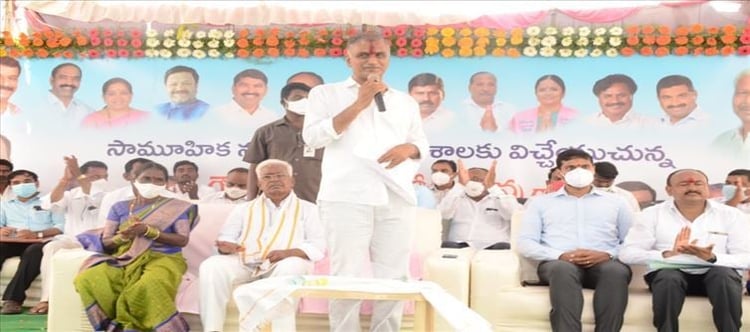


BRS leader Harish Rao has accused Telangana CM Revanth Reddy of openly calling for bloodshed against political opponents, according to the Deccan Chronicle. But the real story is strategic: Revanth is deliberately adopting a hyper-aggressive posture to shed Congress's soft image and force BRS onto the back foot — and BRS, by complaining, is proving it's working.
A Chief Minister who talks about bloodshed against rivals. An Opposition leader who responds not with a counter-rally, but with a formal complaint. If you want to understand who holds power in Telangana right now — forget the assembly arithmetic. Listen to the language.
According to the Deccan Chronicle, BRS senior leader T. Harish Rao has accused Telangana CM Revanth Reddy of calling for bloodshed against political opponents. The word itself — bloodshed, from the mouth of a sitting Chief Minister — would have been unthinkable in mainstream Telangana politics even five years ago. But Revanth Reddy is not a politician who deals in the thinkable. He is a man who climbed from a ZPTC member to the Chief Minister's chair in two decades, a trajectory the Deccan Chronicle has detailed as one of the most aggressive ascents in modern Telangana history. The language is not a slip. It is a strategy.
Political Pulse
Here is what the coverage will not say plainly, so India Herald's read of what is really driving this will: Revanth Reddy is not losing his temper. He is deliberately torching the rhetorical rulebook that K. Chandrashekar Rao once owned. For a decade, KCR was the man who set the temperature in Telangana — the one who could call opponents traitors, question their commitment to Telangana statehood, and make entire parties flinch with a single press conference. Congress, in that era, was the party that issued polite press notes that nobody read. Revanth has reversed the equation entirely. He has adopted the exact hyper-aggressive, street-fighter posture that KCR perfected — but turned it against BRS itself.
The calculation is not complicated, but it is ruthless. By using language that shocks — bloodshed, no less — Revanth achieves three things simultaneously. First, he signals to Congress cadre across Telangana that the party's leadership is no longer timid. For workers who spent years watching BRS bulldoze them in local politics, a CM who talks tough is a CM worth fighting for. Second, he puts BRS in an impossible bind: respond with equal aggression and risk looking like the party of disorder, or file formal complaints and look weak. Harish Rao, a shrewd political operator who once managed KCR's entire electoral machinery, has chosen the latter. That choice is itself the story.
The talk in Congress circles, safely attributed to the party's internal mood rather than any single voice, is that Revanth is doing to BRS exactly what KCR did to Congress between 2014 and 2023 — suffocating the opposition's oxygen by dominating every news cycle with provocation. The difference is that KCR did it from a position of total state dominance. Revanth is doing it while also navigating real governance crises — including the political heat over Gurukul tender allegations that the Deccan Chronicle has separately reported, which gives BRS genuine ammunition. That Revanth chooses to escalate the rhetorical war even while facing governance scrutiny suggests he believes attack is the only defence worth deploying.
Consider the deeper irony. Harish Rao's complaint frames BRS as the party defending democratic decency — the party that wants civilised discourse, that is appalled by violent language. This is the same BRS whose leaders, during the Telangana statehood movement, made rhetoric that would make Revanth's current language sound like a parliamentary address. The political grammar has flipped so completely that BRS is now the party clutching its pearls, and Congress is the party with the swagger. Whether you think that swap is healthy for democracy depends on which side of Telangana's political divide you sit on — but that it has happened at all is the most significant shift in the state's politics since the 2023 election.
There is a word doing the rounds in Hyderabad's political corridors for what Revanth is attempting: demoralisation warfare. The idea is not to defeat BRS in the next election — that is still years away — but to make BRS cadre feel, in their bones, that their party's best days are behind them. Every time a sitting CM uses language that a sitting CM is not supposed to use, and gets away with it without institutional consequence, it sends a message: the old rules do not apply, and the new rules are mine. Harish Rao's complaint, far from checking Revanth, amplifies this message. It tells every BRS worker that the party's response to a street fight is to call the teacher.
Revanth's own political biography makes this posture credible in a way it would not be for a typical Congress leader. As the Deccan Chronicle's profile of his twenty-year journey from ZPTC to CM notes, this is a man who defected from TDP to Congress, survived being sidelined, and then rode the anti-incumbency wave against KCR to the top job. He is not a dynasty product performing toughness. He is a self-made political brawler who genuinely relishes confrontation. BRS's problem is not just that Revanth is aggressive — it is that he is authentically aggressive, and voters can tell the difference.
What Comes Next — The Forward Read
In India Herald's assessment, the likely next chapter unfolds along two tracks. If BRS continues to respond to Revanth's provocations with formal complaints and appeals to decorum, it risks completing its transformation from a ruling party to a permanently reactive opposition — the exact trajectory Congress followed from 2014 to 2023. The alternative — matching Revanth's aggression — carries its own danger, because BRS no longer has state machinery to back its rhetoric, and a street confrontation without institutional power behind it is just noise.
Watch for whether KCR himself enters the rhetorical arena. His silence in recent months has been conspicuous. If even Revanth's bloodshed language does not draw KCR out, it will confirm what many in Hyderabad's political circles already suspect: that BRS's leadership has decided to hunker down and wait for Congress to self-destruct on governance, rather than compete in the arena of provocation. Whether that patience is strategic wisdom or political paralysis is the question that will define Telangana's next election cycle.
The uncomfortable truth for both parties — and this is the part no press release from either side will acknowledge — is that Telangana's voters have shown a consistent appetite for strong, aggressive leadership over polished restraint. KCR understood this before anyone. Revanth understands it now. The only question is whether the voters who rewarded KCR's aggression when it came with development will reward Revanth's aggression even if the governance record is spotty. That is the bet Revanth is making every time he opens his mouth.
Reported and written with AI assistance under India Herald's editorial standards; a human editor governs publication.
Allegations reported here are attributed to named sources and remain unproven unless a court has ruled; matters sub judice are reported without prejudgment.
More from India Herald
Key Takeaways
- Revanth Reddy's 'bloodshed' remark is not a gaffe — it is a calculated adoption of the hyper-aggressive rhetorical style that KCR once monopolised in Telangana, now turned against BRS itself.
- Harish Rao's decision to respond with a formal complaint rather than a counter-rally signals that BRS has been pushed into a reactive, defensive posture — the same trap Congress was stuck in for nearly a decade.
- The real contest is not over language but over who controls Telangana's political grammar: the party that sets the temperature or the party that complains about the heat.
- Watch for KCR's response — or continued silence. If even 'bloodshed' language does not draw him out, it confirms BRS has shifted to a wait-and-watch strategy, ceding the initiative to Congress.
By the Numbers
- Revanth Reddy's political career spans 20 years — from ZPTC member to Telangana CM, one of the most aggressive ascents in modern state politics, per Deccan Chronicle.
- BRS ruled Telangana for approximately a decade (2014–2023) before losing power to Congress in the 2023 assembly elections.
The 5W+H: Who, What, When, Where, Why, How
- Who: Telangana CM Revanth Reddy (Congress) and senior BRS leader T. Harish Rao, as reported by Deccan Chronicle.
- What: Harish Rao accused Revanth Reddy of calling for bloodshed against political opponents, framing it as a threat to democratic norms, according to Deccan Chronicle.
- When: The remarks and the formal complaint surfaced in 2026, amid escalating rhetorical hostility between Congress and BRS in Telangana.
- Where: Telangana — the political confrontation plays out across state-level forums and public speeches.
- Why: Revanth Reddy appears to be deliberately adopting a street-fighter posture to demoralise BRS cadre and establish Congress's dominance in Telangana's political discourse, according to India Herald's analysis of the pattern.
- How: Through repeated inflammatory public remarks that force BRS leaders like Harish Rao to respond defensively — filing complaints and issuing condemnations — rather than setting the agenda themselves, as reported by Deccan Chronicle.
Frequently Asked Questions
What did Revanth Reddy say about bloodshed?
According to the Deccan Chronicle, BRS leader Harish Rao accused Telangana CM Revanth Reddy of calling for bloodshed against political opponents. Revanth's camp has not issued a detailed clarification as of this report.
Why did Harish Rao file a complaint against Revanth Reddy?
Harish Rao accused Revanth of using inflammatory and violent language against political rivals, framing it as a threat to democratic norms in Telangana, as reported by the Deccan Chronicle.
Is BRS losing political ground to Congress in Telangana?
Since losing the 2023 assembly elections, BRS has shifted from an agenda-setting ruling party to a reactive opposition. Revanth Reddy's aggressive rhetorical posture has further forced BRS into a defensive position, with leaders responding through complaints rather than counter-mobilisation.
How did Revanth Reddy rise to become Telangana CM?
Revanth Reddy's political journey spans 20 years, from ZPTC member to Telangana Chief Minister, including a defection from TDP to Congress. The Deccan Chronicle has documented this as one of the most rapid and aggressive political ascents in modern Telangana history.
 click and follow Indiaherald WhatsApp channel