
-

Argentina
-
Assembly
-
British
-
court
-
Delhi
-
England
-
English
-
Heritage Foods
-
history
-
India
-
Indian
-
Indian Oil Corporation
-
INTERNATIONAL
-
Jammu and Kashmir - Srinagar/Jammu
-
Jersey
-
local language
-
March
-
MP
-
Olympic Games
-
politics
-
Population
-
READ
-
REVIEW
-
Spain
-
SPORTS
-
Switzerland
-
Tokyo
-
tollywood-guest-roles
-
United Kingdom
-
VIEW
-
war
-
World Cup
-
zero

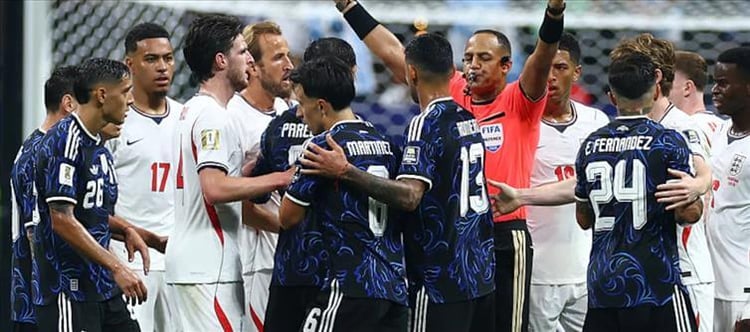
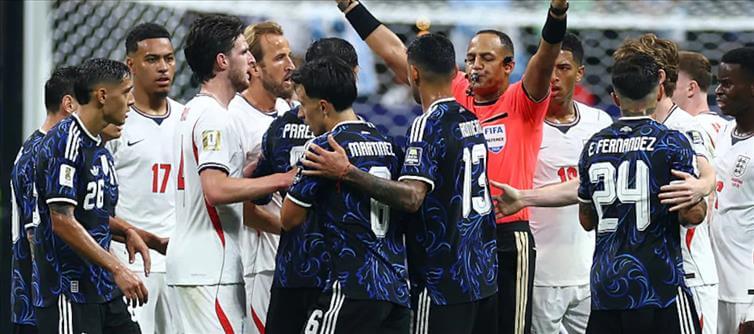
Argentina's Falklands flag display after the World Cup semifinal is not just a FIFA disciplinary matter — it forces India, which backs Argentina's sovereignty claim at the UN, to confront the volatile overlap between sports hosting ambitions and geopolitical commitments, according to reports in The Hindu and India Today.
A football pitch is, by FIFA's own statute, supposed to be the one place on earth where nations compete without the freight of their territorial grudges. On that principle, Argentina's players took a blowtorch to the rulebook — unfurling a banner reading 'Las Malvinas Son Argentinas' within seconds of knocking England out of the World Cup 2026 semifinal, according to The Hindu. The gesture was not spontaneous. The banner was prepared, carried onto the field, and held up for cameras broadcasting to an estimated two billion viewers. And somewhere in South Block, a diplomat who tracks both UN General Assembly voting records and FIFA's disciplinary code is now pulling a very long face.
Because this is not merely Buenos Aires versus London. India has a stake here that no other major footballing aspirant shares — a decades-old, consistent UN vote backing Argentina's sovereignty claim over the Falkland Islands, a position New Delhi reaffirmed as recently as the UN Decolonization Committee sessions. That vote has always been a quiet piece of non-aligned legacy furniture, dusted off annually and put back in the corner. Argentina's players just dragged it onto the world's biggest stage and set it on fire.
Let us be precise about what FIFA's rules say. Article 4 of the FIFA Disciplinary Code, as noted by India Today, explicitly prohibits "political slogans, messages or images" on the field of play. The penalty range is broad — fines, stadium bans, even point deductions in extreme cases. The Times of India reports that FIFA is expected to open a disciplinary investigation. Argentina's football association (AFA) now faces the very real prospect of sanctions ahead of the World Cup final against Spain, as reported by The Indian Express and Hindustan Times.
Political Pulse
Here is what the coverage will not say out loud but the corridors in Lutyens' Delhi are murmuring: India's 2036 Olympic bid and its persistent — if still largely aspirational — interest in hosting a future FIFA World Cup rest on a foundational promise to the International Olympic Committee and FIFA that Indian venues and Indian diplomacy can keep politics out of sport. That promise is now being tested by a country India publicly supports on the very sovereignty question that just blew up the semifinal.
The talk among South Block watchers, as India Herald's read of this situation suggests, is that New Delhi is in a bind it did not create but cannot ignore. If FIFA punishes Argentina harshly, India — which votes alongside Buenos Aires on the Falklands question every year — risks being asked, perhaps by British diplomats or by the IOC's own political-neutrality hawks, whether its UN position is compatible with the apolitical-sport commitments mega-event hosts must make. If FIFA lets Argentina off with a slap, the precedent invites every sovereignty dispute on earth to find a jersey and a camera.
The deeper pattern here is instructive. FIFA has historically struggled to keep nationalism off its stage. From the Yugoslav wars-era shirt protests to the 2018 Swiss players' Albanian eagle salute (which drew fines, per FIFA records), the governing body's enforcement has been uneven. What makes the Falklands display different is scale and timing — a World Cup semifinal, not a group-stage match, with a narrative villain (England) that turns the banner from protest into provocation. According to Hindustan Times, English football officials are reportedly furious and are expected to push FIFA for the maximum sanction.
India's voting record on the Falklands is not a secret — it is, in fact, a matter of public UN documentation. New Delhi has consistently supported the UNGA's call for bilateral negotiations on sovereignty, a position rooted in its anti-colonial doctrine. That position has cost India nothing until now because no one was watching. Two billion people were watching on Saturday.
The question India Herald is tracking is not whether FIFA will fine Argentina — it almost certainly will, given the black-letter clarity of Article 4. The question is what happens next at the intersection of India's sports-diplomacy ambitions and its legacy foreign-policy commitments. India wants to host the world. The world now wants to know whether hosting the world means shelving the politics — or whether every bidding nation arrives with its own banner rolled up and waiting.
Consider the arithmetic. India's 2036 Olympic bid is being evaluated against a backdrop where the IOC has grown increasingly allergic to political gestures — Rule 50, the Olympic Charter's equivalent of FIFA's Article 4, was tightened after the Tokyo 2020 kneeling controversies. A country that votes for another nation's territorial claim at the UN while simultaneously promising the IOC a politics-free Games sits on a contradiction. It is a manageable contradiction — until someone unfurls it on live television.
The irony is sharp enough to cut. Argentina, which India supports on the Falklands, may have just handed ammunition to those in the IOC and FIFA who argue that developing nations with active territorial sympathies are higher-risk hosts. The whisper in Delhi's sports-policy circles, safely attributed to the chatter among those tracking India's mega-event bids, is one of quiet exasperation: Buenos Aires scored a diplomatic own goal that may ricochet off Delhi's 2036 bid dossier.
Where This Goes Next
FIFA's disciplinary committee will almost certainly open proceedings within 48 hours, based on precedent from similar incidents reported by The Times of India. The likely outcome: a fine for the AFA and potential match bans for individual players involved. Whether this touches the final itself — Argentina versus Spain — depends on whether FIFA chooses escalation or containment.
For India, the forward-looking play is subtler. Expect New Delhi to quietly reaffirm — probably through a MEA spokesperson, probably in the anodyne language of 'bilateral dialogue' — that its Falklands position is a matter of principle, not of sports. But the next time India's Olympic bid team sits across from the IOC evaluation commission, someone will ask about political neutrality guarantees. And the honest answer will be harder to give than it was last week.
What Argentina did on that pitch was not about football, and it was never meant to be. It was a sovereignty claim delivered via the most powerful broadcast platform on earth. The question for FIFA is enforcement. The question for India is whether you can cheer the claim at the UN and promise the IOC you will keep the flag rolled up at home. That contradiction was always there. Now everyone has seen it.
Allegations reported here are attributed to named sources and remain unproven unless a court or tribunal has ruled; matters under FIFA disciplinary review are reported without prejudgment.
Reported and written with AI assistance under India Herald's editorial standards; a human editor governs publication.
More from India Herald



Key Takeaways
- Argentina's Falklands banner at the World Cup semifinal is a clear breach of FIFA's Article 4 banning political gestures, and disciplinary proceedings are expected within days, according to India Today and The Times of India.
- India's consistent UN vote backing Argentina's Falklands sovereignty claim — a low-cost legacy position for decades — is now under a global spotlight, creating tension with New Delhi's apolitical-sport promises as it pursues the 2036 Olympic bid.
- FIFA's enforcement history on political gestures is uneven, but the scale of this incident — a semifinal, two billion viewers, a prepared banner — makes a fine-only response politically difficult for the governing body.
- The deeper test is whether any aspiring mega-event host nation can maintain active territorial sympathies at the UN while credibly promising international sports bodies a politics-free stage.
By the Numbers
- FIFA's Article 4 of its Disciplinary Code explicitly bans political slogans and gestures on the field of play — India Today
- An estimated two billion global viewers watched the Argentina vs England semifinal — broadcast data referenced across multiple reports
- India has consistently voted in support of Argentina's Falklands sovereignty claim at the UN General Assembly's Decolonization Committee sessions — UN voting records
The 5W+H: Who, What, When, Where, Why, How
- Who: Argentine national football team players, FIFA, India (as a UN voting nation backing Argentina's Falklands/Malvinas sovereignty claim), and England.
- What: Argentine players unfurled a political banner reading 'Las Malvinas Son Argentinas' on the pitch after defeating England in the FIFA World Cup 2026 semifinal, potentially breaching FIFA regulations banning political demonstrations, as reported by The Hindu and Hindustan Times.
- When: After the Argentina vs England FIFA World Cup 2026 semifinal match, with FIFA sanctions expected in the days ahead.
- Where: The FIFA World Cup 2026 venue in the United States, with diplomatic ramifications extending to the United Nations and New Delhi.
- Why: The Falklands/Malvinas Islands remain a deeply contested sovereignty dispute between Argentina and the United Kingdom; Argentina's players used the global football stage to make a political statement, violating FIFA's Article 4 of its Disciplinary Code which prohibits political slogans and gestures, according to India Today and The Times of India.
- How: Players produced and displayed a large banner with the Falklands sovereignty slogan during on-pitch celebrations immediately after the semifinal victory, in full view of global broadcast cameras, according to The Hindu and Hindustan Times.
Frequently Asked Questions
What is the Falklands flag that Argentina displayed at the FIFA World Cup?
Argentine players unfurled a banner reading 'Las Malvinas Son Argentinas' (The Falklands Are Argentine) after beating England in the 2026 World Cup semifinal. The Falkland Islands, known as Malvinas in Argentina, are a disputed territory controlled by the United Kingdom since 1833, with Argentina claiming sovereignty. The display references an ongoing territorial dispute that escalated into a war in 1982, according to The Hindu.
Does the Falklands flag display violate FIFA rules?
Yes. FIFA's Article 4 of its Disciplinary Code prohibits political slogans, messages, or images on the field of play. Penalties can include fines, stadium bans, and in extreme cases point deductions. FIFA is expected to open disciplinary proceedings, according to India Today and The Times of India.
What is India's position on the Falklands dispute?
India has consistently voted in support of Argentina's sovereignty claim over the Falkland Islands at the UN General Assembly's Decolonization Committee, a position rooted in its anti-colonial foreign policy doctrine. This vote has been reaffirmed in recent UNGA sessions.
How does the Falklands controversy affect India's sports hosting ambitions?
India is pursuing a bid to host the 2036 Olympics and has expressed interest in future FIFA events. Both the IOC (under Rule 50) and FIFA (under Article 4) require host nations to guarantee a politics-free sporting environment. India's active UN support for a territorial sovereignty claim could be scrutinised by evaluation committees assessing its hosting credentials.
What sanctions could Argentina face from FIFA?
Based on precedent — including fines levied on Swiss players for political gestures at the 2018 World Cup — Argentina's football association (AFA) faces likely fines and potential match bans for involved players. Whether sanctions affect the World Cup final against Spain depends on FIFA's disciplinary timeline, according to Hindustan Times.
 click and follow Indiaherald WhatsApp channel