


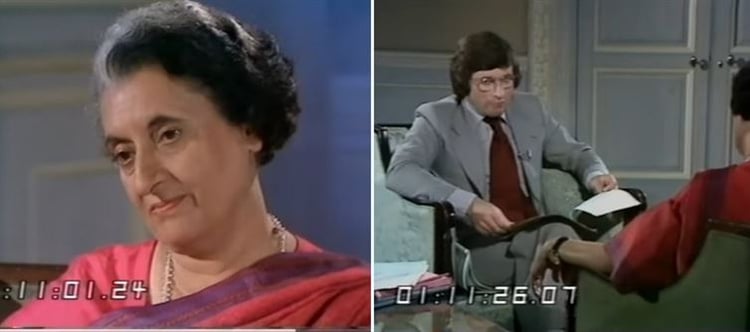

🎙️ The interview That Felt Like a Different India
Watching a 1978 interview of indira gandhi — recorded when morarji desai was prime minister after the Emergency — feels almost surreal today.
The atmosphere was tense. The political wounds were fresh. The Emergency was not some distant chapter; it was a recent memory. Yet the journalists didn’t tiptoe. They didn’t cushion their words. They didn’t preface every question with flattery.
They asked. Directly. Uncomfortably. Relentlessly.
And whatever one thinks of Indira Gandhi’s politics — and opinions vary sharply — she didn’t shrink from the questioning. Her answers were crisp. She didn’t pretend the questions weren’t tough. She faced them head-on.
That exchange felt like democracy doing its job.
🔥 1. When the press Didn’t Blink
There was a time when journalists saw proximity to power not as access to protect, but as a responsibility to challenge.
No rehearsed monologues.
No carefully curated “interactions.”
No sanitized talking points.
Questions were pointed. Follow-ups were sharper. Interruptions happened. It was messy, unscripted, and real.
And leaders — whether they liked it or not — showed up to face it.
🧠 2. Accountability Isn’t Optional — It’s the Job
Answering tough questions isn’t a favor politicians grant. It’s part of the contract.
Democracy isn’t just elections. It’s scrutiny. It’s discomfort. It’s being forced to explain yourself in public when decisions affect millions.
You may agree with a leader. You may oppose them. But what strengthens institutions is the willingness to sit under the glare and respond.
That culture once felt normal.
Today, it feels rare.
📉 3. The Shift: From Interrogation to Amplification?
Fast-forward to the present. Critics argue that the current prime minister, narendra Modi, has largely avoided open-ended, unscripted press conferences for years.
Supporters say communication happens through other channels.
Critics say avoiding tough questioning weakens democratic norms.
But the broader concern isn’t just about one leader. It’s about the ecosystem around power.
When interviews become predictable.
When questioning feels selective.
When the toughest issues are softened or sidelined.
That’s when people start asking whether the press is still playing its historic role — or drifting into comfort.
🏛️ 4. Institutions Under Suspicion
Beyond media, there’s a growing sentiment in parts of the public discourse that institutions themselves feel strained.
Allegations of compromised media.
Accusations of judicial favoritism.
Concerns about post-retirement appointments influencing decisions.
These are serious claims. And whether one agrees with them or not, their very existence signals something important: trust is fragile.
When citizens begin to suspect that watchdogs are too close to those they’re meant to watch, confidence erodes quickly.
⚖️ 5. Why This Comparison Matters
The 1978 interview isn’t nostalgia for a perfect past — india in the 70s was turbulent, divisive, and deeply flawed.
But it did showcase something powerful: a leader under scrutiny, answering without the safety net of choreographed messaging.
That image stands in contrast to what many feel today — a widening distance between power and probing questions.
The issue isn’t about glorifying one era or demonizing another. It’s about asking a simple, uncomfortable question:
Are we still demanding answers from those who govern us?
💬 The Real Debate
This isn’t about party lines. It’s about principle.
A strong democracy doesn’t fear hard questions.
A confident leader doesn’t avoid them.
And a fearless press doesn’t dilute them.
If citizens begin to feel that media is compromised, courts are pressured, and institutions are overly aligned with those in charge, the damage isn’t just political — it’s structural.
The health of a democracy isn’t measured by how loudly leaders speak.
It’s measured by how openly they are questioned.
And perhaps that old interview from 1978 lingers in memory not because it was dramatic, but because it showed something simple:
Power is being asked to explain itself.
Out loud.
 click and follow Indiaherald WhatsApp channel