



Every election promises change. New faces, new narratives, new energy. But when you look closely at candidate lists, a familiar pattern quietly reappears, one that hasn’t shifted much despite all the talk of progress.
In the politically sensitive districts of tirunelveli and Tenkasi, the latest round of candidate announcements tells a story that feels strikingly familiar. Despite a four-cornered contest involving major players, the distribution of tickets continues to revolve around a predictable caste equation.
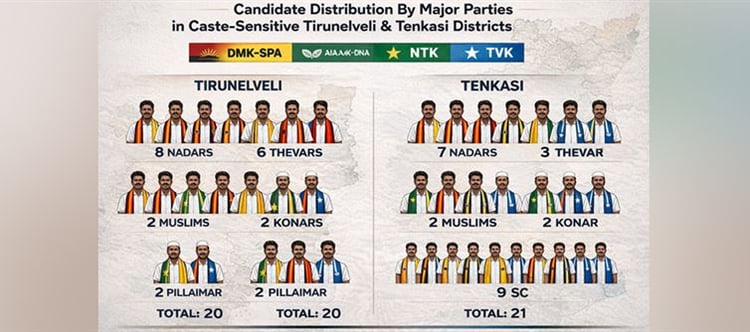
In tirunelveli, where no constituencies are reserved, not a single scheduled caste candidate has been fielded by the major alliances DMK-led SPA, AIADMK-led NDA, NTK, or TVK. Instead, the focus remains heavily tilted toward dominant communities. Across five constituencies, Nadars and Thevars (Maravars) dominate the landscape, accounting for the bulk of candidates.
Break it down further, and the pattern becomes even clearer. The DMK alliance has leaned toward Nadars, while the AIADMK alliance has favored Thevars. NTK and TVK, despite projecting themselves as alternatives, have largely followed the same route, distributing tickets within the same dominant social groups. Out of 20 candidates fielded by these four parties in tirunelveli alone, eight are Nadars, and six are Thevars, with only minimal representation from other communities.
Tenkasi presents a slightly different picture, but only on paper. Here, scheduled caste candidates appear in the fray, but only because two constituencies are reserved. Outside of those, the same trend continues. Nadars, Thevars, and a limited number of Muslims dominate the candidate list.
Even among sitting MLAs, the pattern holds steady, reflecting continuity rather than change in representation.
The takeaway is hard to ignore. While political messaging may emphasize inclusivity and progress, the ground reality suggests that electoral strategy is still deeply rooted in caste arithmetic.
Because in the end, when tickets are distributed, tradition still seems to outweigh transformation.
 click and follow Indiaherald WhatsApp channel