


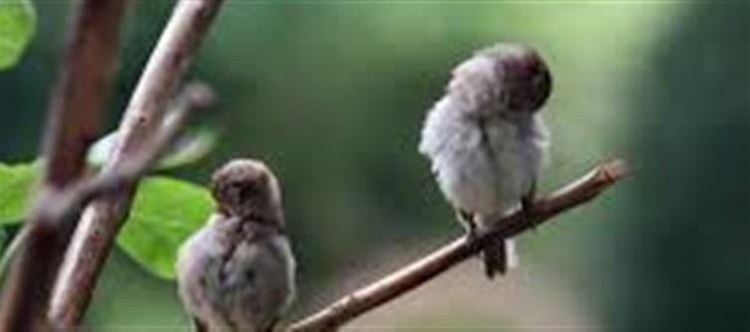

If you’ve ever watched birds roost on tree branches at night, you might have wondered: how do they stay perched without falling asleep? The answer lies in their unique anatomy and evolutionary adaptations.
1. Specialized Tendons in Their Feet
· Birds have a “perching reflex”, a natural mechanism that locks their toes around a branch automatically when they bend their legs.
· When a bird squats on a branch, the tendons in its legs tighten automatically, curling their toes around the branch.
· This mechanism works without conscious effort, allowing birds to stay perched even when fully asleep.
2. No Muscles Required to Hold On
· Because of the tendon-locking system, birds don’t need to use their muscles to grip the branch while sleeping.
· This prevents fatigue and allows birds to rest safely for hours without risk of falling.
3. Lightweight Body Structure
· Birds have lightweight bodies and hollow bones, which reduce the force of gravity acting on them.
· Their low weight, combined with the tendon-locking mechanism, makes it nearly impossible for them to slip off while perched.
4. Evolutionary Advantage
· Sleeping on branches high above the ground keeps birds safe from predators, such as cats or snakes.
· The perching reflex evolved as a survival adaptation, enabling them to rest in elevated, secure locations.
5. Other Interesting Adaptations
· Some birds, like owls, can even sleep while perched in a slightly upright position, using their tail and wings for balance.
· Waterfowl, like ducks, have webbed feet that help them balance on logs or shorelines while sleeping.
Bottom Line:
Birds don’t fall from branches while sleeping because of a special locking tendon system in their feet, their lightweight bodies, and evolutionary adaptations that keep them safe from predators. It’s a perfect example of nature’s ingenious engineering.
Disclaimer:
The views and opinions expressed in this article are those of the author and do not necessarily reflect the official policy or position of any agency, organization, employer, or company. All information provided is for general informational purposes only. While every effort has been made to ensure accuracy, we make no representations or warranties of any kind, express or implied, about the completeness, reliability, or suitability of the information contained herein. Readers are advised to verify facts and seek professional advice where necessary. Any reliance placed on such information is strictly at the reader’s own risk.
.jpg)
 click and follow Indiaherald WhatsApp channel