



The Popular Theory That Claims Timing Can Influence Your Baby’s Sex
For decades, couples hoping to conceive have searched for ways to increase their chances of having either a boy or a girl. One widely circulated theory suggests that timing intercourse around ovulation could influence a baby’s sex. While many people discuss this method online and in parenting forums, it’s important to remember that biology is complex and no natural method can guarantee a baby’s gender.
The idea behind the theory comes from basic genetics.
1. Understanding the X and Y chromosome concept
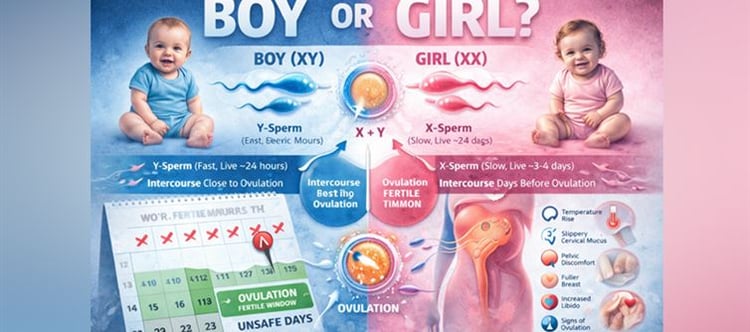
Human eggs always carry an X chromosome. Sperm, however, can carry either X or Y chromosomes. If an X-carrying sperm fertilizes the egg, the baby will genetically be female (XX). If a Y-carrying sperm reaches the egg first, the baby will be male (XY).
2. The theory about sperm speed and survival
According to the popular explanation, Y-chromosome sperm are believed to swim faster but have a shorter lifespan, usually around 24 hours.
In contrast, X-chromosome sperm are said to move more slowly but survive longer, sometimes up to three or four days inside the reproductive tract.
Based on this assumption, some people claim that timing intercourse earlier or later in the fertility window might influence which sperm reaches the egg.
3. Calculating the fertile window
Many fertility guides explain ovulation timing using the menstrual cycle. Typically, ovulation occurs around 14–15 days after the first day of a menstrual period in a regular cycle. The days surrounding ovulation — usually three days before and three days after — are considered the fertile window, when pregnancy is most likely.
4. Physical signs that ovulation may be near
Some common signs associated with ovulation include:
Slight rise in body temperature
Increased cervical mucus that becomes clear and stretchy
Mild pelvic discomfort
Increased libido
Breast sensitivity or bloating
These signals can indicate that the body is in its fertile phase.
The reality check
While the theory about X and Y sperm timing is widely shared, medical experts emphasize that baby sex is ultimately determined randomly at fertilization. Timing methods may help with pregnancy planning, but they cannot reliably guarantee whether a baby will be a boy or a girl.
Still, understanding ovulation and fertility can be helpful for couples trying to conceive — and that knowledge alone can make a big difference.
 click and follow Indiaherald WhatsApp channel