


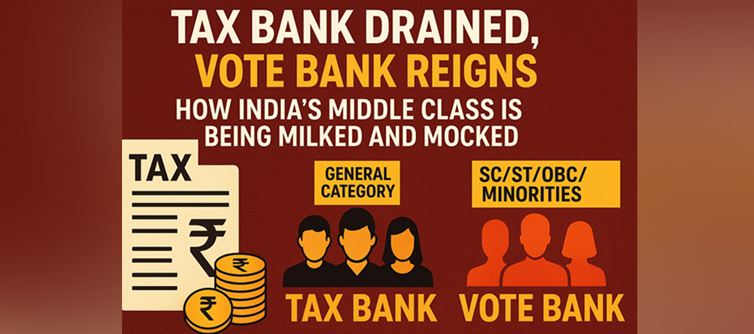

Every election season, one truth glares us in the face — India’s so-called “tax bank” and “vote bank” are not the same. The general category, which contributes the lion’s share of India’s direct taxes, finds itself reduced to little more than a cash cow. Meanwhile, SC/ST/OBC/Minorities are courted as a dependable vote bank, with promises of freebies, reservations, and schemes rolled out like festival discounts.
And what’s the trade-off? The hardworking middle-class taxpayer bleeds silently, footing the bill to keep the electoral machinery of political parties well-oiled.
The Harsh Arithmetic of India’s Democracy
Less than 6% of indians pay income tax — overwhelmingly from the general category.
Nearly 40% of government expenditure is directed toward subsidies, welfare schemes, and populist policies aimed at appeasing electoral vote banks.
While infrastructure, healthcare, and education limp along, caste arithmetic decides budgets and priorities.
This creates a bizarre imbalance: those who fund the system have the least political weight, while those who contribute the least to revenues decide who governs.
What If the ‘Tax Bank’ Went on Strike?
Hypothetically, if India’s middle class refused to pay taxes, the system would collapse within weeks. No salaries for bureaucrats, no fuel for government schemes, no funds for MPs’ pet projects. But in reality, such a boycott would invite swift legal crackdowns, penalties, and even imprisonment.
Short-term fallout:
Disrupted public services and stalled infrastructure.
Massive protests, potential street battles, and chaos.
Long-term fallout:
A weakened economy with deficits, inflation, and a crippled investment climate.
Political instability, yet possible reforms under duress — especially around reservations and subsidy politics.
But history shows us boycotts rarely succeed without massive, organized participation. Remember the Boston Tea Party? It worked because it was united, defiant, and uncompromising. India’s middle class, fragmented and fearful, often lacks that collective edge.
The Bottom Line
The general category is the silent, invisible tax bank. Politicians raid it every year without gratitude. The vote bank, meanwhile, is pampered and wooed endlessly.
Unless this cycle breaks — unless the taxpayer finds a voice and leverage — india will remain a land where taxes are compulsory, but fairness is optional.
 click and follow Indiaherald WhatsApp channel