


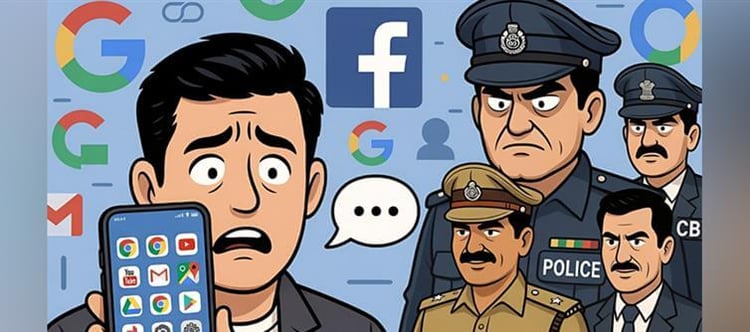

🔥IT’S NOT ABOUT DATA. IT’S ABOUT POWER.
people say it like a gotcha:
“If you trust google and facebook with your data, why cry about a government app?”
The answer is brutally simple — because Silicon Valley can track your ads, not your freedom. google can ignore you. The government cannot. A foreign company can’t send the police, income-tax officers, CBI, or ED to your house. A government can — and in India, often does.
This isn’t a privacy debate.
This is a power debate.
Because you can uninstall Facebook.
You can ditch Android.
You can walk away from Big Tech.
But you cannot walk away from the State.
And when the State asks for the same data that Big Tech has, the consequences aren’t the same.
1️⃣ google Tracks You. facebook Studies You. But Neither Can Punish You.
google can sell your interests to advertisers.
Facebook can target you with reels and political posts.
Android can shove preinstalled bloatware down your throat.
Annoying? Yes.
Invading privacy? Definitely.
Life-altering consequences? No.
None of them can:
File a case against you
Freeze your accounts
Issue a notice
Summon you
Raid your home
Their power ends at ads.
The State’s power begins with enforcement.
2️⃣ Big Tech Collects Data. The government Can Act On It. That’s the Entire Fear.
When a government app requests access, people don’t fear data leaks.
They fear misuse, profiling, targeted pressure, and being pulled into a system where one wrong click can become a legal headache.
Data in the hands of a corporation = corporate greed.
Data in the hands of the government = potential coercive power.
The difference is consequence, not collection.
3️⃣ You Can Reject Big Tech. You cannot Reject Government-Mandated Apps.
Don’t like Android?
Buy an iPhone.
Don’t like Facebook?
Delete your account.
Don’t like WhatsApp?
Move to Signal.
But if the government says:
“Install this for verification.”
“Link this to your SIM.”
“Register here for essential services.”
You can’t say:
“No, thanks.”
Compliance isn’t optional.
And THAT is why distrust rises.
4️⃣ State Surveillance vs corporate Surveillance — One Can Punish, One Can’t
corporate surveillance = annoying
State surveillance = intimidating
Data in corporate servers → used for profit
Data in government servers → could be used for:
Tax scrutiny
Investigations
Law enforcement
Background checks
Social profiling
Administrative pressure
And once systems link Aadhaar + phone + biometrics + app logs…
People fear a future where monitoring becomes mandatory.
5️⃣ India’s Reality: people Don’t Fear Technology. They Fear State Overreach.
In a country where:
ED raids
IT notices
Police summons
FIRs
Administrative pressure
…are often used for reasons ranging from legitimate to political — the fear is not irrational.
The issue isn’t Sanchar Saathi’s stated purpose.
The issue is trust.
And trust cannot be forced with a mandatory download.
6️⃣ people Want Accountability, Not Blind Compliance
Indians are not anti-tech.
They use UPI, DigiLocker, FASTag, Aadhaar, CoWIN — proudly.
But they want clear boundaries between citizen data and state power.
When a government app collects information, the question isn’t:
“Why are you scared? google has it too.”
The real question is:
“What can the State do with my data that google cannot?”
And the answer is uncomfortable.
⚠️ CONCLUSION — THIS IS NOT ABOUT PARANOIA. IT’S ABOUT POWER DYNAMICS.
Foreign corporations know everything about you — but they can’t touch you.
Governments may know less — but they can change your life overnight.
That’s why citizens scrutinize state apps harder.
Not because they hate the government.
But because the consequences are real, personal, and unavoidable.
The public isn’t saying no to Sanchar Saathi.
They’re saying:
“If you want our data, give us transparency, safeguards, and accountability — not blind obedience.”
 click and follow Indiaherald WhatsApp channel